
Research highlights

Bacteria opt for the best price-to-quality ratio to predict the future

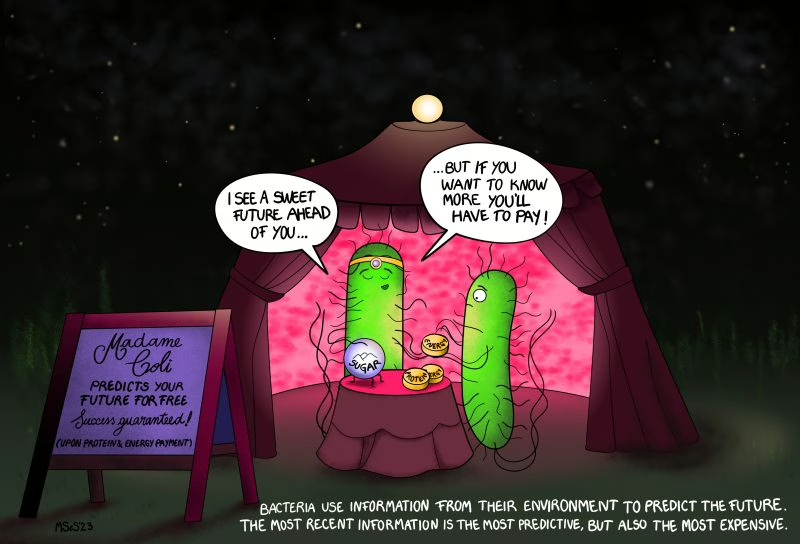
Predicting the future can be a matter of life or death. Just think, every time you cross the street, you predict whether this is possible without being run over. Experiments show that even single-celled organisms such as bacteria can predict the future. The better bacteria can predict changes in their environment, the greater their chances of survival. AMOLF researchers from the theory group of Pieter Rein ten Wolde discovered that E. coli bacteria collect the information with the best price-to-quality ratio to predict the future. The researchers publish the results on October 4th in the journal PNAS.

Any system, be it a human, bacterium, or robot, must predict the future based on information from the past. That first of all requires this information to be stored. Whereas we do that in our brain, bacteria do it with the help of proteins and energy in the cell, a so-called biochemical network. Ultimately, how well a system can predict the future is always limited by the amount and quality of information from the past that it has stored.
Credits: Studio Sardien

The price-to-quality ratio of information
The work of the researchers revealed that E. coli does not collect the most predictive information. This surprised them because if better predictions offer a greater chance of survival, then why would bacteria not use the most reliable information for making these predictions? Further analysis revealed that E. coli does indeed employ a different approach, namely collecting information with the best price-to-quality ratio. This choice is underpinned by an interesting principle.

The most recent information is the most valuable: if you know where a car is now, you have a greater chance of crossing the street safely than if you know where that car was ten seconds ago. However, obtaining recent information is also costly. For that reason, if you need to collect as much predictive information as possible given a fixed budget, it can pay off to store a greater amount of less reliable but cheaper information. The price-to-quality ratio of this information is better.

Given the available budget in terms of proteins and energy, E. coli therefore makes the best possible prediction. This shows that the price of information plays an important role for simple bacteria such as E. coli.

The identified principle, namely that systems have to make a trade-off between the predictive value of information and the price of the information, extends well beyond just E. coli. The developed theory does not only improve our understanding of current biological systems but can, for example, also be used to design efficient robots with minimal energy consumption.

Reference
Age J. Tjalma, Vahe Galstyan, Jeroen Goedhart, Lotte Slim, Nils B. Becker, Pieter Rein ten Wolde, Trade-offs between cost and information in cellular prediction, PNAS, 120 (41) e2303078120, October 4 (2023).


Share article
What's happening

Most recent news items

All news items
Collaboration

Successful outcomes of international EBEAM program led by AMOLF

The EU Pathfinder project Electron Beams Enhancing Analytical Microscopy (EBEAM) that was recently completed has received a highly positive review of the European Innovation Council (EIC). EBEAM brought together eight European research institutions and companies, including AMOLF, that develop new concepts and instruments combining spectroscopic analysis with electron microscopy.

Read news item
Research highlights

Everything you need to know about organoids

Organoids are instrumental in improving our understanding of processes that are otherwise hidden inside the body. For instance, these small 3D organs can be used to test medicines on tissue grown from a patient’s own cells. AMOLF researchers carry out unique and complex experiments to follow organoids in time. In order to enable other researchers to benefit from their experiences, they now publish their methods in the prestigious journal Nature Protocols.

Read news item
Events and outreach

Minister Rianne Letschert wears hat and shoulder ornament inspired by Wim Noorduin’s research

This year at the opening of the parliamentary year (Prinsjesdag) Minister of Education, Culture and Science Rianne Letschert wears a spectacular hat and shoulder ornament. Both of them are inspired by the microscopic structures studied by group leader Wim Noorduin (AMOLF/UvA), which look remarkably like tiny flowers under a microscope. Artist and designer Malou Beemer translated these shapes, normally invisible to the naked eye, into wearable art.

Read news item
Nachi Stern, Group Leader Learning Machines at AMOLF
People and recognition

Nachi Stern awarded ERC Starting Grant to explore how matter learns

Why do brains learn, but rocks do not? Could a material one day adapt to its environment the way a living organism does? AMOLF group leader Dr. Nachi Stern has been awarded an ERC Starting Grant to investigate the physical laws of learning, in a project called, “Physical Learning in Dynamical Systems.”

Read news item
Stay informed

Get the latest research highlights, events, and news from our institute delivered to your inbox