People and recognition

AMOLF researcher Marc Serra Garcia gets NWO Grant for his study on Nano-Computers and Energy Efficiency

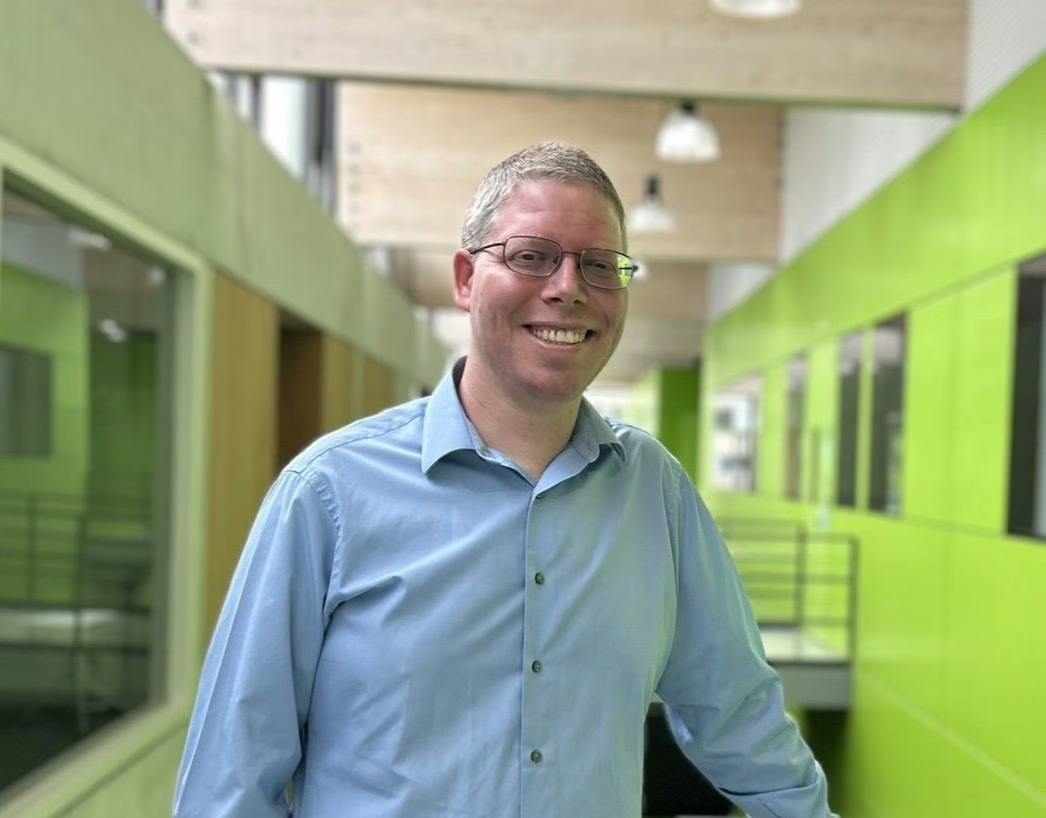
AMOLF group leader Marc Serra Garcia has been awarded a grant of 370.000 euro from NWO (Dutch Research Council) in the Open Competition Domain Science. The grant will fund his project entitled “Autonomous nanomechanical computers near the limits of thermodynamics.” This project aims to delve into the fundamental minimum amount of energy required by computers, using fully self-contained ‘nano-computers’ constructed from nanomechanical elements.

Credits: Ivar Pel

The goal of Serra Garcia’s project is to experimentally investigate the energy efficiency of computers by constructing fully self-contained ‘nano-computers’ made out of nanomechanical elements. These nano-computers will perform simple operations with minimal energy consumption. Unlike previous studies, which focused on systems that still interacted with the environment, this research will close the gap by ensuring complete self-containment, thereby capturing all dominant contributions to energy consumption.

“In this project, we aim to understand how far current computers are from what is physically possible in terms of energy efficiency”, explains Serra Garcia. “This knowledge will not only inform policy makers regarding the environmental impact of computing technologies, but also potentially lead to the development of new strategies to minimize energy consumption.”

The societal impact of this research is expected to be significant, given the ever-growing CO2 footprint of computers, which currently surpasses that of the airline industry. With the rapid expansion of artificial intelligence, addressing the energy efficiency of computing systems is more critical than ever.

Over the course of four years, Serra Garcia and his team will fabricate small systems consisting of silicon nitride beams in the AMOLF NanoLab cleanroom. These systems will be designed to perform simple computations, and their energy consumption will be measured using light-based techniques in the laboratory.

Serra Garcia’s receipt of the NWO grant underscores the significance of his research in advancing our understanding of nano-computers and their energy efficiency. By pushing the boundaries of what is physically possible, this project has the potential to revolutionize computing technology and contribute to a greener, more sustainable future.

Share article
What's happening

Most recent news items

All news items
Collaboration

Successful outcomes of international EBEAM program led by AMOLF

The EU Pathfinder project Electron Beams Enhancing Analytical Microscopy (EBEAM) that was recently completed has received a highly positive review of the European Innovation Council (EIC). EBEAM brought together eight European research institutions and companies, including AMOLF, that develop new concepts and instruments combining spectroscopic analysis with electron microscopy.

Read news item
Research highlights

Everything you need to know about organoids

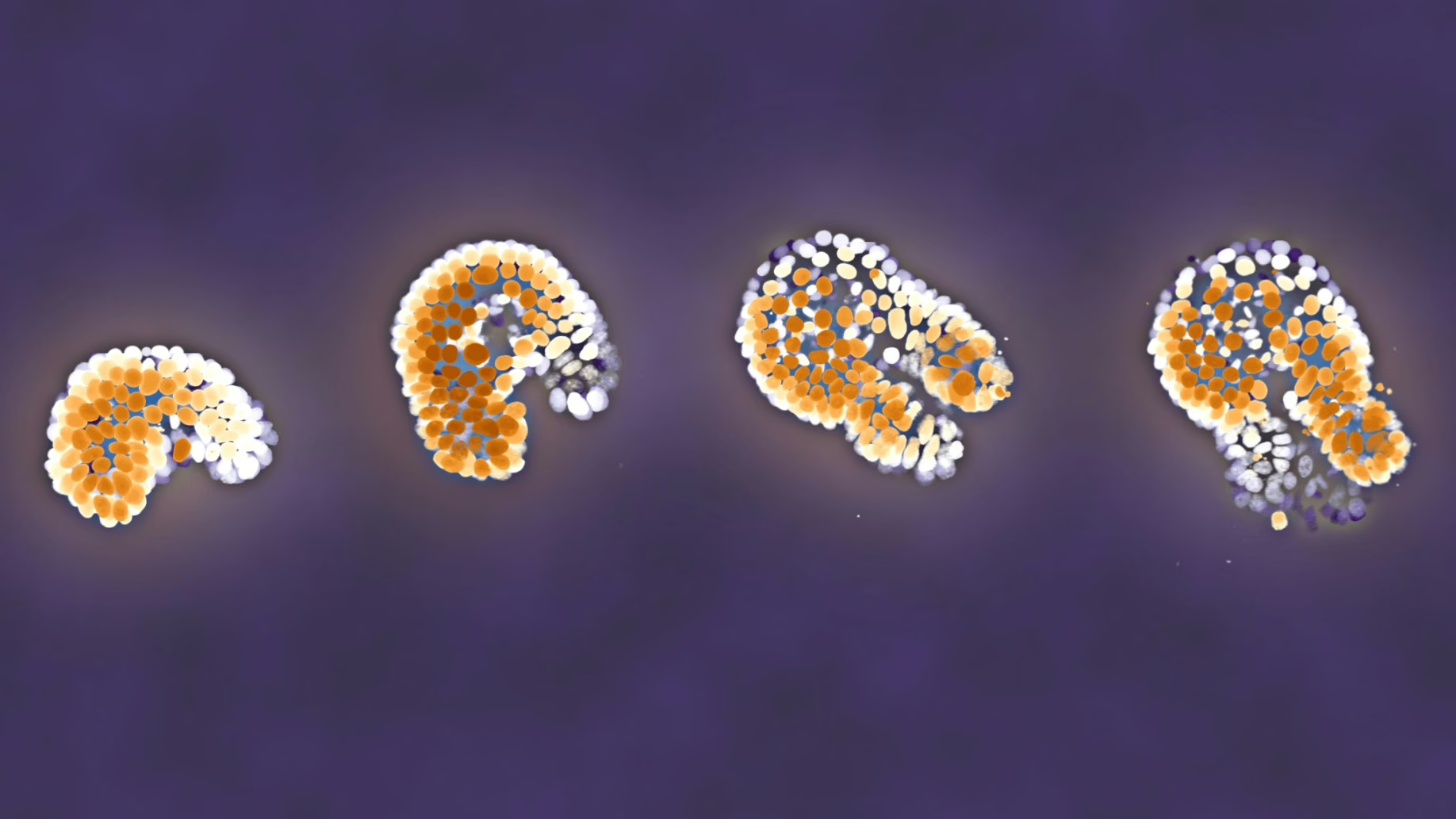
Organoids are instrumental in improving our understanding of processes that are otherwise hidden inside the body. For instance, these small 3D organs can be used to test medicines on tissue grown from a patient’s own cells. AMOLF researchers carry out unique and complex experiments to follow organoids in time. In order to enable other researchers to benefit from their experiences, they now publish their methods in the prestigious journal Nature Protocols.

Read news item
Events and outreach

Minister Rianne Letschert wears hat and shoulder ornament inspired by Wim Noorduin’s research

This year at the opening of the parliamentary year (Prinsjesdag) Minister of Education, Culture and Science Rianne Letschert wears a spectacular hat and shoulder ornament. Both of them are inspired by the microscopic structures studied by group leader Wim Noorduin (AMOLF/UvA), which look remarkably like tiny flowers under a microscope. Artist and designer Malou Beemer translated these shapes, normally invisible to the naked eye, into wearable art.

Read news item
Nachi Stern, Group Leader Learning Machines at AMOLF
People and recognition

Nachi Stern awarded ERC Starting Grant to explore how matter learns

Why do brains learn, but rocks do not? Could a material one day adapt to its environment the way a living organism does? AMOLF group leader Dr. Nachi Stern has been awarded an ERC Starting Grant to investigate the physical laws of learning, in a project called, “Physical Learning in Dynamical Systems.”

Read news item
Stay informed

Get the latest research highlights, events, and news from our institute delivered to your inbox