About AMOLF

AMOLF opens new ultrafast cathodoluminescence microscope

During a festive celebration on June 22, AMOLF has officially opened a new cathodoluminescence microscope in Albert Polman’s group that enables ultrafast optical measurements with a spatial resolution of 10 nanometer.

The new microscope has been built as part of a collaboration between AMOLF, FEI and Delmic. Together, these partners will investigate the potential of time-resolved cathodoluminescence microscopy as a new characterization tool in nanophotonics, quantum optics, semiconductor opto-electronics, biology, geology, photovoltaics, photocatalysis, and other areas.

The new instrument integrates (1) a FEI Quanta 650 scanning electron microscope (SEM) equipped with an ultrafast beam blanker, (2) electronics hardware developed at AMOLF that drives the beam blanker, (3) a Delmic SPARC cathodoluminescence imaging system that collects and analyzes the optical emission induced by the electron beam, and (4) single-photon counting/correlation and time-resolved spectroscopy assembled at AMOLF. The new instrument delivers electron pulses with a duration down to 1-5 ns enabling the combination of ultra-fast fluorescence lifetime imaging with nanoscale spatial resolution, and quantum optical studies in a broad range of systems.

In a further advanced design (to be realized later this year), the SEM electron cathode will be driven by a 250-fs pulsed UV laser beam, creating (single) electron pulses with a duration of 1 picosecond. This will enable ultrafast pump-probe imaging spectroscopy with a spatial resolution of 10 nm. The research program on the new microscope is funded by an ERC Advanced Investigator Grant that was awarded to Polman in 2016.

Cathodoluminescence imaging spectroscopy has been developed over the years at AMOLF as a nanophotonics measurement technique by three subsequent PhD students: Ernst Jan Vesseur, Toon Coenen and Benjamin Brenny, in addition to several postdocs and master students and many technical specialists at AMOLF. Over 40 scientific papers have been published so far, and are listed on http://www.erbium.nl/arcis.htm.
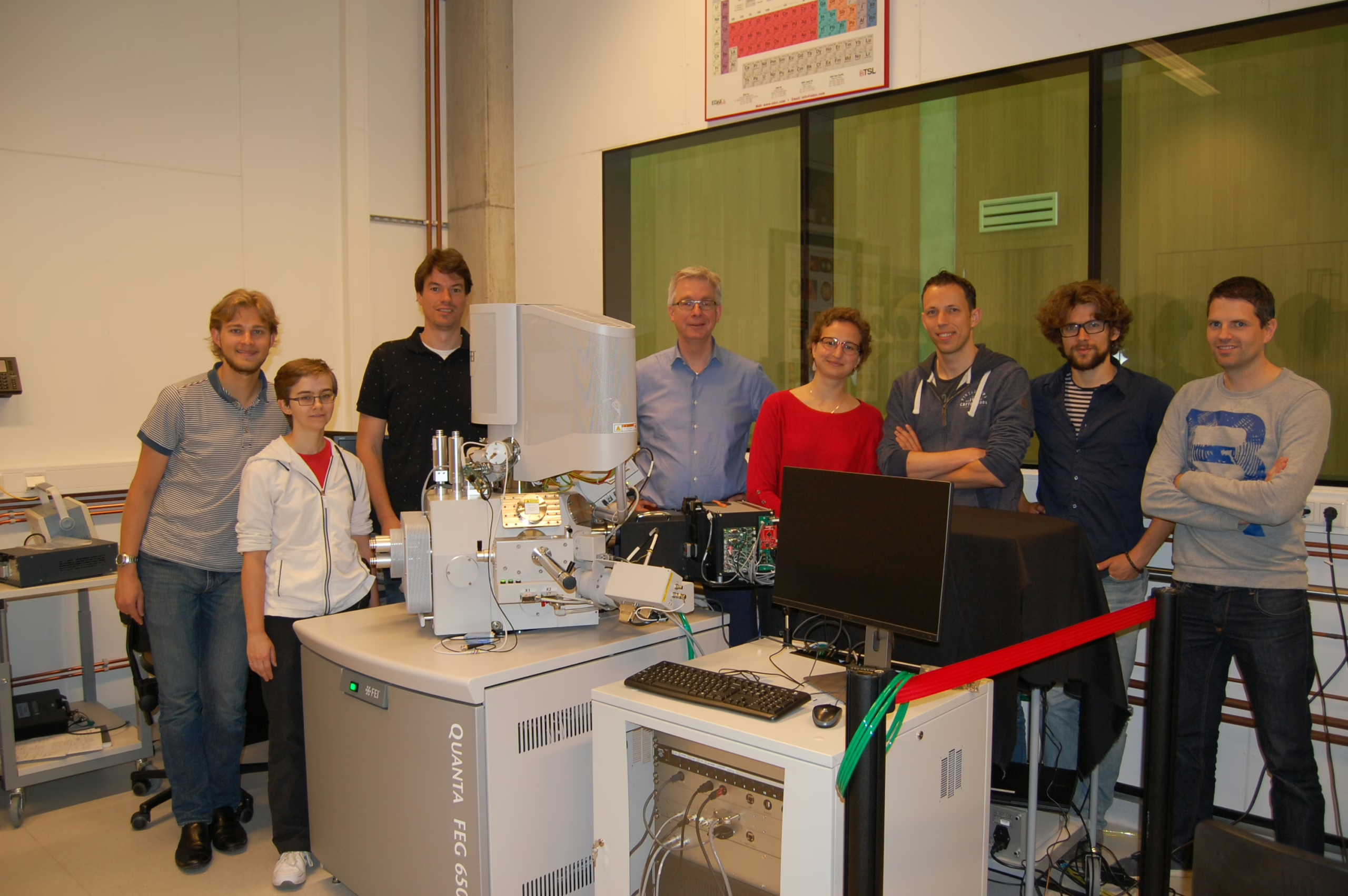

The team behind the electron microscope. From left to right: Benjamin Brenny, Isobel Bicket, Andries Lof, Albert Polman, Sophie Meuret, Toon Coenen, Philip Heringlake, Ronald Buijs
Share article
What's happening

Most recent news items

All news items
Collaboration

Successful outcomes of international EBEAM program led by AMOLF

The EU Pathfinder project Electron Beams Enhancing Analytical Microscopy (EBEAM) that was recently completed has received a highly positive review of the European Innovation Council (EIC). EBEAM brought together eight European research institutions and companies, including AMOLF, that develop new concepts and instruments combining spectroscopic analysis with electron microscopy.

Read news item
Research highlights

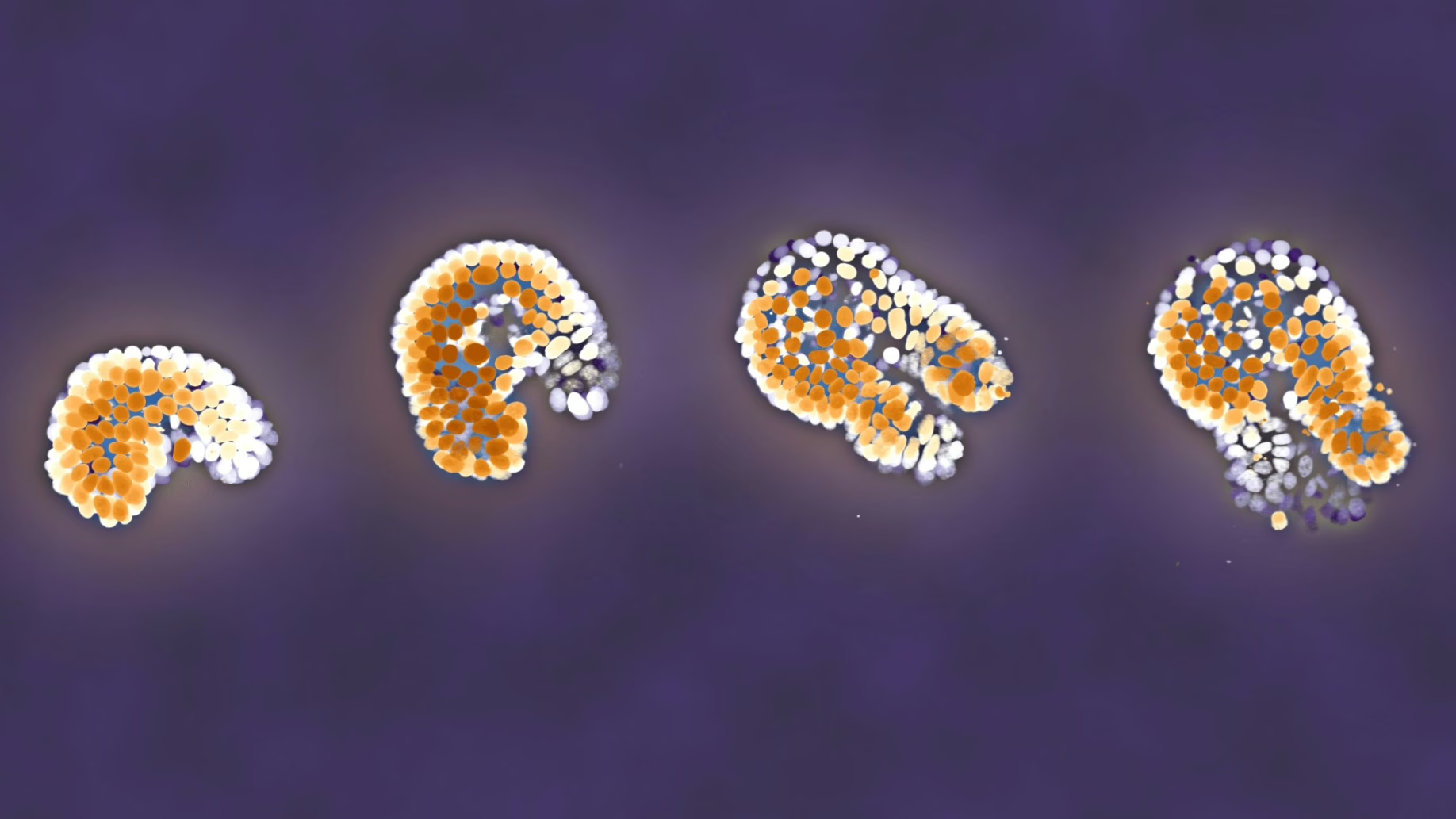
Everything you need to know about organoids

Organoids are instrumental in improving our understanding of processes that are otherwise hidden inside the body. For instance, these small 3D organs can be used to test medicines on tissue grown from a patient’s own cells. AMOLF researchers carry out unique and complex experiments to follow organoids in time. In order to enable other researchers to benefit from their experiences, they now publish their methods in the prestigious journal Nature Protocols.

Read news item
Events and outreach

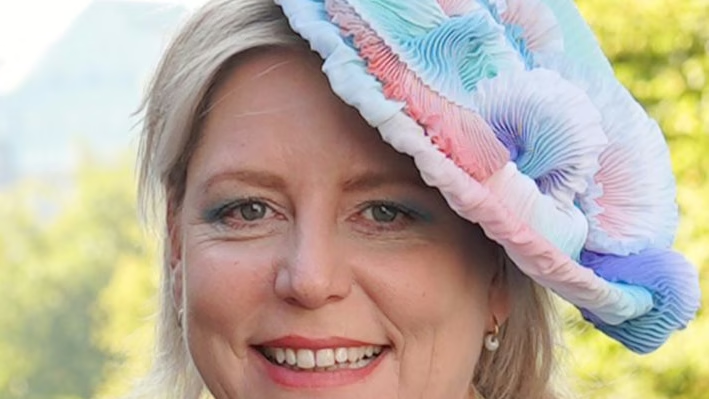
Minister Rianne Letschert wears hat and shoulder ornament inspired by Wim Noorduin’s research

This year at the opening of the parliamentary year (Prinsjesdag) Minister of Education, Culture and Science Rianne Letschert wears a spectacular hat and shoulder ornament. Both of them are inspired by the microscopic structures studied by group leader Wim Noorduin (AMOLF/UvA), which look remarkably like tiny flowers under a microscope. Artist and designer Malou Beemer translated these shapes, normally invisible to the naked eye, into wearable art.

Read news item
Nachi Stern, Group Leader Learning Machines at AMOLF
People and recognition

Nachi Stern awarded ERC Starting Grant to explore how matter learns

Why do brains learn, but rocks do not? Could a material one day adapt to its environment the way a living organism does? AMOLF group leader Dr. Nachi Stern has been awarded an ERC Starting Grant to investigate the physical laws of learning, in a project called, “Physical Learning in Dynamical Systems.”

Read news item
Stay informed

Get the latest research highlights, events, and news from our institute delivered to your inbox