Kasper Spoelstra (cum laude)
- Title: Shedding light on dynamic processes in the intestinal epithelium
- Date: January 23
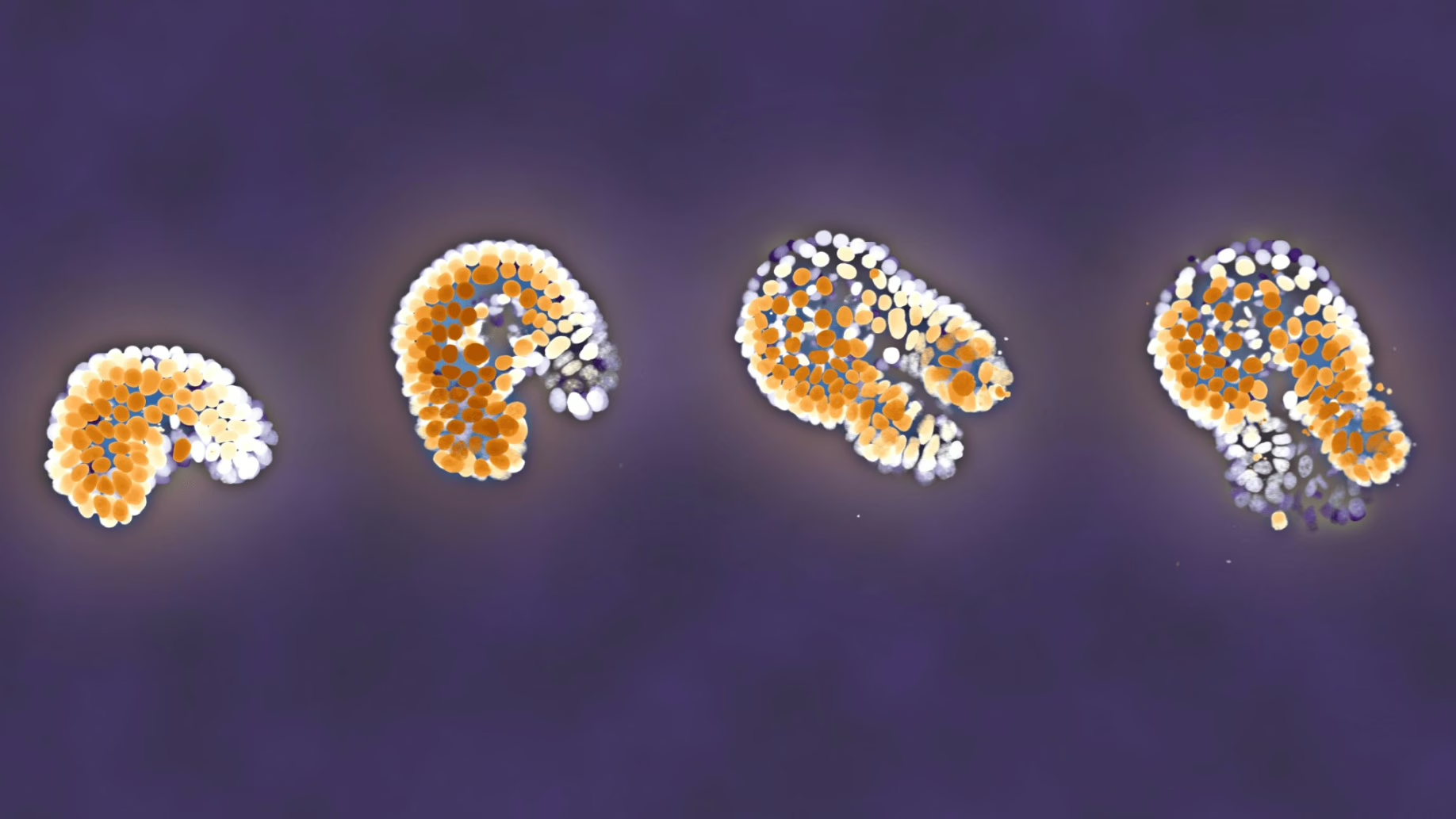
In close collaboration with the Hubrecht Institute, Kasper Spoelstra discovered that cells in the intestinal epithelium use pulling forces to determine which cells are fit to stay in the epithelium and which are removed. Kasper: “Whenever a cell can’t exert enough force it undergoes a process called cell extrusion, which basically means the cell removes itself from the epithelium. One key experiment I did was to weaken individual cells with an infrared laser, and I consistently saw that weakened cells undergo extrusion.”
Learn more
- Read the news item about intestinal cells: Intestinal surface cells pull rather than push – AMOLF
- View Kasper’s thesis in the AMOLF repository: AMOLF Institutional Repository: Shedding light on dynamic processes in the intestinal epithelium
Luca Gross
- Title: Chaperone-mediated protein folding and rescue
- Date: February 9
Luca Gross studied how proteins fold and how molecular chaperones prevent misfolding. He says: “By using single-molecule optical tweezers, I was able to directly observe individual proteins under force and uncover how chaperones actively guide their folding pathways.”
Together with colleagues, Luca showed that some chaperones actively reshape protein-folding pathways in a highly state-dependent way, rather than acting as passive helpers. This provides a more mechanistic view of how cells maintain protein quality under stress.
Learn more
View Luca’s thesis in the AMOLF repository: AMOLF Institutional Repository: Chaperone-mediated protein folding and rescue
Jeroen de Boer (cum laude)
- Title: Neuromorphic Computing with Halide Perovskites
- Date: February 16
Jeroen de Boer developed a new type of computer chip that is able to predict outcomes. This chip is made from the material halide perovskite. Notably, Jeroen managed to make it compute in a way similar to the human brain, which means it uses very little energy. Jeroen explains, “The material has a memory that can be programmed electronically and with light. By using these characteristics, I was able to make tiny devices that function like the synapses and neurons in the brain.”
Learn more
- Read the news item about a solar cell that thinks: A solar cell that thinks: new device processes light similar to the human brain – AMOLF
- View Jeroen’s thesis in the AMOLF repository: AMOLF Institutional Repository: Neuromorphic Computing with Halide Perovskites
Nika van Nielen
- Title: Electrons, photons, & the time in between: probing materials with pump-probe cathodoluminescence in an ultrafast SEM
- Date: February 25
In her thesis, Nika van Nielen used an ultrafast scanning electron microscope with unique capabilities, developed at AMOLF. Using both electron and laser beams to excite nanomaterials and precisely controlling the delay between them, she measured the emitted light to resolve the dynamic processes occurring in the material with high spatial and temporal resolution. During her PhD, she worked on further advancing the microscope to exploit the quantum properties of electrons to study electron-light-matter interactions.
Learn more
View Nika’s thesis in the AMOLF repository: AMOLF Institutional Repository: Electrons, photons, & the time in between: probing materials with pump-probe cathodoluminescence in an ultrafast SEM
Sergio Picella
- Title: Mechanical Adaptability in Fluidic Soft Robots
- Date: March 4
Sergio Picella worked on mechanical adaptability in fluidic soft robots. These are flexible, compliant machines powered and controlled by fluids. Together with his colleagues, Sergio has shown that by carefully designing materials and structures, complex behaviors can emerge. He used simple physical principles, allowing machines to sense, decide, and act using only mechanical and fluidic components.
Learn more
View Sergio’s thesis in the AMOLF repository: AMOLF Institutional Repository: Mechanical Adaptability in Fluidic Soft Robots
Evelijn Akerboom
- Title: Exciting coherent processes in cathodoluminescence
- Date: March 11
Evelijn Akerboom explored how electrons interact with nanostructures, and what happens when we look beyond the classical particle description of the electron.
In her thesis Evelijn presents three approaches. First, she studied the optical response of individual nanostructures, excited by electrons. Next, she excited multiple structures with the same electrons, studying the interference. This effect can be compared to skipping a stone across a calm pond: waves interfere and can cancel each other out. Finally, she studied the transmitted electron after the interaction.
Learn more
- Read a news item about Evelijn’s cathodoluminescence research: Cathodoluminescence research advances measurements of light matter interactions – AMOLF
- View Evelijn’s thesis in the AMOLF repository: AMOLF Institutional Repository: Exciting coherent processes in cathodoluminescence