Research highlights

A solar cell that thinks: new device processes light similar to the human brain

Imagine a camera that cannot only see light but also understand what it sees without a computer, and even without being plugged in. AMOLF PhD student Jeroen de Boer from the Hybrid Solar Cells group has developed the first step towards such a device: a tiny light sensor that also processes information, inspired by how the human brain works. His findings were published in the journal Device on December 17.

From solar cells to smart sensors

Jeroen’s invention is based on a material commonly used in solar cells: halide perovskite. This material converts light into electricity, but in Jeroen’s device it does something extra. “It doesn’t just sense light,” he explains, “it remembers it for a short time. That memory allows it to process video information more efficiently than a regular camera.”

Mimicking the brain

In the brain, neurons and synapses store and process information at the same time, which makes thinking fast and energy-efficient. This new perovskite-based device mimics that principle. Because it uses the energy from light itself, it could one day operate without a power cable.

Learning from networks

To test how such a system might work, Jeroen and his colleagues built a small device and then simulated a network of thousands of them. The network could recognize images and moving objects in videos with very high accuracy, showing that this type of ‘neuromorphic’ computing can handle complex visual tasks while using very little energy.

Group leader Bruno Ehrler: “I imagine a future where a solar-powered face recognition camera could identify a person instantly and safely, without sending data to a computer or drawing power from the electricity grid.”

Learn more

If you have questions about this research, please contact Bruno Ehrler (b.ehrler@amolf.nl).

This paper was published in Device, a Cell Press journal: In-sensor computing with halide perovskite-based optoelectronic reservoir networks

Read full paper: https://www.sciencedirect.com/science/article/pii/S2666998625003138

Share article
What's happening

Most recent news items

All news items
Collaboration

Successful outcomes of international EBEAM program led by AMOLF

The EU Pathfinder project Electron Beams Enhancing Analytical Microscopy (EBEAM) that was recently completed has received a highly positive review of the European Innovation Council (EIC). EBEAM brought together eight European research institutions and companies, including AMOLF, that develop new concepts and instruments combining spectroscopic analysis with electron microscopy.

Read news item
Research highlights

Everything you need to know about organoids

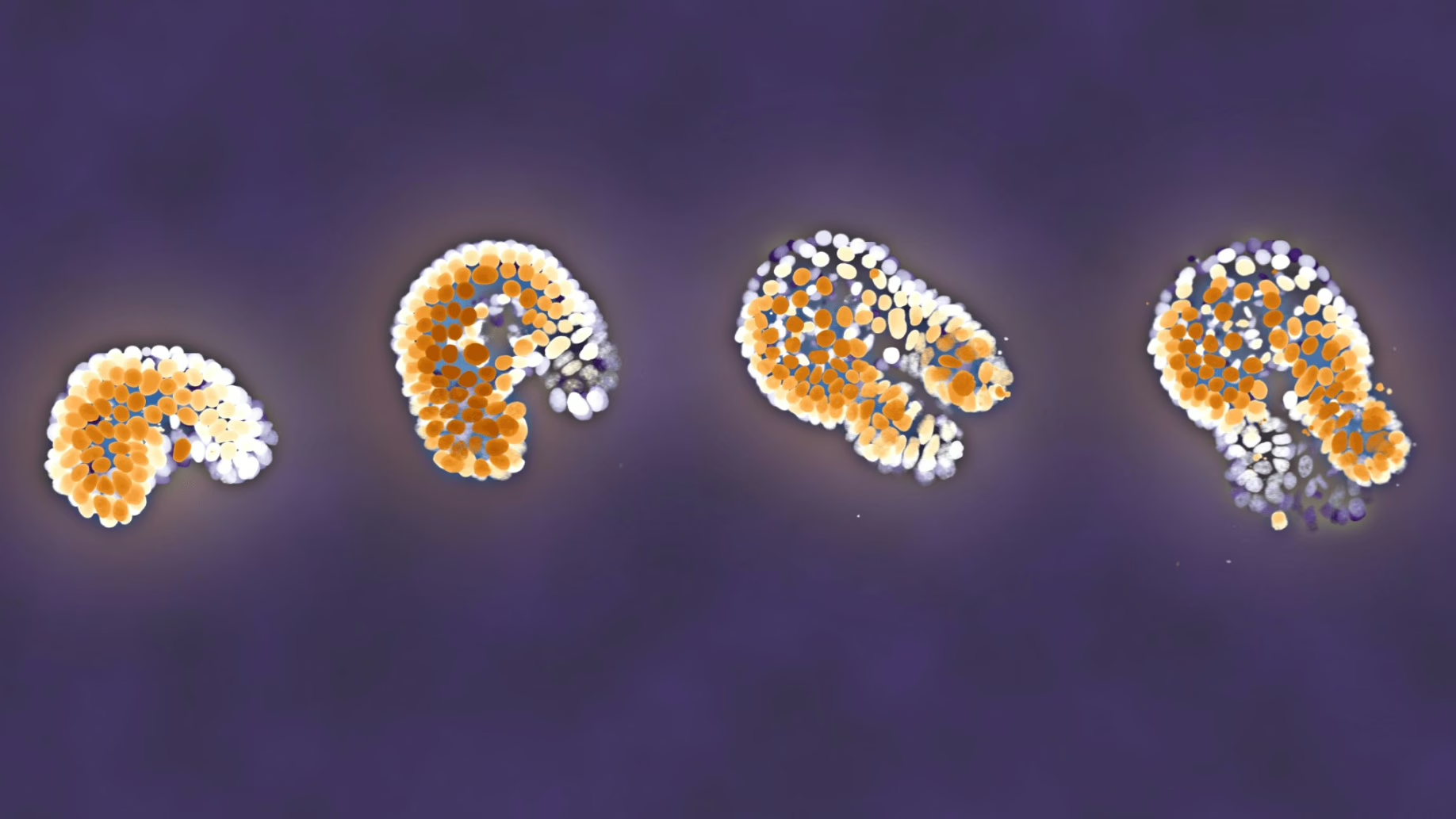
Organoids are instrumental in improving our understanding of processes that are otherwise hidden inside the body. For instance, these small 3D organs can be used to test medicines on tissue grown from a patient’s own cells. AMOLF researchers carry out unique and complex experiments to follow organoids in time. In order to enable other researchers to benefit from their experiences, they now publish their methods in the prestigious journal Nature Protocols.

Read news item
Events and outreach

Minister Rianne Letschert wears hat and shoulder ornament inspired by Wim Noorduin’s research

This year at the opening of the parliamentary year (Prinsjesdag) Minister of Education, Culture and Science Rianne Letschert wears a spectacular hat and shoulder ornament. Both of them are inspired by the microscopic structures studied by group leader Wim Noorduin (AMOLF/UvA), which look remarkably like tiny flowers under a microscope. Artist and designer Malou Beemer translated these shapes, normally invisible to the naked eye, into wearable art.

Read news item
Nachi Stern, Group Leader Learning Machines at AMOLF
People and recognition

Nachi Stern awarded ERC Starting Grant to explore how matter learns

Why do brains learn, but rocks do not? Could a material one day adapt to its environment the way a living organism does? AMOLF group leader Dr. Nachi Stern has been awarded an ERC Starting Grant to investigate the physical laws of learning, in a project called, “Physical Learning in Dynamical Systems.”

Read news item
Stay informed

Get the latest research highlights, events, and news from our institute delivered to your inbox