
News & updates
Latest developments from our institute
Stay informed about new research results, awards, events, and collaborations across our scientific community.
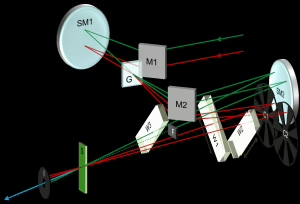
Observation of quantum molecular motions at work in next-generation solar cells
Researchers from AMOLF, Cambridge, Lund and Kiel have revealed that molecular vibrations drive the process known as singlet fission.
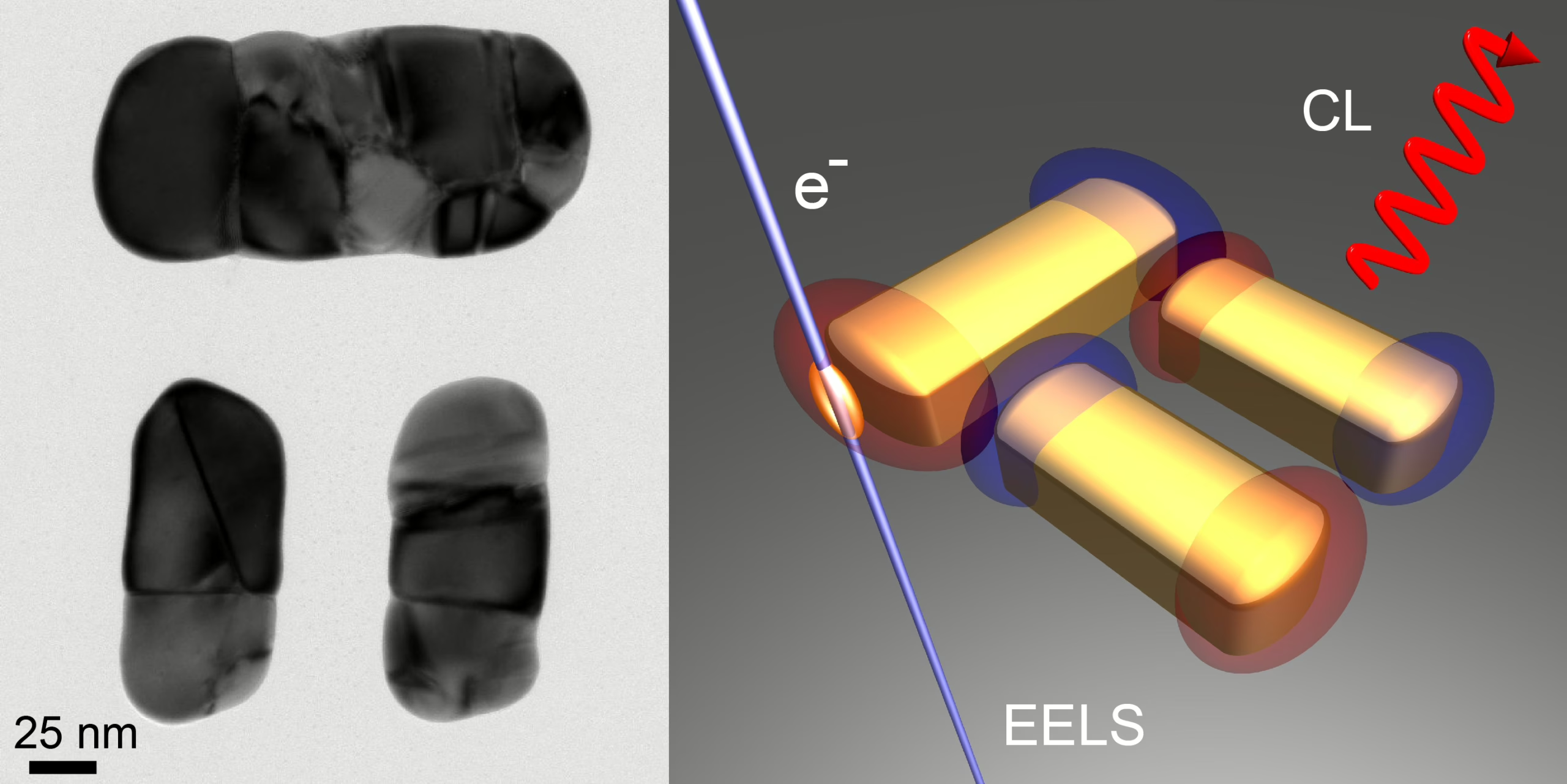
Electron beam controls artificial optical molecule at the nanoscale
Metallic nanoparticles have the ability to confine light to volumes much smaller than the wavelength. If such particles are arranged in a special configuration they can show interesting optical phenomena, similar to a molecule consisting of multiple atoms. Such coupled particle systems are therefore referred to as metamolecules. Due to their small size, it is difficult to control and study their optical response. To address this problem, researchers from the FOM institute AMOLF and Stanford University have used an electron beam to control the optical behavior of such a metamolecule in a novel way by carefully positioning it with respect to the structure. The research was published in Nanoletters on October 12th, 2015.
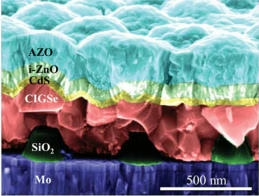
Triple PV highlights: three articles on light management in thin-film solar cells
Within a relatively short time span three leading scientific journals published papers on solar cell research carried out at AMOLF in the Light Management in New Photovoltaic Materials (LMPV) research program. The first author of these three papers is former AMOLF PhD student Claire van Lare. She demonstrates new scattering patterns for efficient light management in ultrathin solar cells. Van Lare graduated in October 2014 on a PhD thesis “Light-trapping in thin-film solar cells using dielectric and metallic nanostructures”.
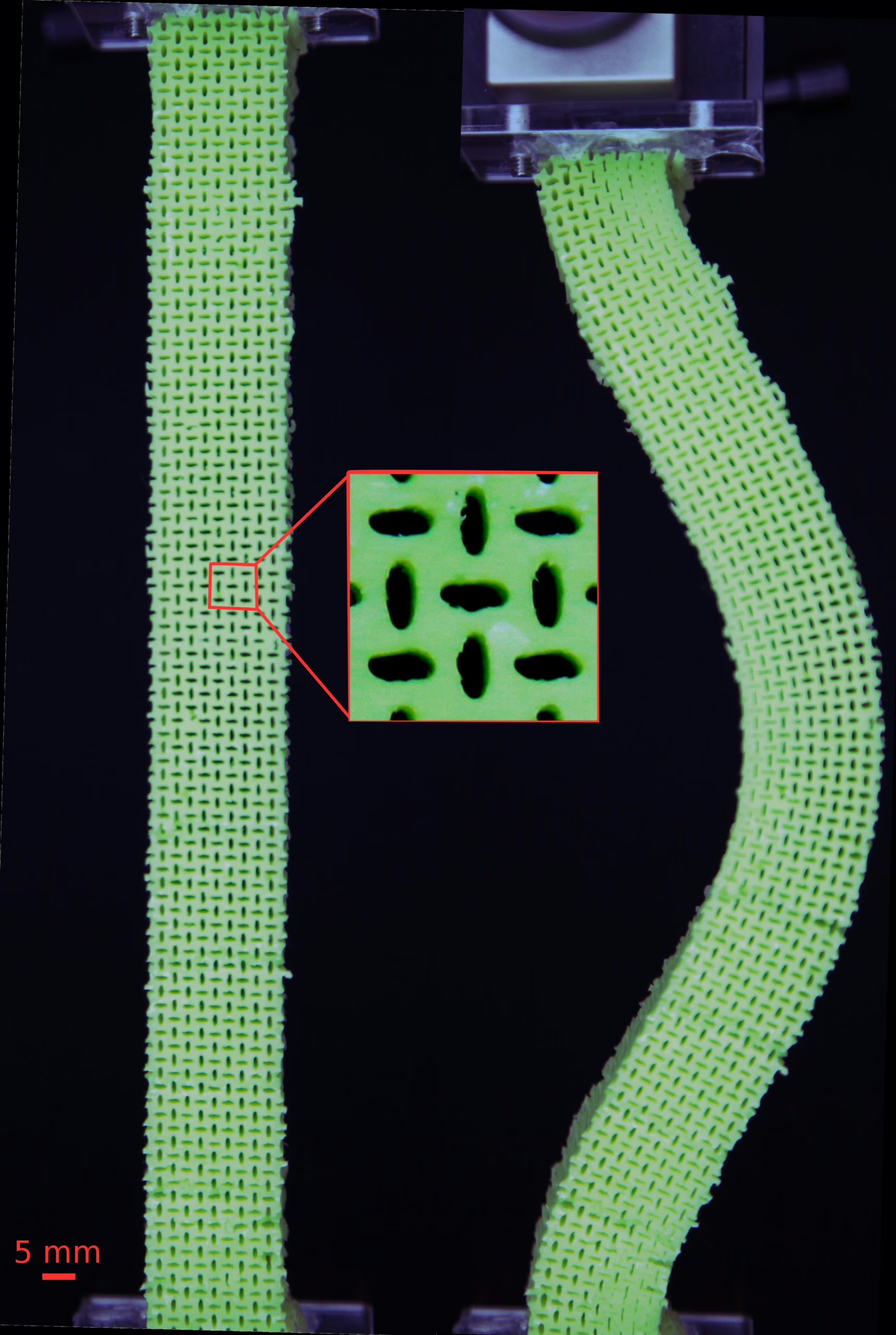
Metamaterial undermines 250-year-old construction principles
Researchers from the Mechanical Metamaterials group have demonstrated how a rubber beam subjected to less pressure bends faster.This behaviour defies our expectations and appears to undermine the centuries-old bending laws. The beam is made from a metamaterial, which gives it the name metabeam. Metamaterials have special properties that do not occur in nature. By providing the metabeam with a carefully chosen pattern of small holes, the researchers managed to cause the strange behaviour. They published their work, a collaboration with Leiden Insitute of Physics and Harvard University, on 21 July online in Physical Review Letters.
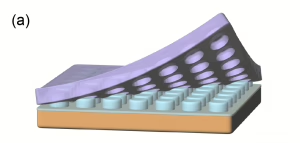
Nanoparticle coating eliminates reflection from glass
Reflection of light off glass surfaces is a problem occurring in everyday life, and hinders the performance of solar panels, smart phone and tablet displays. Researchers from FOM institute AMOLF have found a new and simple method to eliminate this reflection, by printing a silica nanopatterned antireflection coating onto the device.
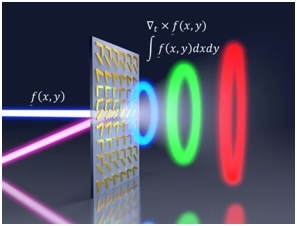
Highlights of nanophotonics published in Science
The research field of nanophotonics, the science and application of light at the nanoscale, has seen a rapid growth in the last years, with AMOLF researchers among the pioneers. In a recent article in Science, AMOLF group leaders Femius Koenderink and Albert Polman together with Andrea Alù, visiting professor from the University of Texas, review scientific highlights, applications and a future perspective of light at the nanoscale.

Nanoscale optical tomography using electrons
A team of researchers from AMOLF and Stanford University has developed a novel way to make three-dimensional optical images of nanoscale objects. They irradiate the object with a 30 keV electron beam under different angles and collect the cathodoluminescence emitted by the sample. Using a tomographic reconstruction they then determine the three-dimensional light distribution in metallic crescent particles at nanoscale resolution.
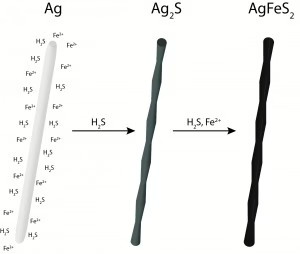
Solar cell researchers combine the best of two worlds with mineral based nanowires
For the first time a team of researchers from FOM Institute AMOLF have synthesized a mineral (AgFeS2) to create semiconducting nanowires. This earth-abundant semiconductor has a direct band gap of 0.88 eV and thus could form the basis for a cheap bottom cell in a multi-junction photovoltaic material. This work was published in the Journal of the American Chemical Society on March 26, 2015.