
News & updates
Latest developments from our institute
Stay informed about new research results, awards, events, and collaborations across our scientific community.
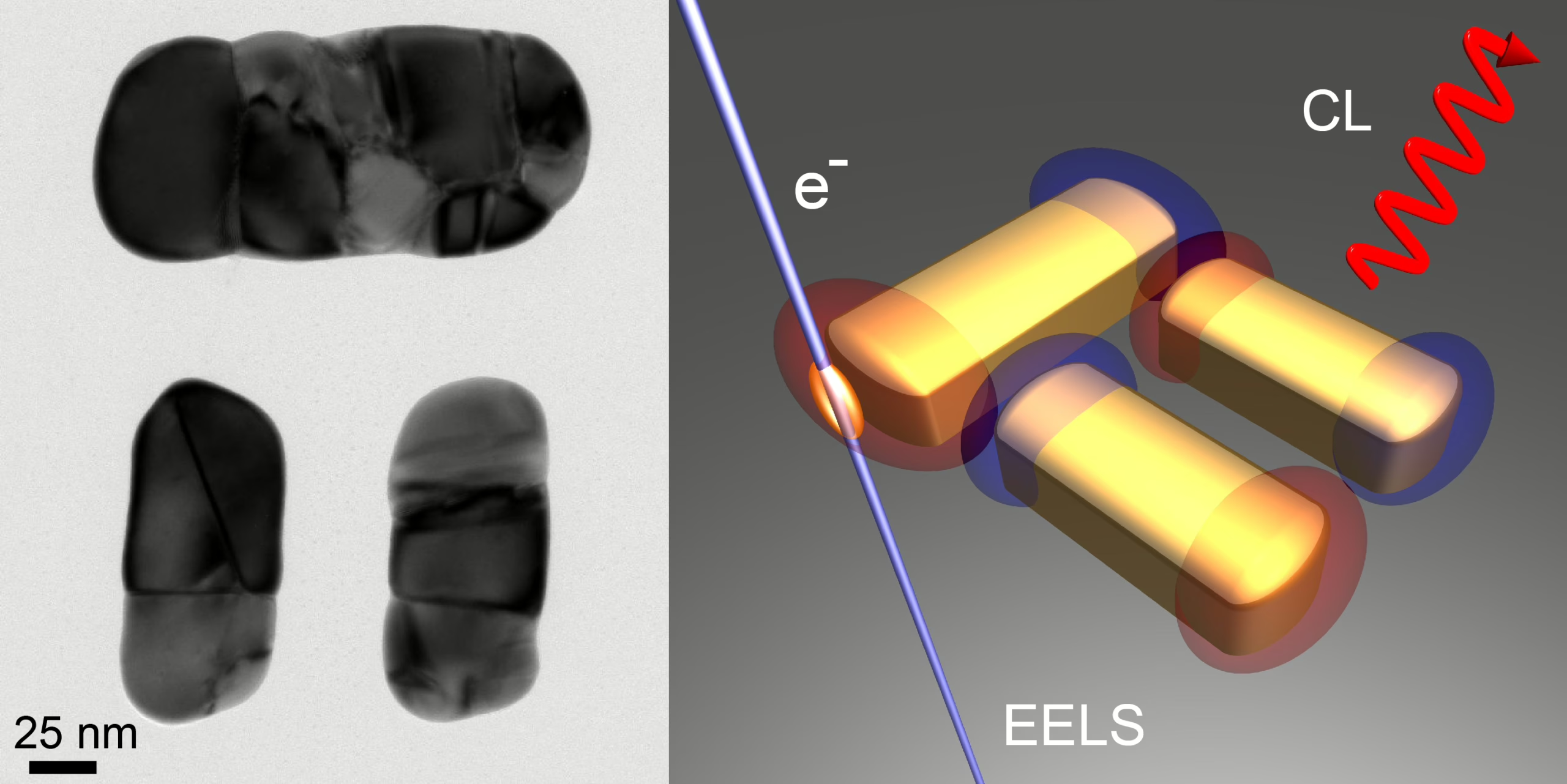
Electron beam controls artificial optical molecule at the nanoscale
Metallic nanoparticles have the ability to confine light to volumes much smaller than the wavelength. If such particles are arranged in a special configuration they can show interesting optical phenomena, similar to a molecule consisting of multiple atoms. Such coupled particle systems are therefore referred to as metamolecules. Due to their small size, it is difficult to control and study their optical response. To address this problem, researchers from the FOM institute AMOLF and Stanford University have used an electron beam to control the optical behavior of such a metamolecule in a novel way by carefully positioning it with respect to the structure. The research was published in Nanoletters on October 12th, 2015.
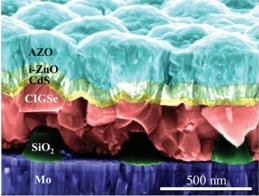
Triple PV highlights: three articles on light management in thin-film solar cells
Within a relatively short time span three leading scientific journals published papers on solar cell research carried out at AMOLF in the Light Management in New Photovoltaic Materials (LMPV) research program. The first author of these three papers is former AMOLF PhD student Claire van Lare. She demonstrates new scattering patterns for efficient light management in ultrathin solar cells. Van Lare graduated in October 2014 on a PhD thesis “Light-trapping in thin-film solar cells using dielectric and metallic nanostructures”.
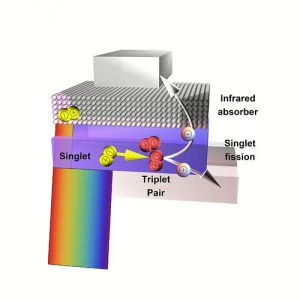
SOLARDAM – Amsterdam solar energy initiative has received first grant
The solar energy research network SOLARDAM has received its first research grant.The 1 M€ grant from the Amsterdam Academic Alliance (AAA) enables collaborative research between AMOLF, UvA, VU, and ECN on the development of novel methods to convert sunlight to electricity and fuel.
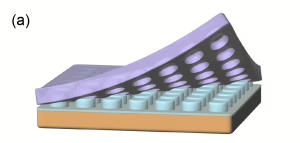
Nanoparticle coating eliminates reflection from glass
Reflection of light off glass surfaces is a problem occurring in everyday life, and hinders the performance of solar panels, smart phone and tablet displays. Researchers from FOM institute AMOLF have found a new and simple method to eliminate this reflection, by printing a silica nanopatterned antireflection coating onto the device.
Highlights of nanophotonics published in Science
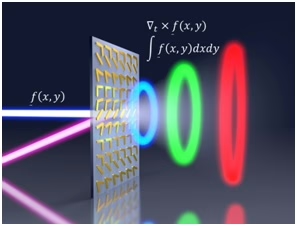
The research field of nanophotonics, the science and application of light at the nanoscale, has seen a rapid growth in the last years, with AMOLF researchers among the pioneers. In a recent article in Science, AMOLF group leaders Femius Koenderink and Albert Polman together with Andrea Alù, visiting professor from the University of Texas, review scientific highlights, applications and a future perspective of light at the nanoscale.
Nanoscale optical tomography using electrons
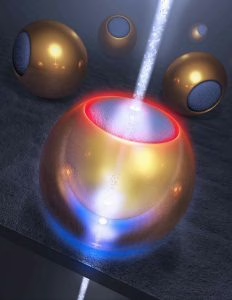
A team of researchers from AMOLF and Stanford University has developed a novel way to make three-dimensional optical images of nanoscale objects. They irradiate the object with a 30 keV electron beam under different angles and collect the cathodoluminescence emitted by the sample. Using a tomographic reconstruction they then determine the three-dimensional light distribution in metallic crescent particles at nanoscale resolution.
SOLARDAM – Amsterdam solar energy initiative started
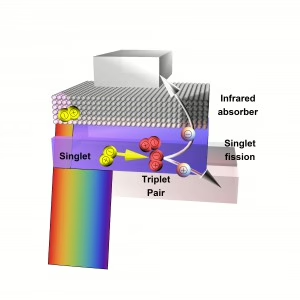
The solar energy research network SOLARDAM has received its first research grant. The 1 M€ grant from the Amsterdam Academic Alliance (AAA) enables collaborative research between AMOLF, UvA, VU, and ECN on the development of novel methods to convert sunlight to electricity and fuel.
New mechanism to convert light into electricity: the ‘plasmo-electric effect’
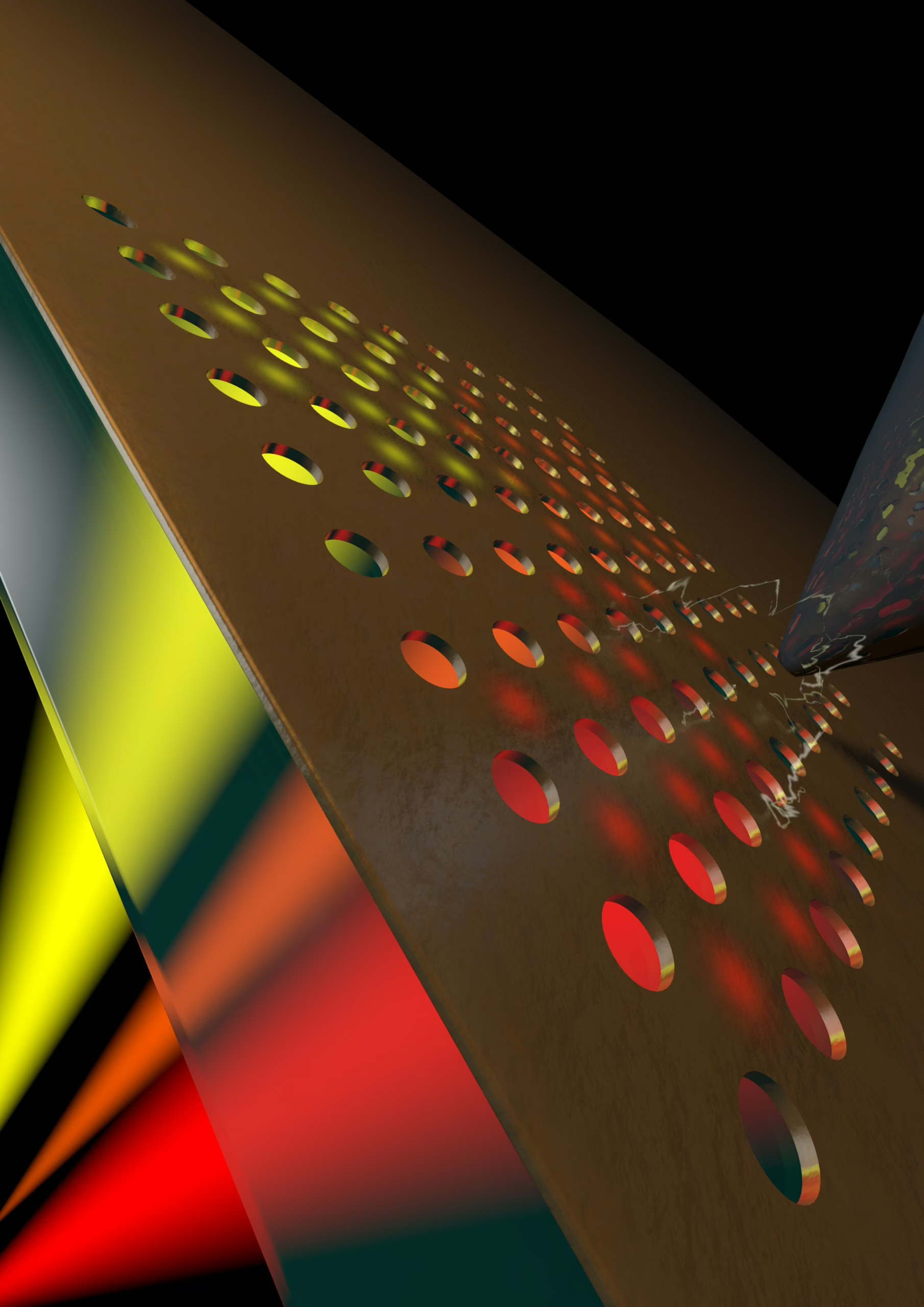
Researchers of the FOM Institute AMOLF and the California Institute of Technology have discovered a new method to generate electrical potentials using light. Using precisely sculpted metal nanocircuits they found that light can be effectively captured and converted to an electrical potential as high as 100 millivolt. The research was published on 30 October 2014 in the journal Science. The AMOLF-Caltech team, who have been collaborators for many years, give the newly discovered effect the name “plasmo-electric effect”. Albert Polman, the leader of the AMOLF-part of the team: “This is an entirely new way to convert light into electricity. We have now shown that we can create a voltage; the next step is to see if we can also collect current and generate electrical power.”