
News & updates
Latest developments from our institute
Stay informed about new research results, awards, events, and collaborations across our scientific community.
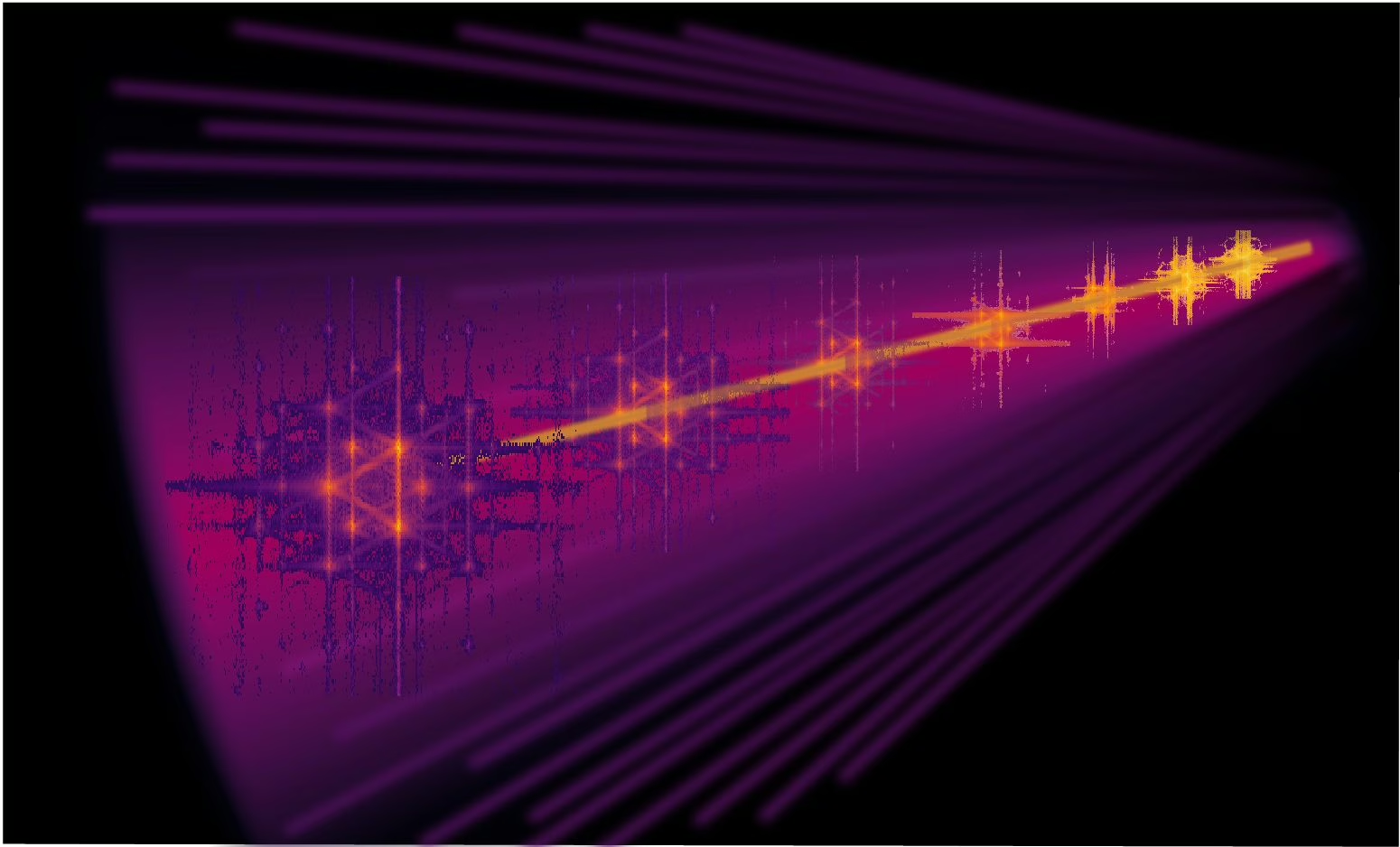
Quantifying topological protection of light on a chip
Photonic topological insulators are currently at the forefront of on-chip photonic research due to their potential for loss-free information transport. Realized in photonic crystals, they enable robust propagation of optical states along domain walls. But how robust is robust? In order to answer this, researchers from AMOLF and TU Delft quantified photonic edge state transport using phase-resolved near-field optical microscopy. The findings provide a crucial step towards error-free integrated photonic quantum networks. The results were published in the journal Light Science & Applications.
Huib Bakker re-installed
AMOLF director Huib Bakker has been re-installed by the NWO-I Foundation Board for a period of five years.
Wim Noorduin appointed professor by special appointment at the University of Amsterdam
Wim Noorduin has been appointed professor by special appointment of Self-Organizing Matter at the Faculty of Science at the University of Amsterdam (UvA). The chair was established on behalf of the Foundation for the Advancement of Atomic and Molecular Physics (‘Stichting tot bevordering van de Atoom- en Molecuulfysica’). Noorduin will continue at AMOLF as leader of the Self-Organizing Matter group.
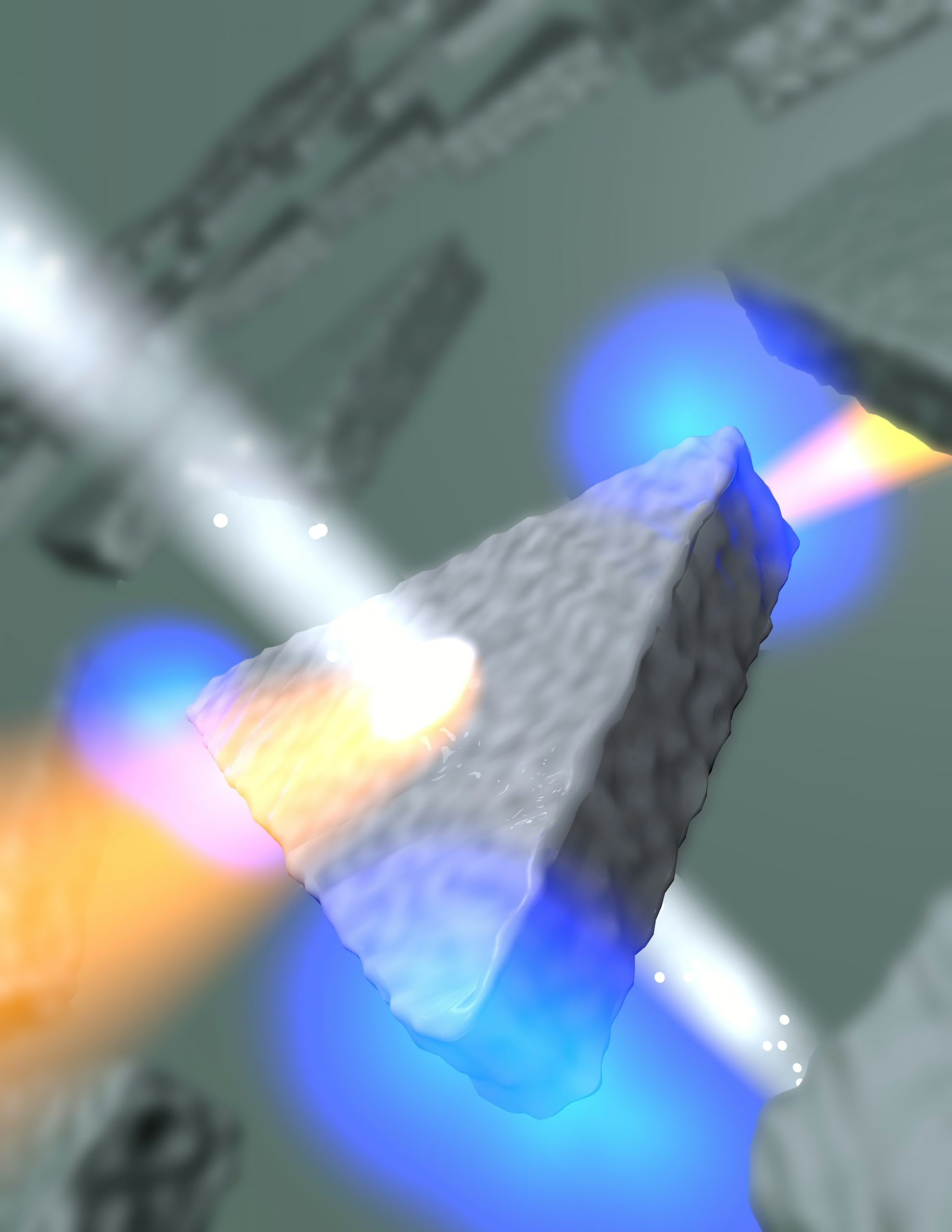
European grant for electron microscopy techniques
The European Union’s Horizon 2020 research and innovation programme has awarded a FET Proactive grant to a consortium of 8 European institutions to develop new ways to perform electron microscopy. AMOLF is one of the partners in the Electron Beams Enhancing Analytical Microscopy (eBEAM) consortium. The total budget is 5 M€.
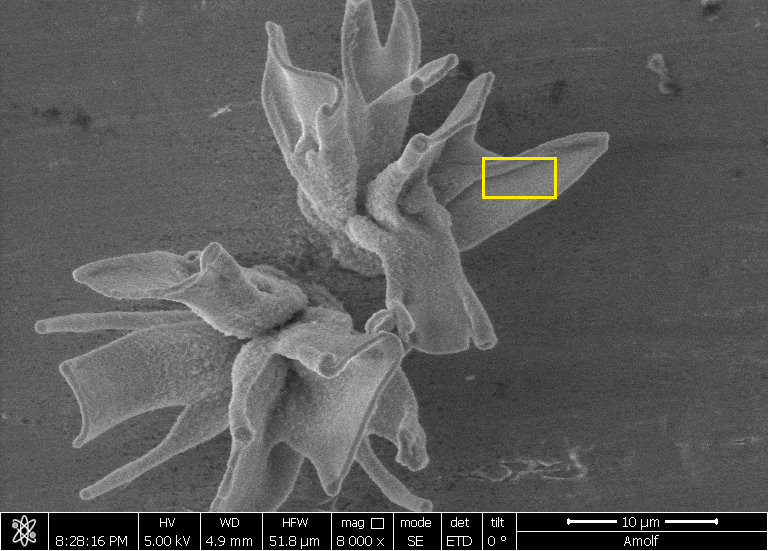
Transforming Self-Assembled Architectures into Functional Materials
Imagine if a material would arrange itself into a shape suited for its application. It may result in a catalyst that maximizes its own surface area for improved efficiency or a micro-actuator that forms appendages to grab nearby objects. This is the promise that self-assembly holds: making complex, functional materials by letting matter shape itself. Yet, not all matter that self-assembles into interesting forms turns out to have a useful function in its final shape. Researchers of the Self-Organizing Matter group recently discovered that ion exchange allows them to separate the self-assembly process from the resulting material. Their findings were published in Advanced Materials on November 16th and highlighted in Nature and Nature Reviews Materials.
MRS Fall Meeting prizes for Susan Rigter
At the 2020 Virtual MRS Fall Meeting, PhD student Susan Rigter has won two awards with her poster Amorphous Halide Perovskite Thin Films. First, the Materials Research Society announced that she had won the Best Poster Award in the symposium, followed by the news that she was also shortlisted for best poster at the overall conference sponsored by ACS Energy Letters. Like a cherry on the cake, Rigter also received this second prize for her poster.
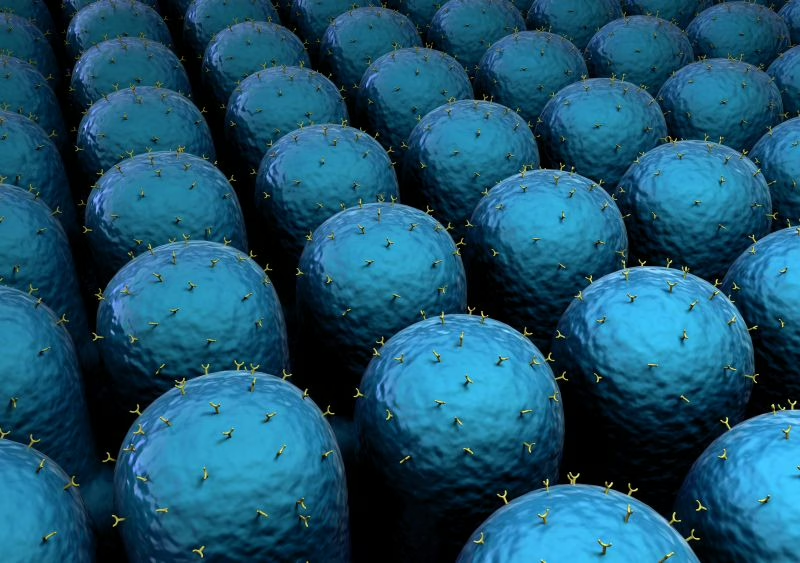
Dynamic risk management in cell populations
Much like investors on the stock market, cell populations prepare for changes in the environment by spreading the risk. The tool box they use contains a repertoire of sensory receptors on the surface of individual cells. These receptors can be tweaked to make individual members of the population responsive to different environmental signals. It was thought that cells could only modify this diversity relatively slowly, by producing new receptor proteins or degrading them. Scientists at AMOLF (Amsterdam, the Netherlands) and Yale University (New Haven, CT) now report the discovery of a mechanism that enables cell populations to tune their diversity much faster, by a combination of physical and chemical interactions between existing proteins. The findings are published in the journal Science Advances on November 13th.
Bas Overvelde appointed in Eindhoven
Bas Overvelde (Soft Robotic Matter) has been appointed as part-time associate professor at Eindhoven University of Technology (TU/e). While his group and lab will stay at AMOLF, he will spend one day a week at the Institute for Complex Molecular Systems (ICMS). Overvelde wishes to initiate new collaborations with TU/e researchers, especially in the field of Soft Robotics.