
News & updates
Latest developments from our institute
Stay informed about new research results, awards, events, and collaborations across our scientific community.
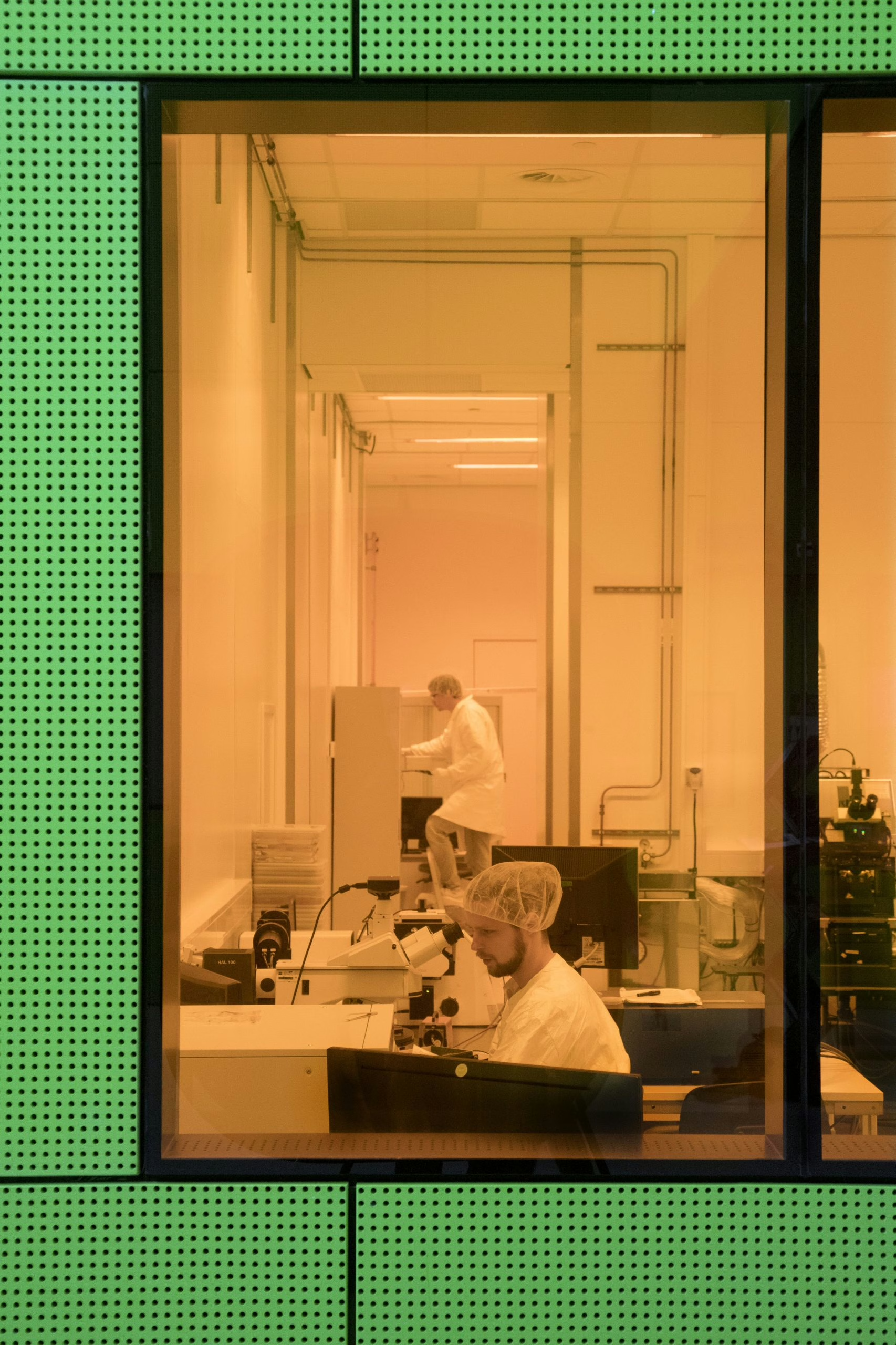
SHINE consortium receives NWO funding to combine the best of two worlds
A consortium consisting of AMOLF and other academic partners in the Netherlands receives funding from the NWO Research Infrastructure (RI) call for the project ‘Shining light on atomic-scale processes’ (SHINE). AMOLF’s group leader Wiebke Albrecht (Hybrid Nanosystems) is the principal investigator. The total budget for the duration of the project is 3 million euros.
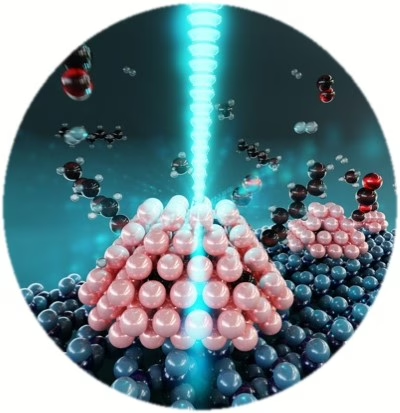
Light-Catalyst Interactions to Sense and Steer Chemical Reactions
AMOLF and Utrecht University have been awarded a 1.9 million euro research project by the Dutch Research Council (NWO) Key Technologies 2020-2023 programme to develop radically new catalytic reactors using plasmonic systems. The project entitled “Sensing and Steering Catalytic Reactions with Light” (CatLight) is a multidisciplinary collaboration between AMOLF (Alarcon-Llado, Albrecht, Ehrler, Garnett and Polman), Utrecht University (Weckhuysen, Hutter, Rabouw), and industrial partners BASF, ExxonMobil, Shell, Toyota Motor Europe, DENSsolutions, and Delmic.

NWO funding for perovskite solar foil consortium
The Light Management in New Photovoltaic Materials (LMPV) Center at AMOLF starts a new solar consortium on perovskite solar foils by roll-to-roll manufacturing, which has recently been funded by NWO’s Knowledge and Innovation Convenant (KIC). The grant has been awarded as part of the ‘Innovations for wind and solar energy’ thematic call for proposals. The consortium consists of a mix of academic organizations and small and medium-sized enterprises. The total grant amount is 1,5 million euro.
Record efficiencies in thin film photovoltaic cells
Silicon solar cells have proven to be the champion photovoltaic technology, as they use earth abundant raw materials (i.e. Si) and perform with high efficiency. However, they are based on thick, rigid and heavy wafers and can therefore only be installed in a limited amount of places. One of the ways to overcome this disadvantage is to use thin membranes instead. This will reduce the amount of Si by more than 99% (dramatically saving in raw materials) and also make the cells flexible and lightweight. As such, these cells can be easily integrated into buildings, urban architecture and even small every day gadgets. The problem though, is that such thin Si membranes cannot absorb light as efficiently. In fact, only 25% of the sunlight is absorbed and you can even see through them!
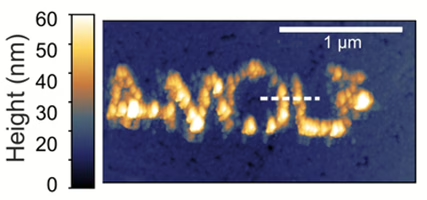
Microscope prints patterns at the nanoscale
Researchers from AMOLF’s 3D-Photovoltaics group have successfully used an atomic force microscope to electrochemically print at the nanoscale. This technique can print structures for a new generation of solar cells on chips. The researchers published their results today in the journal Nanoscale.
Less can be more: semiconductor nanowires for flexible photovoltaics
Capturing and manipulating light at nanoscale is a key factor to build high efficiency solar cells. Researchers in the 3D Photovoltaics group have recently presented a promising new design. Their simulations show that vertically stacked nanowires on top of ultrathin silicon films reduces the total amount of material needed by 90% while increasing the efficiency of the solar cell. These promising simulation results are an important step towards new generation solar cells that are used in myriad ways in our buildings and landscape. The results have been published on May 23rd in Optics Express.

Tenure track group leader Esther Alarcon reinforces photovoltaics research
As of Februari 1st, Esther Alarcon starts as a tenure track group leader in the FOM focus group Light Management in New Photovoltaic Materials (LMPV). Alarcon is the third group leader in the LMPV focus group and with Alarcon the focus group has filled all of its tenure track positions.
SOLARDAM – Amsterdam solar energy initiative has received first grant
The solar energy research network SOLARDAM has received its first research grant.The 1 M€ grant from the Amsterdam Academic Alliance (AAA) enables collaborative research between AMOLF, UvA, VU, and ECN on the development of novel methods to convert sunlight to electricity and fuel.