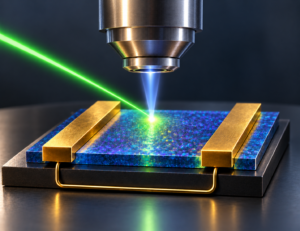
Computers normally process information using electronic circuits. But what if a material could perform calculations simply by moving or changing shape? Such a material could potentially use less energy than conventional computers, making it a more sustainable alternative.
In the past few years, researchers in AMOLF’s Hypersmart Matter group have often worked with systems consisting of small movable objects connected by springs. When one part moves, it influences the movement of other parts. Together, these interacting components can process a wealth of information. By harnessing these interactions, the material can perform calculations and exhibits smart behavior.
Taking next steps
In their Nature Communications publication, the AMOLF researchers describe how they built on their knowledge of simplified systems. Group leader Dr. Marc Serra Garcia reflects: “First, we realized that if we want to design a system that, for instance, distinguishes between words, we need to find the exact shape that this system needs to have. This proved to be extremely difficult because there are many possible shapes a material can have.”
To overcome this challenge, Marc and his team members used mathematical models describing how these systems behave to develop a new, broadly applicable design method, much like a building kit. This approach allows them to design a wide variety of physical structures that can perform specific tasks.
Thus, the same approach could potentially be used for many different applications, from wearable technology to infrastructure. The exact structure would depend on what the material needs to do.
Nonlinear behavior
An important advance is that the new method accounts for nonlinear behavior. This means that when a material is deformed, its response does not necessarily increase in direct proportion to the force applied. Such behavior becomes particularly important when structures undergo larger movements and is essential for many computing tasks.
Existing design methods mainly focused on simpler, linear behavior. The new approach makes it possible to systematically design materials that use more complex mechanical interactions to perform calculations.
Towards materials with built-in intelligence
The research opens up possibilities for materials that do more than respond passively to their surroundings. In the future, sensors might be able to process some of the information they collect through their own mechanical movements, reducing the need for separate electronic processing and potentially saving energy.
The approach could also contribute to devices that combine memory and computation within the same physical structure.

Learn more
– To find out more about a prototype of a smart structure – developed a few years ago by collaborators at Robertsson’s lab at the Switzerland Innovation Park Zurich – read the news item entitled “Sound-powered sensors stand to save millions of batteries”.
– If you have any questions about this research, contact Marc Serra Garcia at e-mail: m.serragarcia@amolf.nl.
– The research was carried out by Sima Zahedi Fard, Paolo Tiso, Parisa Omidvar, and Marc Serra-Garcia. The paper, “Designing nonlinear perturbative metamaterials that compute“, was published in Nature Communications.