Collaboration

Successful outcomes of international EBEAM program led by AMOLF

The EU Pathfinder project Electron Beams Enhancing Analytical Microscopy (EBEAM) that was recently completed has received a highly positive review of the European Innovation Council (EIC). EBEAM brought together eight European research institutions and companies, including AMOLF, that develop new concepts and instruments combining spectroscopic analysis with electron microscopy.

The EBEAM program that was co-initiated and directed by AMOLF group leader Professor Albert Polman, developed a range of new measurement techniques that significantly expand the capabilities of electron microscopy. Two product prototypes developed within EBEAM by the industrial partners are close to market introduction.

New generation of electron microscopy platforms

The review report, written by international experts, states:

“EBEAM has laid the groundwork for a new generation of electron microscopy platforms, with applications spanning materials science, semiconductor metrology, renewable energy, and quantum technologies. EBEAM has not only achieved its objectives but has also set a standard for future initiatives in this field. It stands as an exemplar of how Horizon Europe and EIC funding can drive scientific excellence, economic growth, and long-term technological leadership”.

From innovation to application

Several technologies developed within EBEAM are now moving towards practical use. A new module that measures light emitted by materials inside an electron microscope is being tested by early users. A prototype of an ultrafast electron microscope, which can capture extremely fast processes in materials, is being validated for use by researchers and industry. The program is also further developing software to reconstruct microscope images, while technology for generating ultrafast electron pulses has been licensed.

These developments show how EBEAM is helping to turn fundamental research into practical technologies. As the EIC panel wrote: “By supporting small and medium-sized companies and fostering collaboration, EBEAM is not just advancing technology, it’s driving economic growth and securing Europe’s position as a leader in this critical field.”
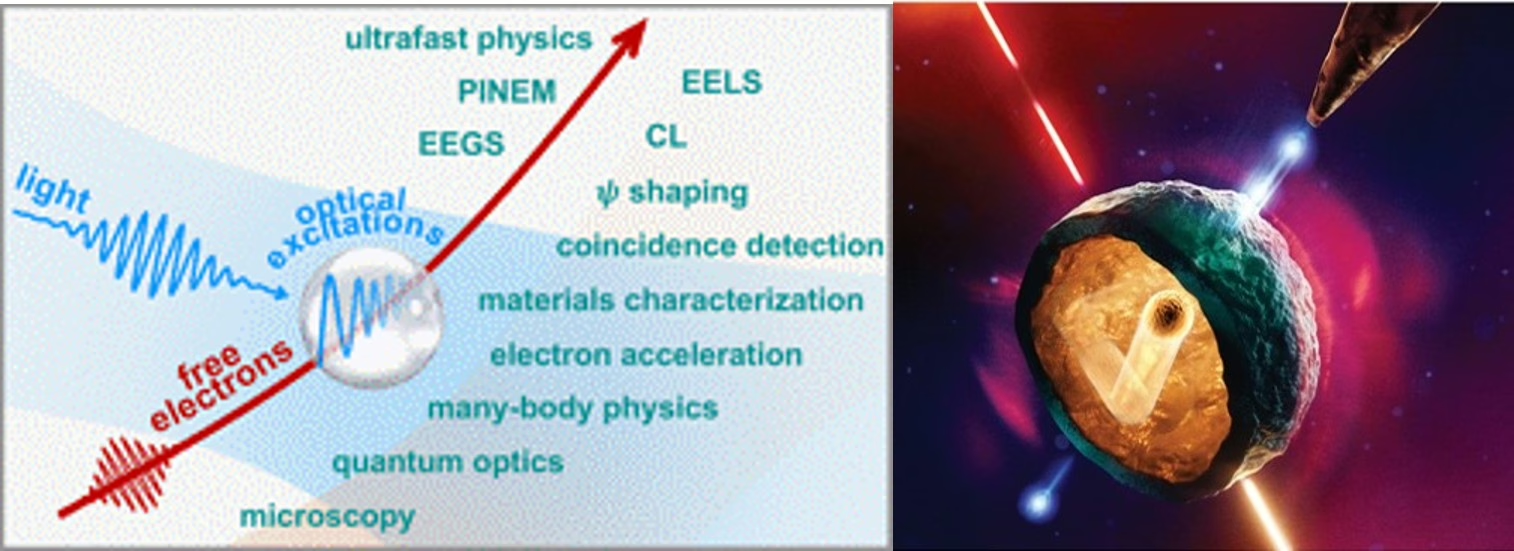
Physical processes discussed in electron-light-matter interaction (from Roadmap for quantum nanophotonics with free electrons (ACS Photonics 12, 4760 (2025)

A closer look at the scientific milestones

In parallel to the technical developments, EBEAM has been very successful in developing new scientific insights. The outcomes have been published in more than 40 peer-reviewed journal articles. As written by the reviewers: “The achievements are remarkable: energy resolution has reached the sub-10 μeV range, temporal resolution has entered the attosecond regime, and the project has even demonstrated the world’s first quantum entanglement between free electrons and photons. These milestones are complemented by the development of novel techniques, such as self-referenced cathodoluminescence probing and Ramsey-type interferometry, which combine electron and optical fields in unprecedented ways.”
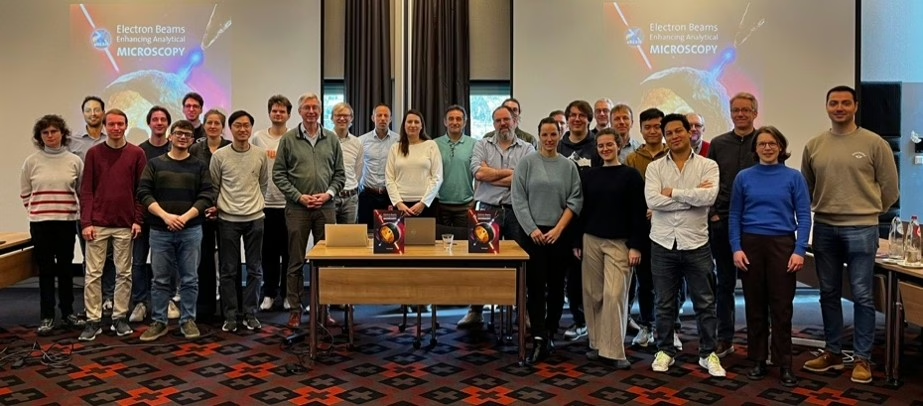
Participants at the concluding EBEAM workshop in Amsterdam, March 12, 2026

Partners

The EBEAM program was a collaboration between the Universities of Antwerpen, Göttingen, Kiel, and Paris Saclay, ICFO (Castelldefels, Spain), Delmic (Delft), Thermo Fisher (Eindhoven) and AMOLF. The final report of the EBEAM program and the list of publications are available at the EBEAM website: www.e-beam.eu.

Learn more

If you have any questions about the EBEAM program, please contact Albert Polman at email: a.polman@amolf.nl.

To read more about research in the group led by Albert Polman, visit the Photonic Materials research group on our website.
Share article
What's happening

Most recent news items

All news items
Research highlights

Everything you need to know about organoids

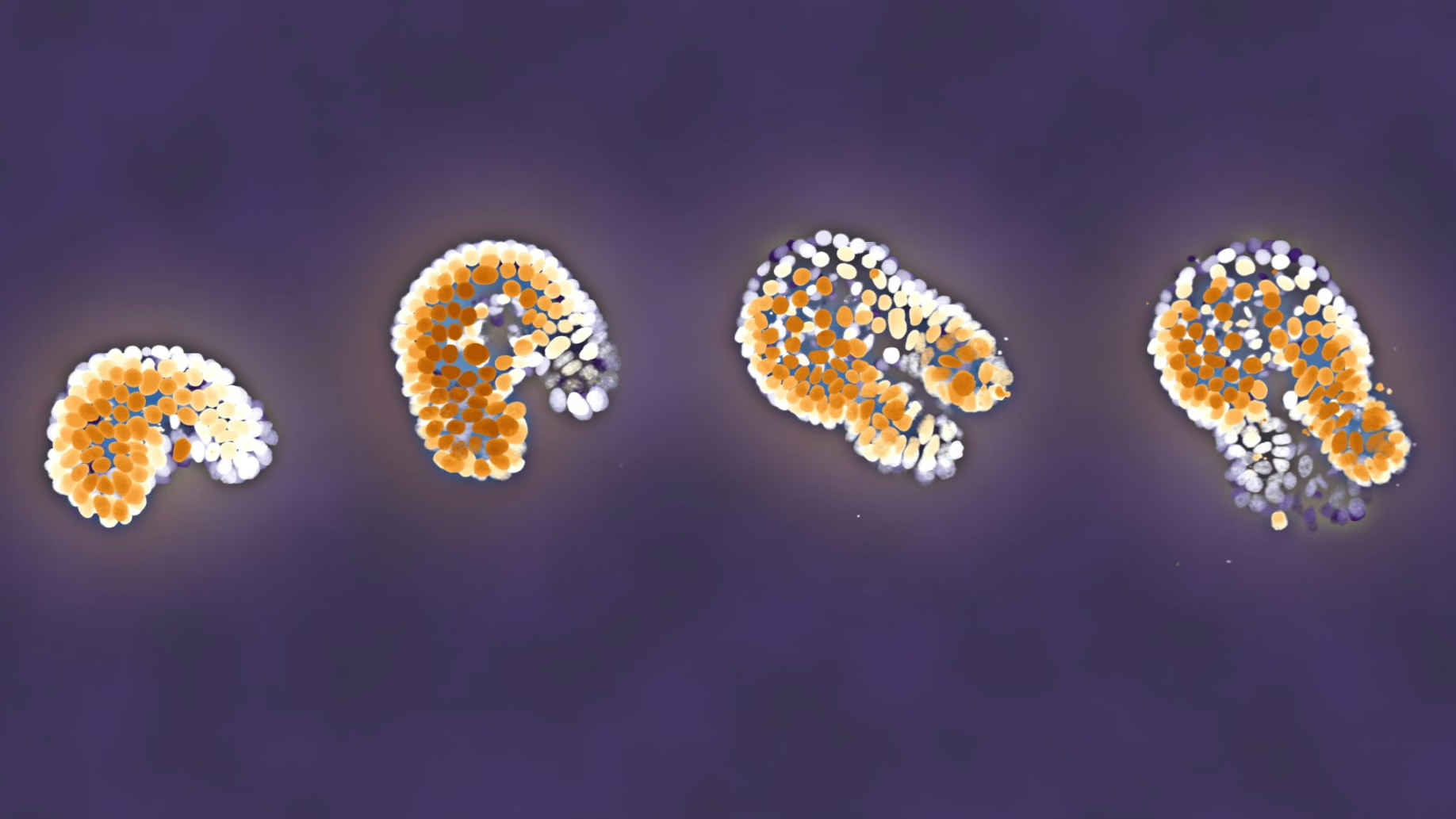
Organoids are instrumental in improving our understanding of processes that are otherwise hidden inside the body. For instance, these small 3D organs can be used to test medicines on tissue grown from a patient’s own cells. AMOLF researchers carry out unique and complex experiments to follow organoids in time. In order to enable other researchers to benefit from their experiences, they now publish their methods in the prestigious journal Nature Protocols.

Read news item
Events and outreach

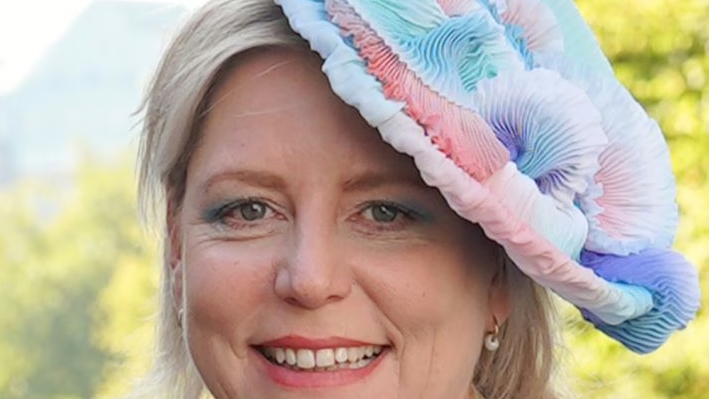
Minister Rianne Letschert wears hat and shoulder ornament inspired by Wim Noorduin’s research

This year at the opening of the parliamentary year (Prinsjesdag) Minister of Education, Culture and Science Rianne Letschert wears a spectacular hat and shoulder ornament. Both of them are inspired by the microscopic structures studied by group leader Wim Noorduin (AMOLF/UvA), which look remarkably like tiny flowers under a microscope. Artist and designer Malou Beemer translated these shapes, normally invisible to the naked eye, into wearable art.

Read news item
Nachi Stern, Group Leader Learning Machines at AMOLF
People and recognition

Nachi Stern awarded ERC Starting Grant to explore how matter learns

Why do brains learn, but rocks do not? Could a material one day adapt to its environment the way a living organism does? AMOLF group leader Dr. Nachi Stern has been awarded an ERC Starting Grant to investigate the physical laws of learning, in a project called, “Physical Learning in Dynamical Systems.”

Read news item
First author Rohit Raj in his lab at AMOLF
Research highlights

Tiny glass spheres offer a new way to control light

Researchers from the Nanoscale Solar Cells group at AMOLF have developed a new way to control light using tiny glass spheres. The spheres can efficiently capture incoming light and control which color is guided in which direction. This could help make photocatalysis, where light is used to drive chemical reactions, more efficient and ultimately contribute to more sustainable chemical processes. The technique could also be useful for future semiconductor applications. The research was published in ACS Photonics on August 13, 2026.

Read news item
Stay informed

Get the latest research highlights, events, and news from our institute delivered to your inbox