Events and outreach

Minister Rianne Letschert wears hat and shoulder ornament inspired by Wim Noorduin’s research

This year at the opening of the parliamentary year (Prinsjesdag) Minister of Education, Culture and Science Rianne Letschert wears a spectacular hat and shoulder ornament. Both of them are inspired by the microscopic structures studied by group leader Wim Noorduin (AMOLF/UvA), which look remarkably like tiny flowers under a microscope. Artist and designer Malou Beemer translated these shapes, normally invisible to the naked eye, into wearable art.

Driven by curiosity, Wim tries to find out how nature works using chemistry as his toolbox. The hat symbolizes how this kind of curiosity can grow into innovations that make our society safer, healthier or more creative.

From a sense of wonder to a safer environment

The microscopic mineral structures studied by Wim look a lot like flowers. When he first discovered them, he was mesmerized by their beauty and felt as though he were standing in a garden full of flowers. His fascination was shared by the editors of the renowned scientific journal Science, who featured one of his images on its cover.

A few years later, Wim discovered that they could be transformed into the solar cell material halide perovskite. This became the basis for a spray that can make toxic lead visible. Today, this lead detection spray is distributed worldwide by the company Lumetallix. It is used to detect harmful lead particles in people’s living environments. And it is also used by police in forensic investigations to determine where shots were fired and who fired them.
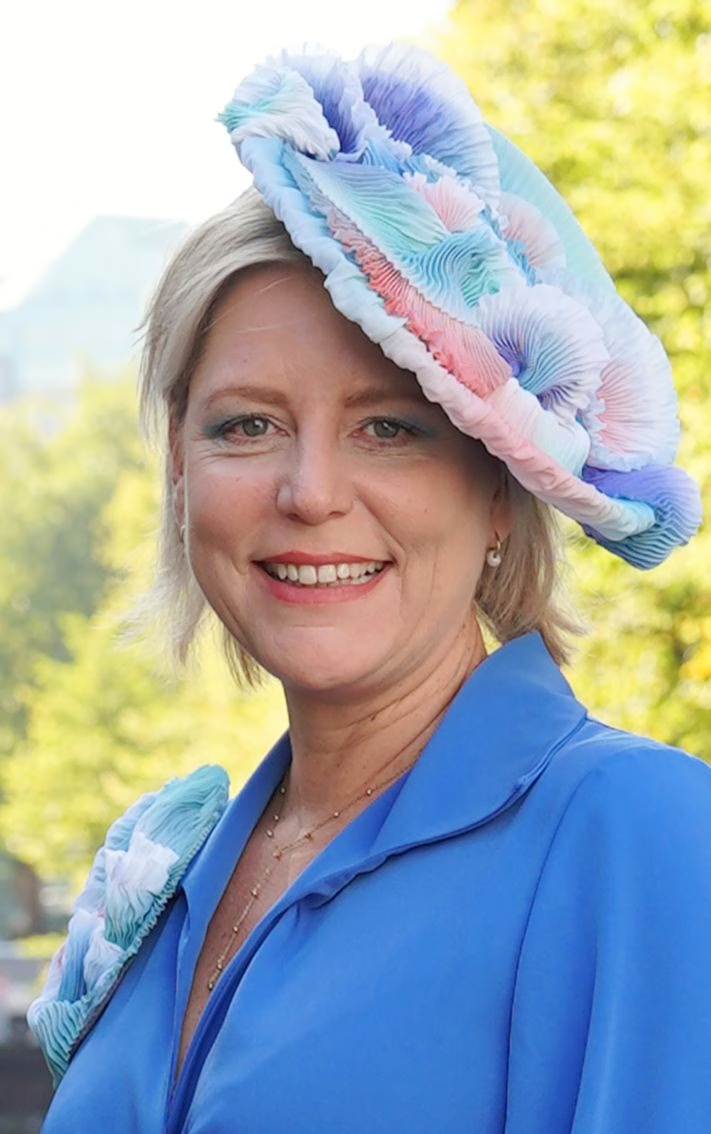
Minister of Education, Culture and Science Rianne Letschert wears a hat and shoulder ornament inspired by research of Wim Noorduin

Translating science into wearable accessories

The Dutch Research Council (NWO) took the initiative to translate the scientific discoveries in Wim’s lab into wearable accessories for Prinsjesdag. NWO brought Wim and artist Malou Beemer together through the Art Route of the Dutch Research Agenda and challenged them to create a hat symbolizing the power of collaboration between science and art. In doing so, the hat also highlights the importance of collaboration across disciplines in creating an innovative society.
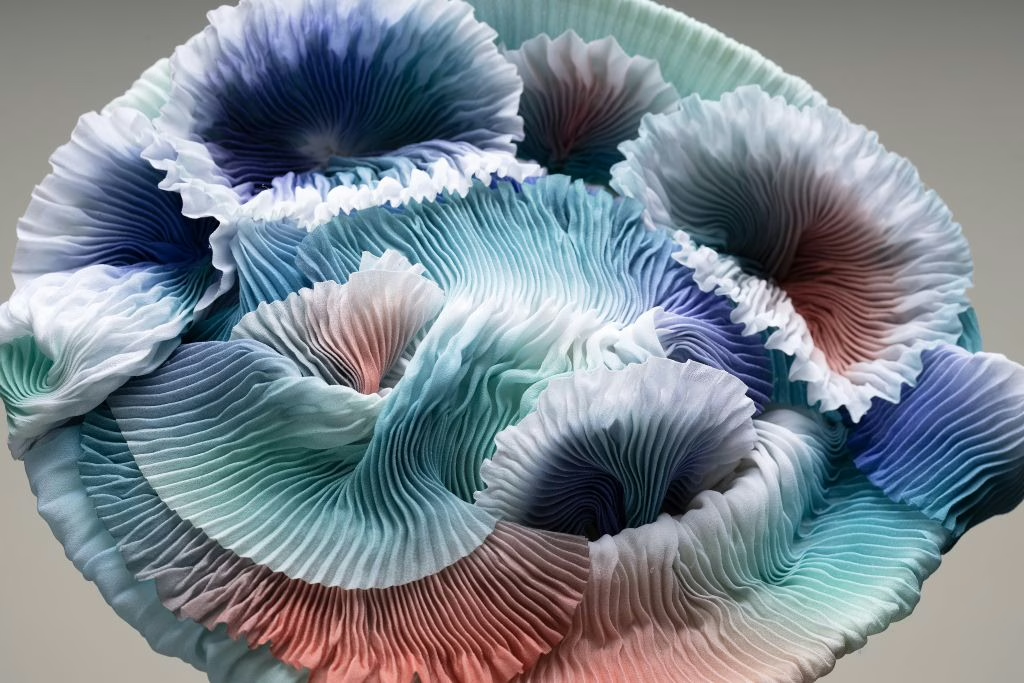
Top view of the hat worn by Minister Rianne Letschert. Image: NWO, Hilbert Krane.
Top view of the hat worn by Minister Rianne Letschert. Image: NWO, Hilbert Krane

Malou is a designer, artist, and researcher. In her work, she explores the relationship between people, the body, and their surroundings, using fashion, textiles, and technology to create innovative and socially sustainable designs. Through her studio, she works on interdisciplinary projects that focus on design innovation and interaction with textiles.

A shared fascination

Wim says that it was very inspiring to work together. “Malou and I are actually not that different from each other. Our starting point is the same: we are fascinated by processes in nature and by how organisms use simple building blocks to create complex and functional structures. For example, we are both interested in processes that show emergent, or spontaneously arising, behavior: as a result, the result is more than the sum of its parts.”
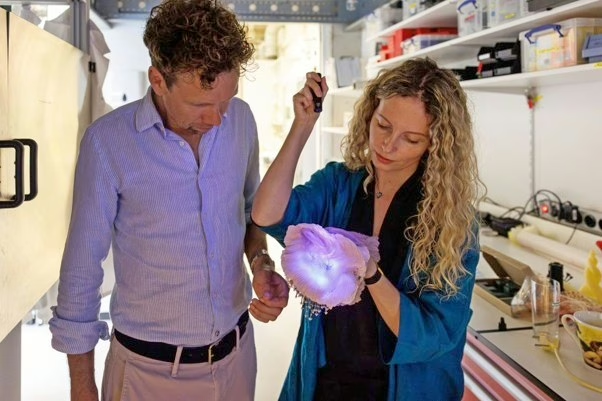
Wim Noorduin (left) and Malou Beemer (right). Photo NWO, Paul Tolenaar

Learn more

If you want to read more about how to turn a mineral structure into a solar cell material, read the following news items:

Share article
What's happening

Most recent news items

All news items
Collaboration

Successful outcomes of international EBEAM program led by AMOLF

The EU Pathfinder project Electron Beams Enhancing Analytical Microscopy (EBEAM) that was recently completed has received a highly positive review of the European Innovation Council (EIC). EBEAM brought together eight European research institutions and companies, including AMOLF, that develop new concepts and instruments combining spectroscopic analysis with electron microscopy.

Read news item
Research highlights

Everything you need to know about organoids

Organoids are instrumental in improving our understanding of processes that are otherwise hidden inside the body. For instance, these small 3D organs can be used to test medicines on tissue grown from a patient’s own cells. AMOLF researchers carry out unique and complex experiments to follow organoids in time. In order to enable other researchers to benefit from their experiences, they now publish their methods in the prestigious journal Nature Protocols.

Read news item
Nachi Stern, Group Leader Learning Machines at AMOLF
People and recognition

Nachi Stern awarded ERC Starting Grant to explore how matter learns

Why do brains learn, but rocks do not? Could a material one day adapt to its environment the way a living organism does? AMOLF group leader Dr. Nachi Stern has been awarded an ERC Starting Grant to investigate the physical laws of learning, in a project called, “Physical Learning in Dynamical Systems.”

Read news item
First author Rohit Raj in his lab at AMOLF
Research highlights

Tiny glass spheres offer a new way to control light

Researchers from the Nanoscale Solar Cells group at AMOLF have developed a new way to control light using tiny glass spheres. The spheres can efficiently capture incoming light and control which color is guided in which direction. This could help make photocatalysis, where light is used to drive chemical reactions, more efficient and ultimately contribute to more sustainable chemical processes. The technique could also be useful for future semiconductor applications. The research was published in ACS Photonics on August 13, 2026.

Read news item
Stay informed

Get the latest research highlights, events, and news from our institute delivered to your inbox