People and recognition

Huibregtsen prize nomination for lead detection method

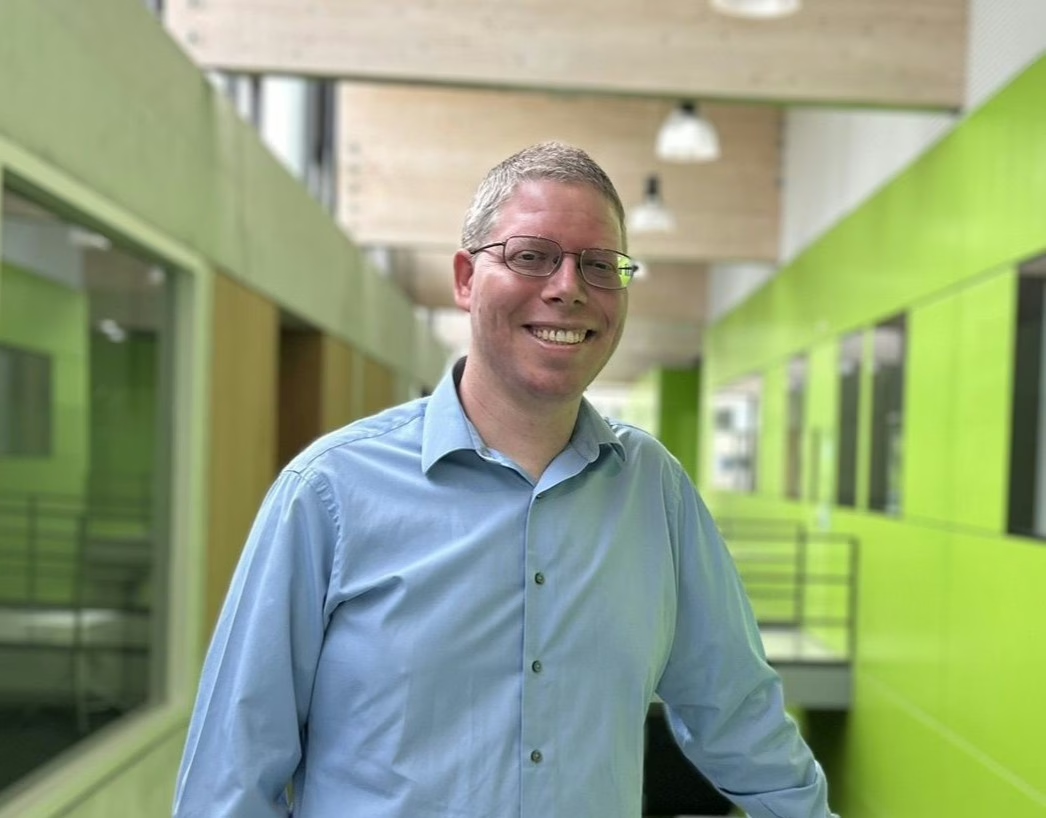
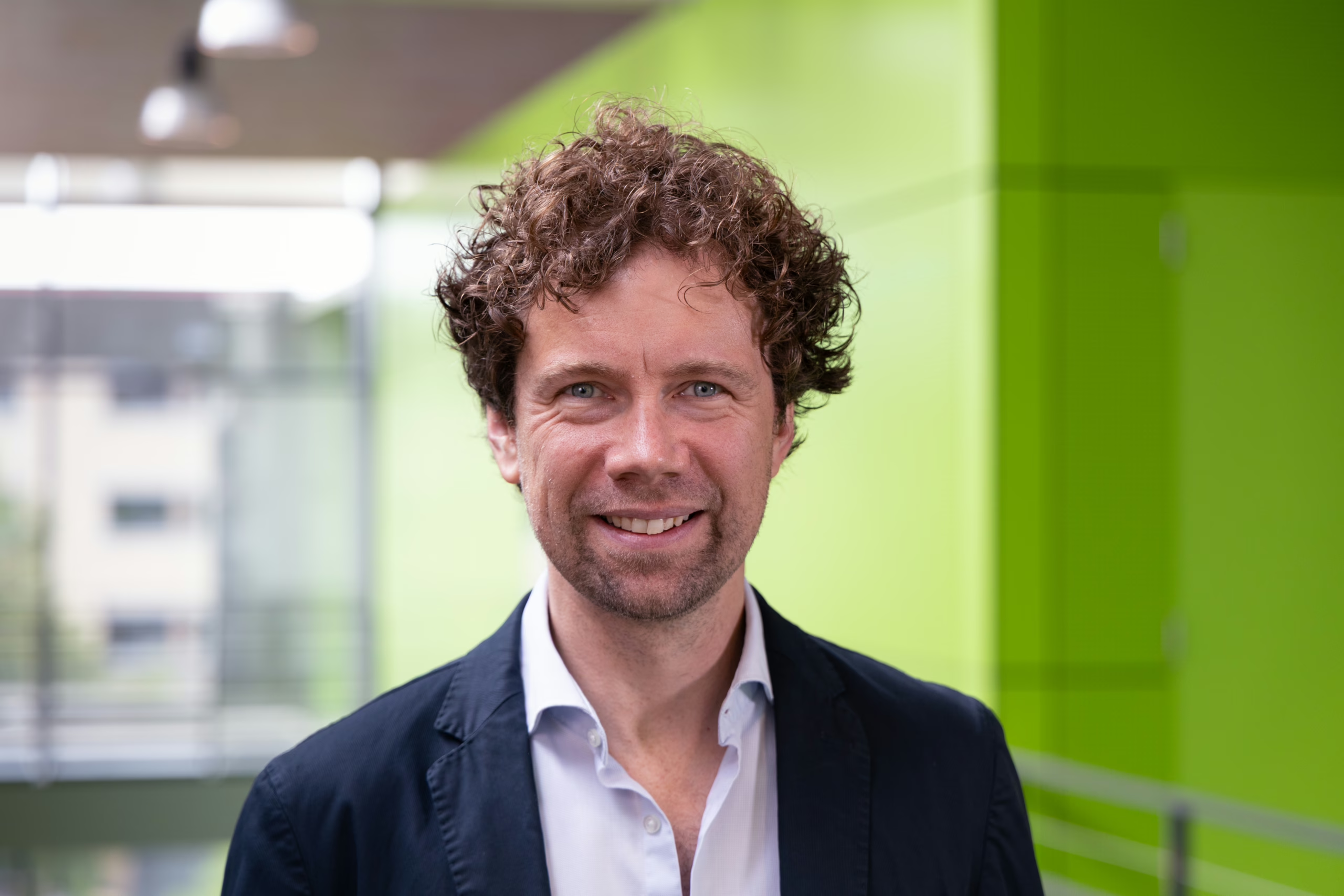
AMOLF group leader Professor Wim Noorduin and his collaborator Professor Arian van Asten (UvA) have been nominated for the Huibregtsen Prize 2026. The winner will be announced at the annual event called ‘Avond van Wetenschap en Maatschappij’ (evening of science and society) on October 8, 2026. The prize recognizes scientists who combine scientific excellence and innovation with particular societal relevance or outreach.

Professor Wim Noorduin, AMOLF group leader Self-Organizing Matter

Jury report

In its press release, Stichting De Avond van Wetenschap en Maatschappij, which organizes the event in October, describes Wim and Arian’s project as follows: “The original research project by chemists Noorduin and Van Asten has an exceptionally strong narrative and scores highly across the board. It is a compelling example of how curiosity-driven research can have an enormous impact on society, even when that impact could not have been precisely predicted in advance.”

Responding to the news about the nomination, Wim says: “It’s great to see that our research, that started out as very fundamental, is now making a real impact on society.”

From mineralized structures to gunshot residue

Wim’s scientific journey at AMOLF started with research on the controlled self-organization of mineralized structures. While working from home during the COVID pandemic, Wim discovered a chemical method to detect the presence of lead atoms on a surface. His group was studying perovskite, a very promising material for solar cells, when he realized that its light-emitting properties could help visualize lead atoms in the environment.

This discovery offered a promising way to help address the global problem of lead poisoning. People are often unaware of the presence of lead in their environment. Today, a startup company called Lumetallix distributes the lead detection kit worldwide.

The next step in Wim’s research was the start of his collaboration with Arian van Asten. Together, they developed the lead detection test into a method for detecting gunshot residue. This method is faster, more sensitive, and easier to use than current alternatives. Forensic experts at the Amsterdam police are already testing it in real-life crime scene investigations.

Learn more

If you have questions about lead detection research, then contact group leader Wim Noorduin at w.noorduin@amolf.nl

To read more about the lead detection method, read this news item on our website.

To read more about the crime scene application, read ‘Solving crimes with glowing evidence: a brand-new method to detect gunshot residue at the crime scene‘.

Share article
What's happening

Most recent news items

All news items
Collaboration

Successful outcomes of international EBEAM program led by AMOLF

The EU Pathfinder project Electron Beams Enhancing Analytical Microscopy (EBEAM) that was recently completed has received a highly positive review of the European Innovation Council (EIC). EBEAM brought together eight European research institutions and companies, including AMOLF, that develop new concepts and instruments combining spectroscopic analysis with electron microscopy.

Read news item
Research highlights

Everything you need to know about organoids

Organoids are instrumental in improving our understanding of processes that are otherwise hidden inside the body. For instance, these small 3D organs can be used to test medicines on tissue grown from a patient’s own cells. AMOLF researchers carry out unique and complex experiments to follow organoids in time. In order to enable other researchers to benefit from their experiences, they now publish their methods in the prestigious journal Nature Protocols.

Read news item
Events and outreach

Minister Rianne Letschert wears hat and shoulder ornament inspired by Wim Noorduin’s research

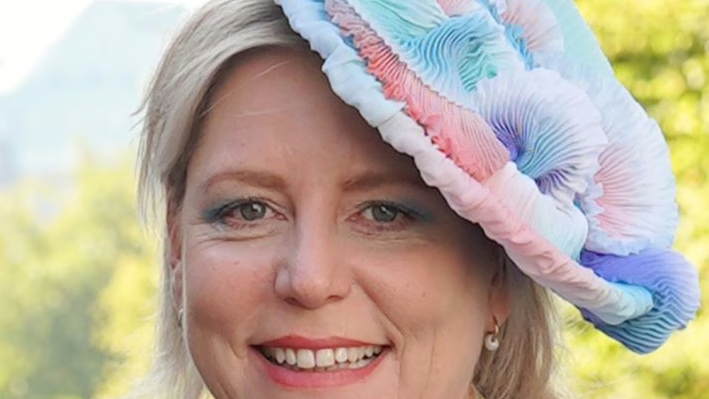
This year at the opening of the parliamentary year (Prinsjesdag) Minister of Education, Culture and Science Rianne Letschert wears a spectacular hat and shoulder ornament. Both of them are inspired by the microscopic structures studied by group leader Wim Noorduin (AMOLF/UvA), which look remarkably like tiny flowers under a microscope. Artist and designer Malou Beemer translated these shapes, normally invisible to the naked eye, into wearable art.

Read news item
Nachi Stern, Group Leader Learning Machines at AMOLF
People and recognition

Nachi Stern awarded ERC Starting Grant to explore how matter learns

Why do brains learn, but rocks do not? Could a material one day adapt to its environment the way a living organism does? AMOLF group leader Dr. Nachi Stern has been awarded an ERC Starting Grant to investigate the physical laws of learning, in a project called, “Physical Learning in Dynamical Systems.”

Read news item
Stay informed

Get the latest research highlights, events, and news from our institute delivered to your inbox