Research highlights

Material that can both store and process information for low-energy computing

Researchers at AMOLF and the University of Konstanz have developed a mechanical material that can store, move, and process information within the same physical structure. The findings, published in Physical Review Letters, could help inspire future computing technologies that use far less energy than conventional computers.

A different way of computing

Modern computers separate memory and computation into different hardware components. As a result, enormous amounts of energy are spent continuously moving information between processors and memory units, a problem known as the ‘von Neumann bottleneck’.

The researchers wanted to explore a different approach: a material in which information storage and computation happen together. Although their demonstration is mechanical, the underlying design principles could eventually inspire similar approaches in, for instance, systems based on light-matter interactions.

Information stored in buckling beams

The researchers built an elastic metamaterial consisting of interconnected beams cut from a thin polymer sheet. Some of these beams can buckle into two stable positions, similar to a snap bracelet bending in opposite directions. These two states represent binary information: a ‘0’ or a ‘1’.

By periodically compressing the material, the researchers caused the stored ‘0’ and ‘1’ states to propagate through the structure. As the buckling pattern shifts step by step along the chain, information effectively travels through the material itself. The concept resembles racetrack memory, a proposed technology in which data moves through a magnetic device instead of remaining fixed in place.
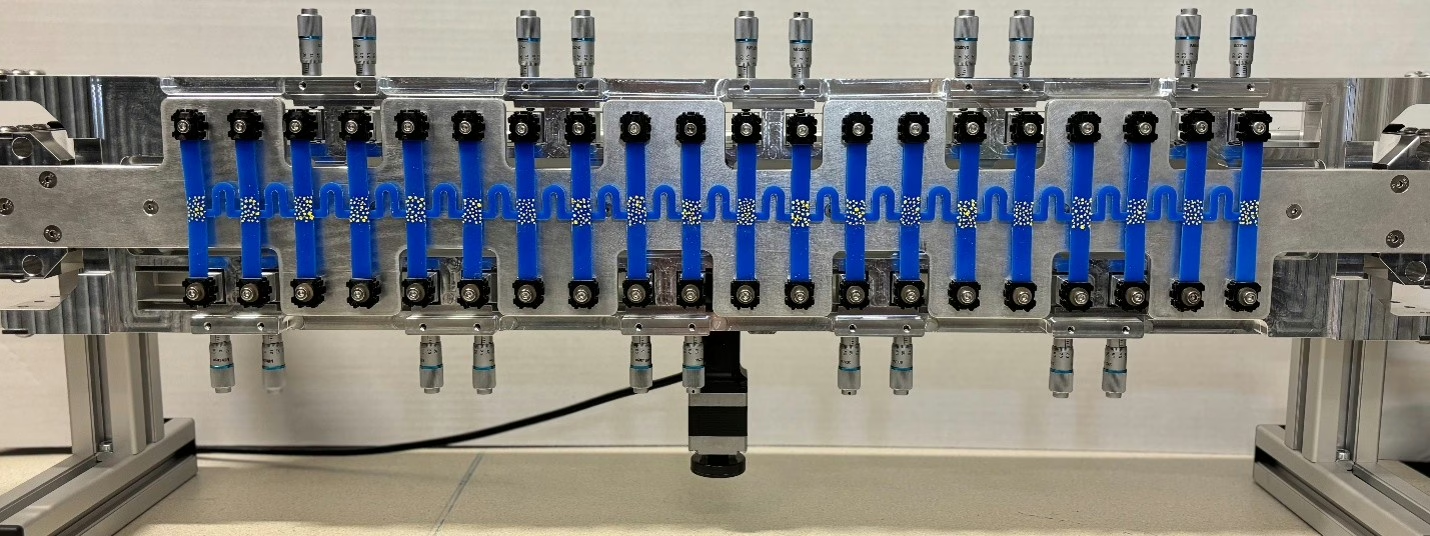
Mechanical material that can store, move, and process information

The same structure performs logic operations

The key advance is that the same mechanical elements both store information and participate in computation. Using simulations, the researchers showed that their material could perform logical operations using structures that behave like NAND gates (short for NOT AND), which are fundamental building blocks of digital electronics. They also designed a mechanical half-adder, a simple circuit that adds binary numbers together.

Unlike many earlier mechanical computing systems, the material can continuously process streams of information without resetting after every operation.

Robust information transport

The motion of information through the material is guided by topology, a branch of physics that describes properties that remain stable despite small imperfections in the material. This makes the information transport robust against defects or fabrication imperfections.

Although the current system operates on relatively slow mechanical timescales, the researchers believe that miniaturized versions could one day lead to highly energy-efficient computing devices.

Learn more

  • If you have questions about this research, then contact AMOLF group leader Marc Serra Garcia at M.SerraGarcia@amolf.nl
  • The paper ‘Racetrack computing with a topological boundary ratchet’ was published in Physical Review Letters
  • Read the full paper
Share article
What's happening

Most recent news items

All news items
Collaboration

Successful outcomes of international EBEAM program led by AMOLF

The EU Pathfinder project Electron Beams Enhancing Analytical Microscopy (EBEAM) that was recently completed has received a highly positive review of the European Innovation Council (EIC). EBEAM brought together eight European research institutions and companies, including AMOLF, that develop new concepts and instruments combining spectroscopic analysis with electron microscopy.

Read news item
Research highlights

Everything you need to know about organoids

Organoids are instrumental in improving our understanding of processes that are otherwise hidden inside the body. For instance, these small 3D organs can be used to test medicines on tissue grown from a patient’s own cells. AMOLF researchers carry out unique and complex experiments to follow organoids in time. In order to enable other researchers to benefit from their experiences, they now publish their methods in the prestigious journal Nature Protocols.

Read news item
Events and outreach

Minister Rianne Letschert wears hat and shoulder ornament inspired by Wim Noorduin’s research

This year at the opening of the parliamentary year (Prinsjesdag) Minister of Education, Culture and Science Rianne Letschert wears a spectacular hat and shoulder ornament. Both of them are inspired by the microscopic structures studied by group leader Wim Noorduin (AMOLF/UvA), which look remarkably like tiny flowers under a microscope. Artist and designer Malou Beemer translated these shapes, normally invisible to the naked eye, into wearable art.

Read news item
Nachi Stern, Group Leader Learning Machines at AMOLF
People and recognition

Nachi Stern awarded ERC Starting Grant to explore how matter learns

Why do brains learn, but rocks do not? Could a material one day adapt to its environment the way a living organism does? AMOLF group leader Dr. Nachi Stern has been awarded an ERC Starting Grant to investigate the physical laws of learning, in a project called, “Physical Learning in Dynamical Systems.”

Read news item
Stay informed

Get the latest research highlights, events, and news from our institute delivered to your inbox