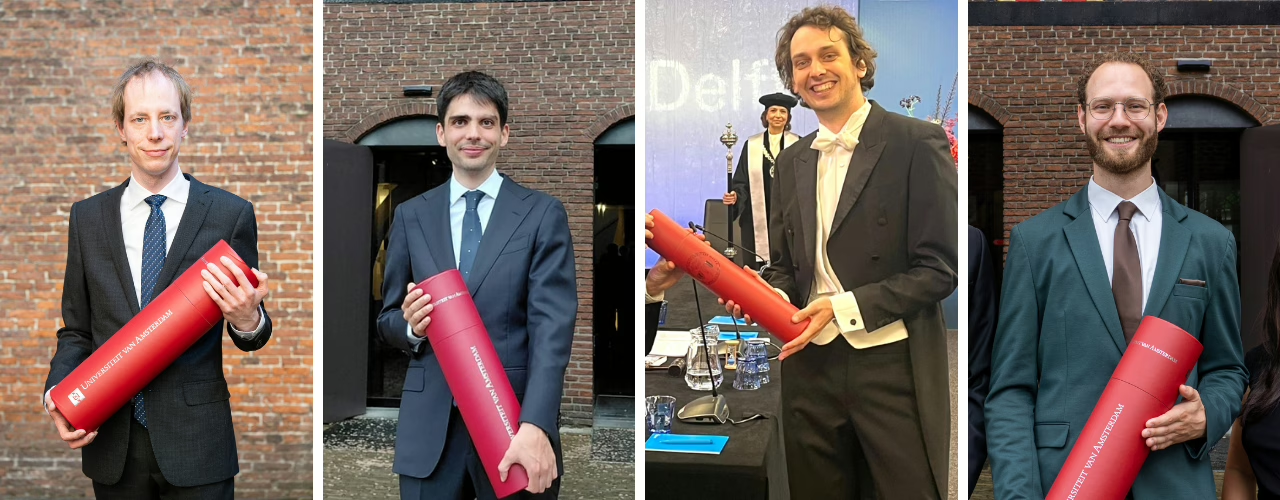
Sjoerd van Dongen (cum laude)
At AMOLF, Sjoerd worked on separating molecules that are mirror images of each other, just like our hands. Sjoerd was a group member of the Self-Organizing Matter group led by Wim Noorduin.
The so-called chiral molecules that Sjoerd worked on have very different properties, which is important when using them for pharmaceutical drugs. Sjoerd says: “The problem is that you only want one mirror image, but you can’t easily separate them. It’s a huge challenge. If you have the wrong one people can get very ill.”
Sjoerd used crystallization as a method to separate the two mirror images. “I introduced a chemical reaction that allows us to couple the chemical process with the physical process. This way, we can convert one into the other, and we get only the desired form.”
Currently, Sjoerd works for a UvA start-up company named SolarFoil. “We make foils for light management for agricultural applications. Plants don’t use green light, and they get harmed by UV light. We create materials that convert UV and green light to wavelengths that are used for photosynthesis.”
Read the thesis of Sjoerd van Dongen
Paul Ducarme
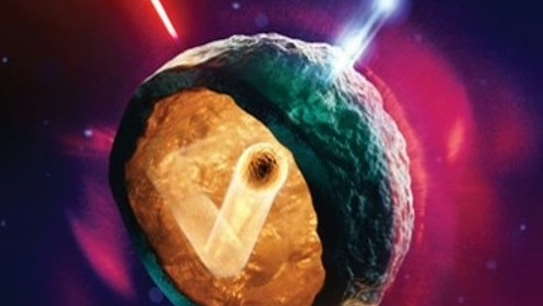
Joint AMOLF/ARCNL PhD student Paul Ducarme successfully defended his thesis, ‘Harnessing Mechanical Instabilities for Functional Structures Using Nonlinear Building Blocks’. At AMOLF, Paul worked under the supervision of Bas Overvelde and Martin van Hecke, and at ARCNL under the supervision of Bart Weber.
For his doctoral research, Paul developed elastic structures to demonstrate new phenomena in mechanics using instabilities. He says: “I studied how shape and geometry can be tuned to create new functional behaviors in matter, using only mechanics. I constructed the systems with simple building blocks, like a LEGO set.”
The highlight of Paul’s research was undoubtedly his demonstration of ‘counter-snapping’ behavior. Paul says: “I showed that pulling on a structure can make it shrink, something you definitely don’t expect. I highlighted many new exotic properties and functionalities unlocked by this phenomenon. These could potentially be used in a wide range of applications.”
Max Betjes (cum laude)
Max Betjes defended his thesis with cum laude honors on May 7 at TU Delft. He carried out his doctoral research in two AMOLF groups under the supervision of Sander Tans and Jeroen van Zon. Strikingly, his work was almost equally divided between these two groups. Max especially enjoyed the early years in the organoid team, when he and colleagues such as Rutger Kok and Xuan Zhang were pioneering a brand-new research field.
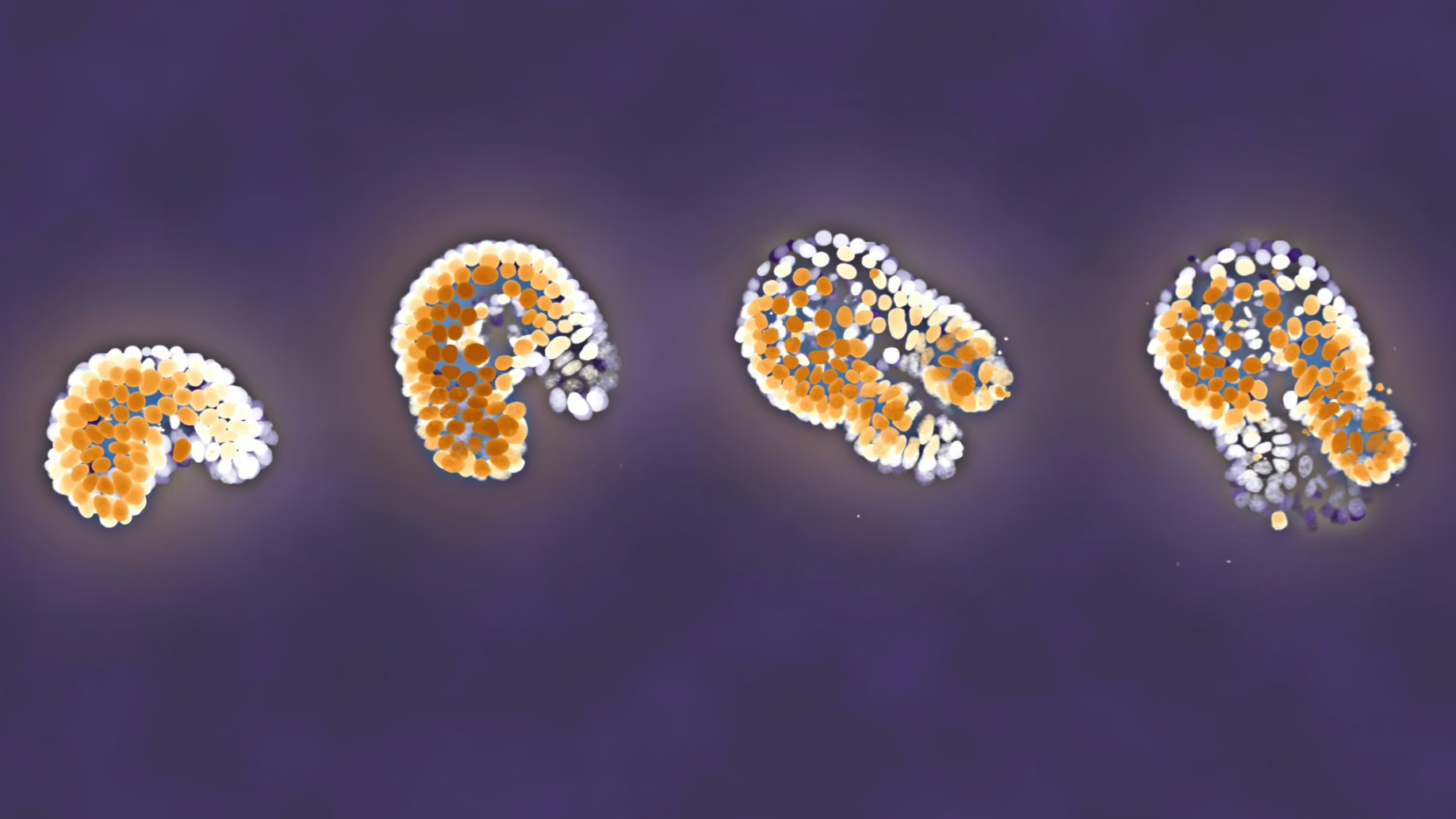
The first part of Max’s thesis focuses on intestinal organoids (tiny, simplified organs grown in the lab). He studied the relationship between cell function and position in the intestine.
The second part of the thesis deals with cell imaging, including the development of a new tracking algorithm. Frustrated by the time required to manually check cell-tracking data, Max created this algorithm to enable more efficient analysis. He validated the automated approach using cell movement data from organoid.
Mees Dieperink
On June 3, Mees Dieperink defended his thesis, ‘Rodcast: quantitative morphology–property correlations in gold plasmonic nanoparticles’.
During his doctoral research, Mees studied the shape of metal nanoparticles. The shape of a metal nanoparticle directly determines its color. For example, the gold spheres used in COVID-19 rapid antigen tests appear bright red. Mees explains: “We don’t know exactly what colors other shapes have because each individual particle is different. In my research, I tried to determine the color and shape of individual metal nanoparticles as precisely as possible.”
Over the years, Mees got to know many people at AMOLF. Fortunately, the next step in his career will not take him very far. As of July 1, Mees will join neighboring SolarNL as Program Officer.
Read more in our newsletter
Stay up to date with the latest research, events, and news from AMOLF. Subscribe to the newsletter and receive updates directly in your inbox.