Events and outreach

Vibrant ExpeditieNext

Each spring, AMOLF participates in ‘ExpeditieNext’, the national science festival for kids. This year, AMOLF expanded its contribution by offering two activities: ‘Make your own hologram’ and the newly developed ‘Flavor enhancers’. ‘ExpeditieNext’ 2026 took place in Enkhuizen on May 1.

‘ExpeditieNext’ is popular with both visiting kids and their families, as well as with AMOLF researchers. Organized by the Nationale Wetenschapsagenda, the event aims to spark kids’ interest in science. Each year, a town outside the Randstad is transformed into a lively festival site filled with hands-on activities. The event is also highly popular among AMOLF researchers, so much so that the registration list fills up quickly.

‘Make your own hologram’
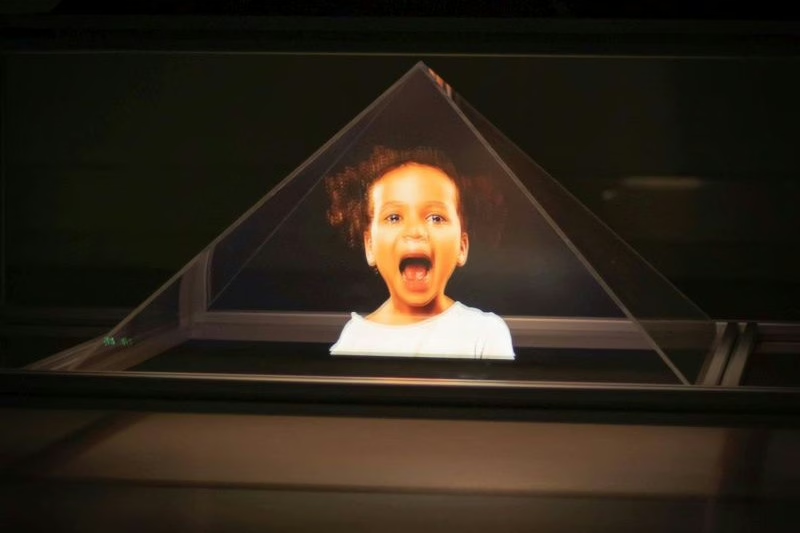
Hologram activity ExpeditieNext - Credits Wessel Zwart

Much of AMOLF’s research focuses on light and the interaction between light and matter. The hologram activity at ‘ExpeditieNext’ aims to inspire kids to explore the possibilities of light manipulation. After being filmed in a video booth, they see a projection of themselves appear in the room. Their parents receive the video by email, and to recreate the effect for friends and family at home, the kids make a small hologram pyramid to take with them.

‘Flavor enhancers’

Researchers in the Self-Organizing Matter group, led by Wim Noorduin, developed a new demonstration to illustrate their research on chiral molecules. The activity introduces mirror-image molecules, which resemble one another – much like our left and right hands – but have different properties. Kids started by smelling different types of fruit and then assembled a chiral molecule puzzle. Interestingly, at the end of the day, it turned out that the participating kids had created almost equal numbers of left- and right-handed molecules.

‘ExpeditieNext’ 2027

  • Next year, ‘ExpeditieNext’ will take place in Gorinchem on April 27
  • More information about the event on the ExpeditieNext website

Image credits

  • Header image: Photo by Shutterstock
  • Article image: Photo by Wessel Zwart
Share article
What's happening

Most recent news items

All news items
Collaboration

Successful outcomes of international EBEAM program led by AMOLF

The EU Pathfinder project Electron Beams Enhancing Analytical Microscopy (EBEAM) that was recently completed has received a highly positive review of the European Innovation Council (EIC). EBEAM brought together eight European research institutions and companies, including AMOLF, that develop new concepts and instruments combining spectroscopic analysis with electron microscopy.

Read news item
Research highlights

Everything you need to know about organoids

Organoids are instrumental in improving our understanding of processes that are otherwise hidden inside the body. For instance, these small 3D organs can be used to test medicines on tissue grown from a patient’s own cells. AMOLF researchers carry out unique and complex experiments to follow organoids in time. In order to enable other researchers to benefit from their experiences, they now publish their methods in the prestigious journal Nature Protocols.

Read news item
Events and outreach

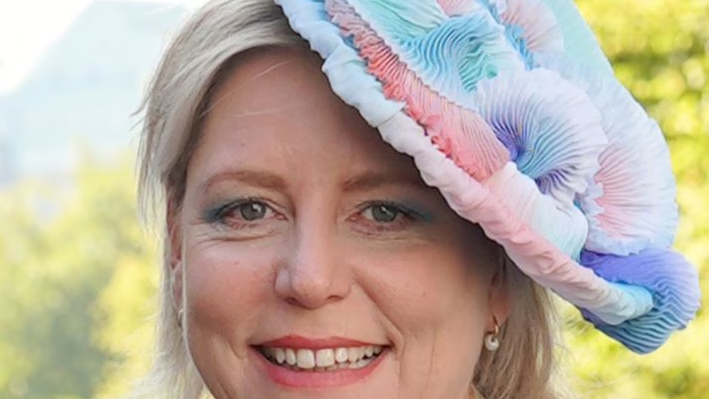
Minister Rianne Letschert wears hat and shoulder ornament inspired by Wim Noorduin’s research

This year at the opening of the parliamentary year (Prinsjesdag) Minister of Education, Culture and Science Rianne Letschert wears a spectacular hat and shoulder ornament. Both of them are inspired by the microscopic structures studied by group leader Wim Noorduin (AMOLF/UvA), which look remarkably like tiny flowers under a microscope. Artist and designer Malou Beemer translated these shapes, normally invisible to the naked eye, into wearable art.

Read news item
Nachi Stern, Group Leader Learning Machines at AMOLF
People and recognition

Nachi Stern awarded ERC Starting Grant to explore how matter learns

Why do brains learn, but rocks do not? Could a material one day adapt to its environment the way a living organism does? AMOLF group leader Dr. Nachi Stern has been awarded an ERC Starting Grant to investigate the physical laws of learning, in a project called, “Physical Learning in Dynamical Systems.”

Read news item
Stay informed

Get the latest research highlights, events, and news from our institute delivered to your inbox