Research highlights

Writing words into smart materials

Researchers at AMOLF, EPFL, and Leiden University have developed a new way to store information in mechanical metamaterials. These are artificial materials that have been engineered to exhibit unique properties. In a paper published in Science Advances on May 6, the team shows how one simple signal can cause a response in multiple mechanical elements (material bits) simultaneously. This extraordinary level of control allows them to write all letters of the alphabet into a mechanical system. The discovery could help create future smart materials, soft robots, and remotely controlled devices.

A mechanical version of computer memory

A ‘material bit’ is a small mechanical element that can exist in two stable positions, similar to the 0s and 1s used in digital computers. In this study, the material bits are tiny flexible rubber beams that can snap either left or right. Snapping to the right holds different information from snapping to the left.

Mechanical systems, built from many of these material bits, can potentially store large amounts of information or change their shape and function when needed. But writing many bits at the same time is difficult. Existing methods often require researchers to control each bit separately.

Controlling bits through motion
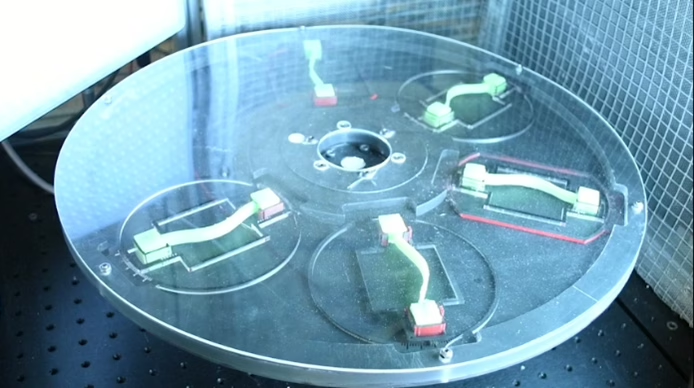
Rubber beams mounted on a platform. The beams respond to speed and acceleration. Credits: AMOLF

To solve this problem, the researchers mounted the rubber beams on a rotating platform. They discovered that the beams respond to two factors: the speed at which the platform spins and the level of acceleration.

By carefully using these two factors, the team could decide exactly which material bits would switch and which would remain unchanged. This required designing an ‘orbit’ in the abstract space of driving protocols. This made it possible to write several bits independently using only one dynamic input instead of many separate controls.

“Our dynamic control paradigm offers a versatile route towards smart, remotely operated devices that can function efficiently across a wide range of physical systems applications, from microfluidics and implants, to smart infrastructure and underwater or medical robotics,” summarizes AMOLF group leader Professor Martin van Hecke.

Writing the alphabet

To demonstrate the system, the researchers built a five-bit mechanical memory device at EPFL in Lausanne. They then designed dynamic input signals that could write all 26 uppercase letters of the alphabet using a standard computer encoding system. In one experiment, the device wrote the word ‘ORBIT’, named after the design.

Information in Matter

One of the essential findings of this research is that the rubber beams store information depending on whether they have snapped or not. This demonstrates that information can be encoded directly in matter. At AMOLF, research groups in the Information in Matter theme are exploring this fascinating phenomenon, in systems ranging from plant-fungal networks to the mechanics of light in a nanophotonic structure.

Learn more

If you have questions about this research, please contact group leader Martin van Hecke. This research has been published in the journal Science Advances: Dynamic drives allow independent control of material’.

Share article
What's happening

Most recent news items

All news items
Collaboration

Successful outcomes of international EBEAM program led by AMOLF

The EU Pathfinder project Electron Beams Enhancing Analytical Microscopy (EBEAM) that was recently completed has received a highly positive review of the European Innovation Council (EIC). EBEAM brought together eight European research institutions and companies, including AMOLF, that develop new concepts and instruments combining spectroscopic analysis with electron microscopy.

Read news item
Research highlights

Everything you need to know about organoids

Organoids are instrumental in improving our understanding of processes that are otherwise hidden inside the body. For instance, these small 3D organs can be used to test medicines on tissue grown from a patient’s own cells. AMOLF researchers carry out unique and complex experiments to follow organoids in time. In order to enable other researchers to benefit from their experiences, they now publish their methods in the prestigious journal Nature Protocols.

Read news item
Events and outreach

Minister Rianne Letschert wears hat and shoulder ornament inspired by Wim Noorduin’s research

This year at the opening of the parliamentary year (Prinsjesdag) Minister of Education, Culture and Science Rianne Letschert wears a spectacular hat and shoulder ornament. Both of them are inspired by the microscopic structures studied by group leader Wim Noorduin (AMOLF/UvA), which look remarkably like tiny flowers under a microscope. Artist and designer Malou Beemer translated these shapes, normally invisible to the naked eye, into wearable art.

Read news item
Nachi Stern, Group Leader Learning Machines at AMOLF
People and recognition

Nachi Stern awarded ERC Starting Grant to explore how matter learns

Why do brains learn, but rocks do not? Could a material one day adapt to its environment the way a living organism does? AMOLF group leader Dr. Nachi Stern has been awarded an ERC Starting Grant to investigate the physical laws of learning, in a project called, “Physical Learning in Dynamical Systems.”

Read news item
Stay informed

Get the latest research highlights, events, and news from our institute delivered to your inbox