About AMOLF

AMOLF receives grant from Sustainable Science Fund

How can we make research at AMOLF more sustainable? One answer to this question is to reduce the amount of liquid nitrogen used for performing experiments. Recently, AMOLF was awarded a grant of 48,760 euro from NWO and the Dutch Climate Research Initiative (KIN) to purchase equipment that will allow the institute to produce gaseous nitrogen in-house. As a result, AMOLF will purchase less liquid nitrogen, which requires a significant amount of energy to produce.

Research institutes often use large amounts of liquid nitrogen, even though for many applications neither the liquid form nor ultra-high purity is required. Turning nitrogen into a liquid is an energy intensive process, as it must be cooled to extremely low temperatures (−196 °C). In addition, the transport and storage of liquid nitrogen require further energy and complex logistics, resulting in a substantial environmental impact.
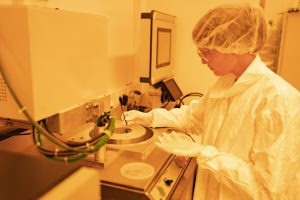
Researcher in the AMOLF NanoLab Amsterdam. Credits: Ivar Pel

Gaseous nitrogen

The project, titled ‘Fit for purpose nitrogen: reducing liquid nitrogen use through local nitrogen generation in research laboratories,’ involves the purchase of equipment to produce gaseous nitrogen from pressurized ambient air. The NanoLab within AMOLF is a strong candidate to launch this project because it uses substantial amounts of liquid nitrogen for its daily operation.  In addition, its infrastructure can be adapted relatively easily. Other labs at AMOLF will continue to use liquid nitrogen where experiments require extremely low temperatures and/or high purity.

From idea to implementation

AMOLF technician Dion Ursem came up with the idea of producing gaseous nitrogen locally. He says: “I’ve had this idea for a while, and the sustainability grant provided the push it needed. Within a short timeframe, I focused on the technical aspects, turning it into something we could properly calculate, validate, and prepare for implementation.”

Christian Niederauer, chair of the AMOLF sustainability workgroup, took the next step and quickly applied for the grant. He recalls that there was only one week left to prepare the proposal. “It worked because everyone immediately got on board at full speed. While Dion and his colleagues focused on the technical calculations and gathering the necessary information, I was able to focus entirely on writing the proposal.”

Sustainable Science Fund

With the call, NWO aims to drive forward ecological sustainability and ensure that researchers can conduct their research with the least possible undesirable impact on the climate, environment and living environment.

To find out more about the Sustainable Science Fund, go to the NWO website.

Share article
What's happening

Most recent news items

All news items
Collaboration

Successful outcomes of international EBEAM program led by AMOLF

The EU Pathfinder project Electron Beams Enhancing Analytical Microscopy (EBEAM) that was recently completed has received a highly positive review of the European Innovation Council (EIC). EBEAM brought together eight European research institutions and companies, including AMOLF, that develop new concepts and instruments combining spectroscopic analysis with electron microscopy.

Read news item
Research highlights

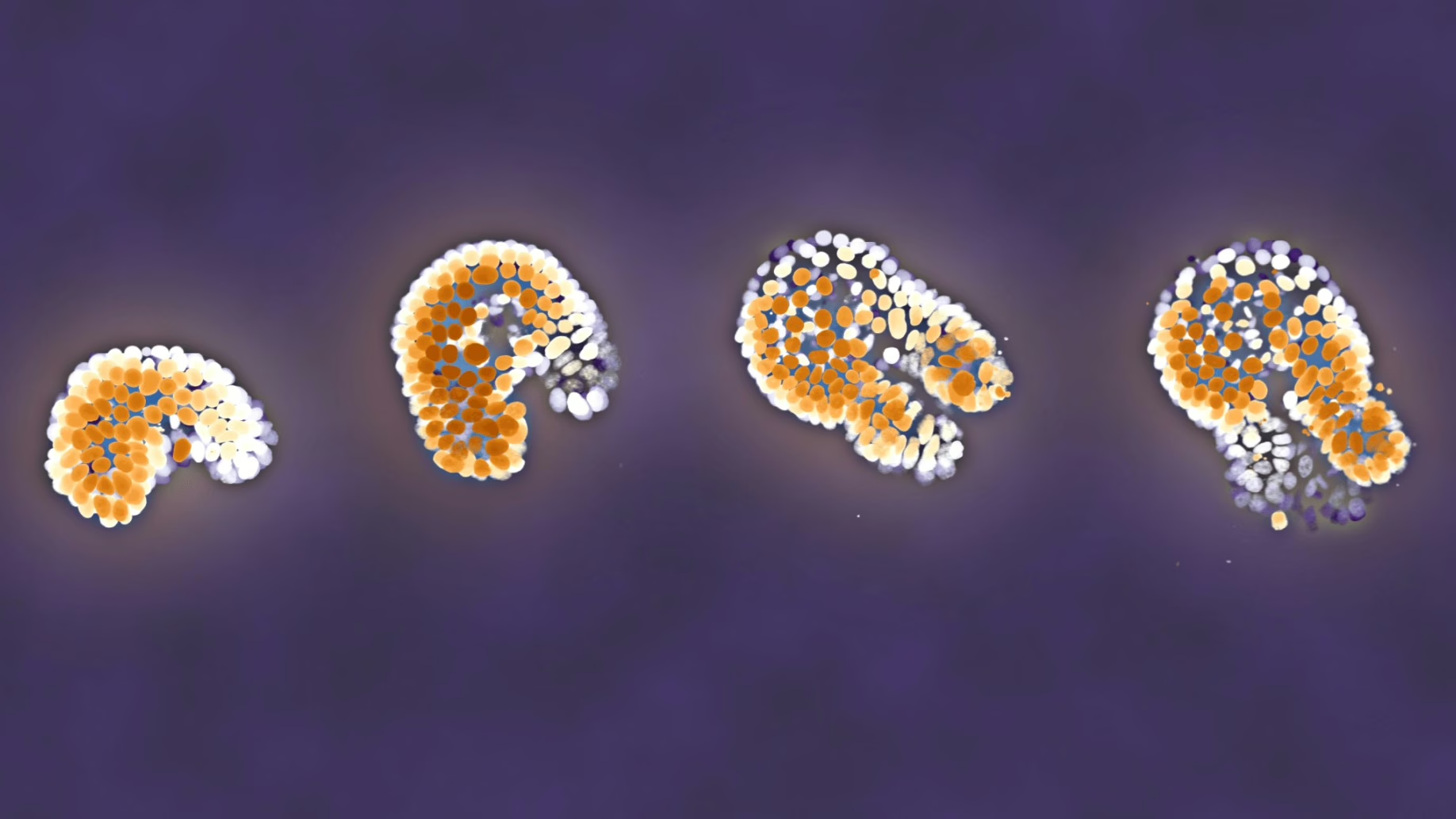
Everything you need to know about organoids

Organoids are instrumental in improving our understanding of processes that are otherwise hidden inside the body. For instance, these small 3D organs can be used to test medicines on tissue grown from a patient’s own cells. AMOLF researchers carry out unique and complex experiments to follow organoids in time. In order to enable other researchers to benefit from their experiences, they now publish their methods in the prestigious journal Nature Protocols.

Read news item
Events and outreach

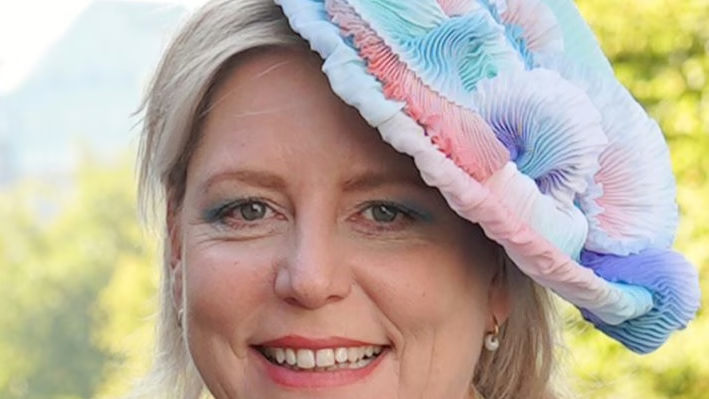
Minister Rianne Letschert wears hat and shoulder ornament inspired by Wim Noorduin’s research

This year at the opening of the parliamentary year (Prinsjesdag) Minister of Education, Culture and Science Rianne Letschert wears a spectacular hat and shoulder ornament. Both of them are inspired by the microscopic structures studied by group leader Wim Noorduin (AMOLF/UvA), which look remarkably like tiny flowers under a microscope. Artist and designer Malou Beemer translated these shapes, normally invisible to the naked eye, into wearable art.

Read news item
Nachi Stern, Group Leader Learning Machines at AMOLF
People and recognition

Nachi Stern awarded ERC Starting Grant to explore how matter learns

Why do brains learn, but rocks do not? Could a material one day adapt to its environment the way a living organism does? AMOLF group leader Dr. Nachi Stern has been awarded an ERC Starting Grant to investigate the physical laws of learning, in a project called, “Physical Learning in Dynamical Systems.”

Read news item
Stay informed

Get the latest research highlights, events, and news from our institute delivered to your inbox