People and recognition

Vici grant for Ewold Verhagen

On February 26th, NWO announced that AMOLF group leader Ewold Verhagen receives a Vici grant to carry out the project Programmable nonlinear optomechanical metamaterials. The budget available for this research project is 1.5 M€. NWO considers the Vici grant as an incentive for adventurous, talented, and groundbreaking researchers.

Programming mechanical machines on a chip with light
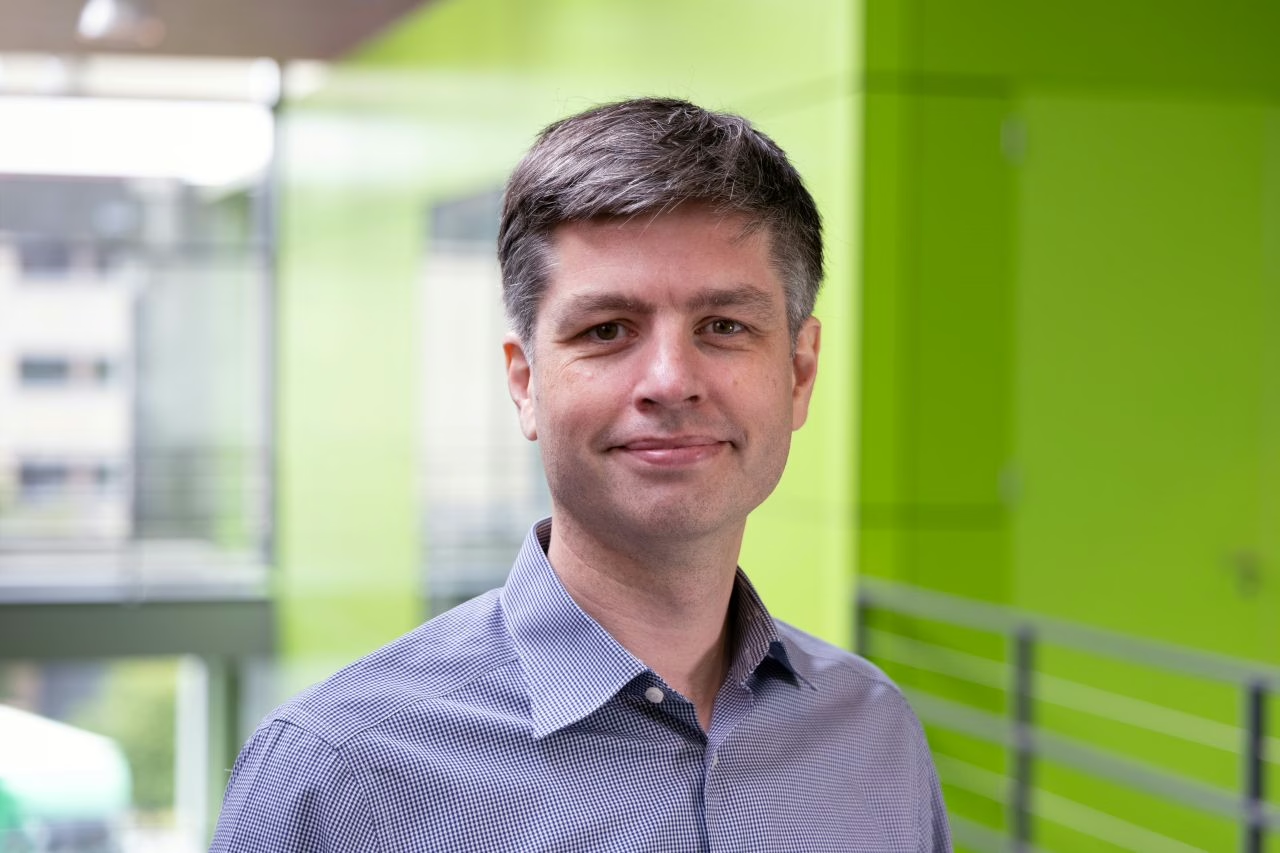
Photonic Forces group leader Ewold Verhagen at AMOLF

With his Photonic Forces team, Ewold will develop so-called optomechanical metamaterials, networks of coupled nanomechanical resonators on a chip that are designed so that light and mechanical motion (vibrations or deformation) strongly interact with each other in ways not normally found in nature.

By programming these optomechanical networks with lasers, the researchers aim to explore new ways to make them behave like miniature sound lasers, microscopic engines, or computing circuits. These form minimal model systems that operate at the fundamental performance bounds, allowing general insight into the working of physical systems and the constraints on their function.

Uncharted territory

It is of particular interest to find out how the performance of such systems depends on structure and symmetry, aiming to discover fundamental design rules. Such insights may inspire new technologies for stable signal generation, nanoscale machines, and unconventional computing methods.

Ewold is looking forward to stepping into such uncharted territory, exploring the fundamental physics of nonlinear networks and leveraging the extreme degree of precision and programmability that optomechanical systems offer.

Vici scheme

The Vici grant is one of the most prestigious grants for senior researchers in the Netherlands. Ewold says: “Receiving it is a great honor, and it feels like recognition for the past work of my team and collaborators. The Vici scheme is unique in enabling research with such an open, explorative aim, with enough focus and mass to really explore a new direction for the group. I am super excited to see where it takes us.”

Learn more

For information about the Programmable nonlinear optomechanical metamaterials project, please contact Ewold Verhagen at E.Verhagen@amolf.nl.

Share article
What's happening

Most recent news items

All news items
Collaboration

Successful outcomes of international EBEAM program led by AMOLF

The EU Pathfinder project Electron Beams Enhancing Analytical Microscopy (EBEAM) that was recently completed has received a highly positive review of the European Innovation Council (EIC). EBEAM brought together eight European research institutions and companies, including AMOLF, that develop new concepts and instruments combining spectroscopic analysis with electron microscopy.

Read news item
Research highlights

Everything you need to know about organoids

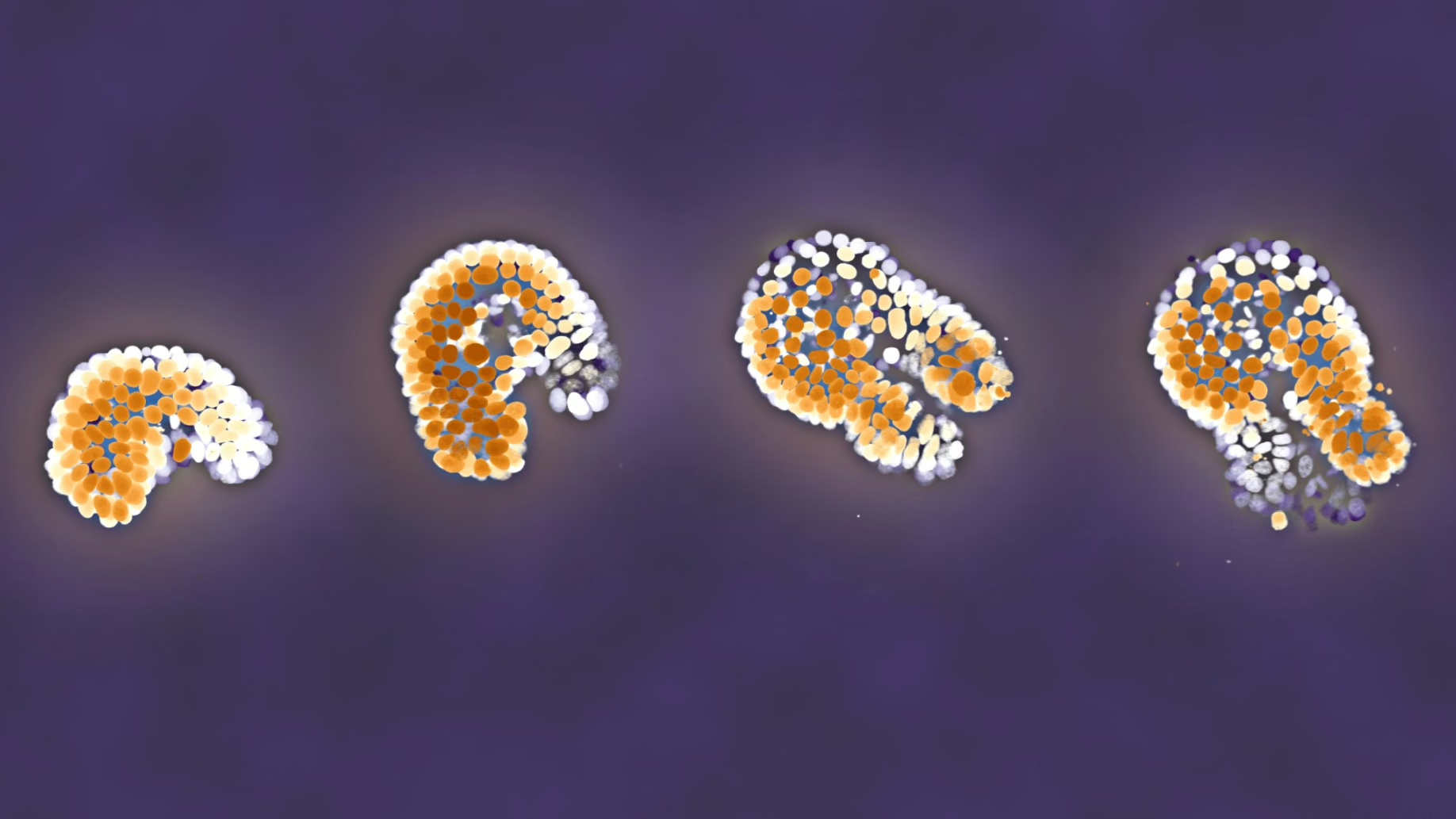
Organoids are instrumental in improving our understanding of processes that are otherwise hidden inside the body. For instance, these small 3D organs can be used to test medicines on tissue grown from a patient’s own cells. AMOLF researchers carry out unique and complex experiments to follow organoids in time. In order to enable other researchers to benefit from their experiences, they now publish their methods in the prestigious journal Nature Protocols.

Read news item
Events and outreach

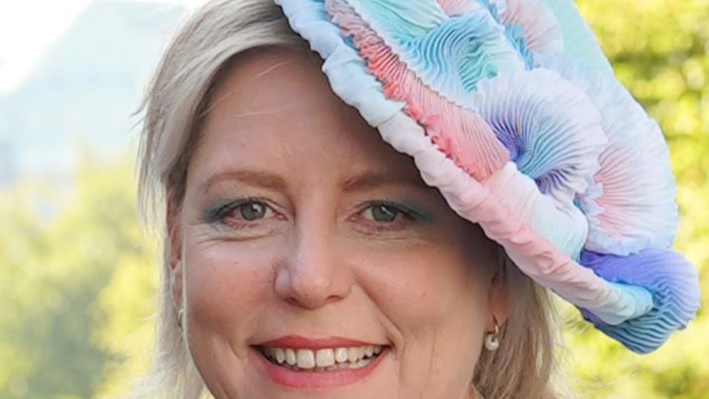
Minister Rianne Letschert wears hat and shoulder ornament inspired by Wim Noorduin’s research

This year at the opening of the parliamentary year (Prinsjesdag) Minister of Education, Culture and Science Rianne Letschert wears a spectacular hat and shoulder ornament. Both of them are inspired by the microscopic structures studied by group leader Wim Noorduin (AMOLF/UvA), which look remarkably like tiny flowers under a microscope. Artist and designer Malou Beemer translated these shapes, normally invisible to the naked eye, into wearable art.

Read news item
Nachi Stern, Group Leader Learning Machines at AMOLF
People and recognition

Nachi Stern awarded ERC Starting Grant to explore how matter learns

Why do brains learn, but rocks do not? Could a material one day adapt to its environment the way a living organism does? AMOLF group leader Dr. Nachi Stern has been awarded an ERC Starting Grant to investigate the physical laws of learning, in a project called, “Physical Learning in Dynamical Systems.”

Read news item
Stay informed

Get the latest research highlights, events, and news from our institute delivered to your inbox