People and recognition

Kevin Peters receives prestigious physics thesis prize

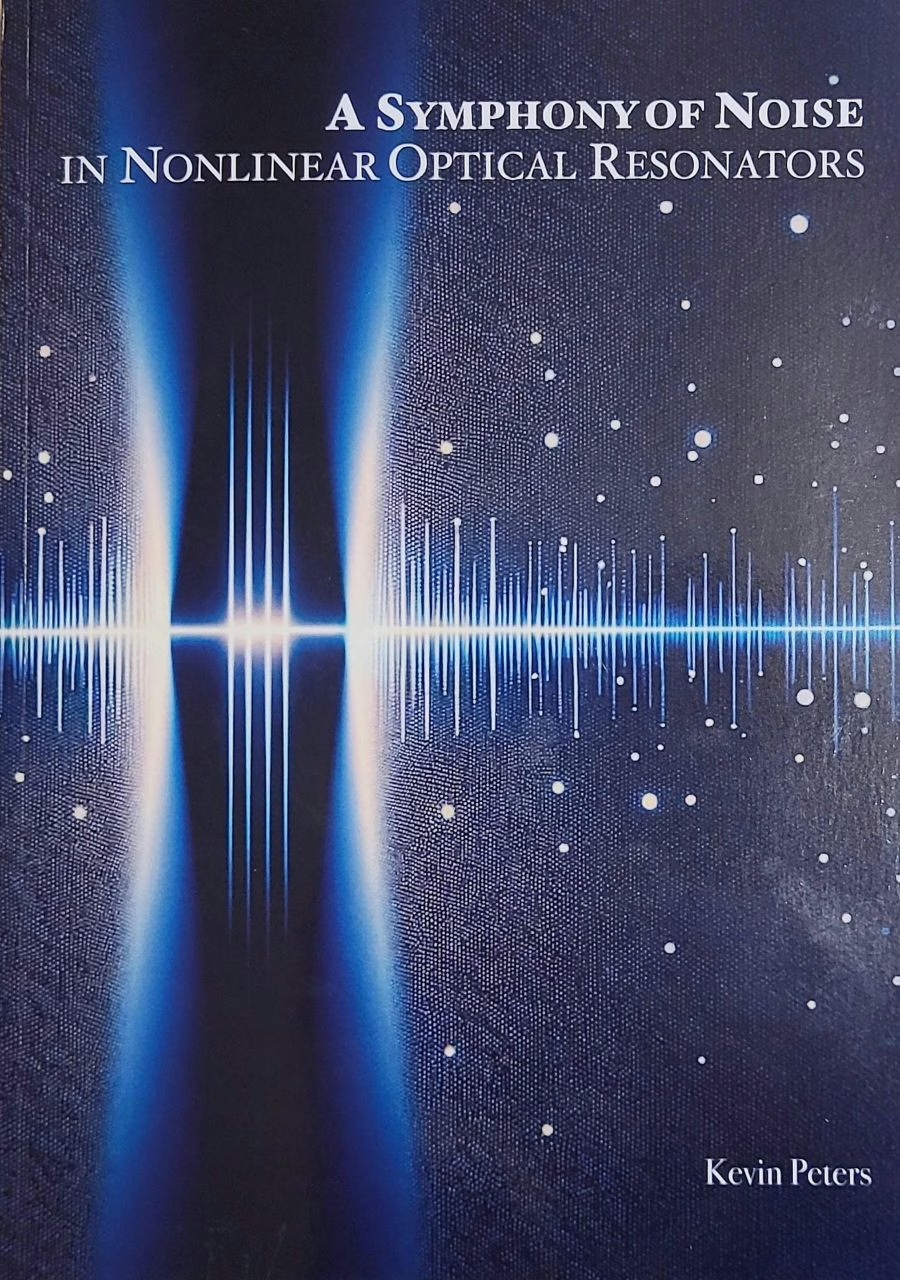
Kevin Peters is the winner of the Ehrenfest-Afanassjewa physics thesis prize 2025. He carried out his research in the group of Said Rodriguez at AMOLF and successfully defended his PhD at Utrecht University on September 4. His thesis, entitled A Symphony of Noise in Nonlinear Optical Resonators, describes his research which combines photonics, nonlinear dynamics, statistical physics, and related fields.

The Ehrenfest-Afanassjewa thesis award
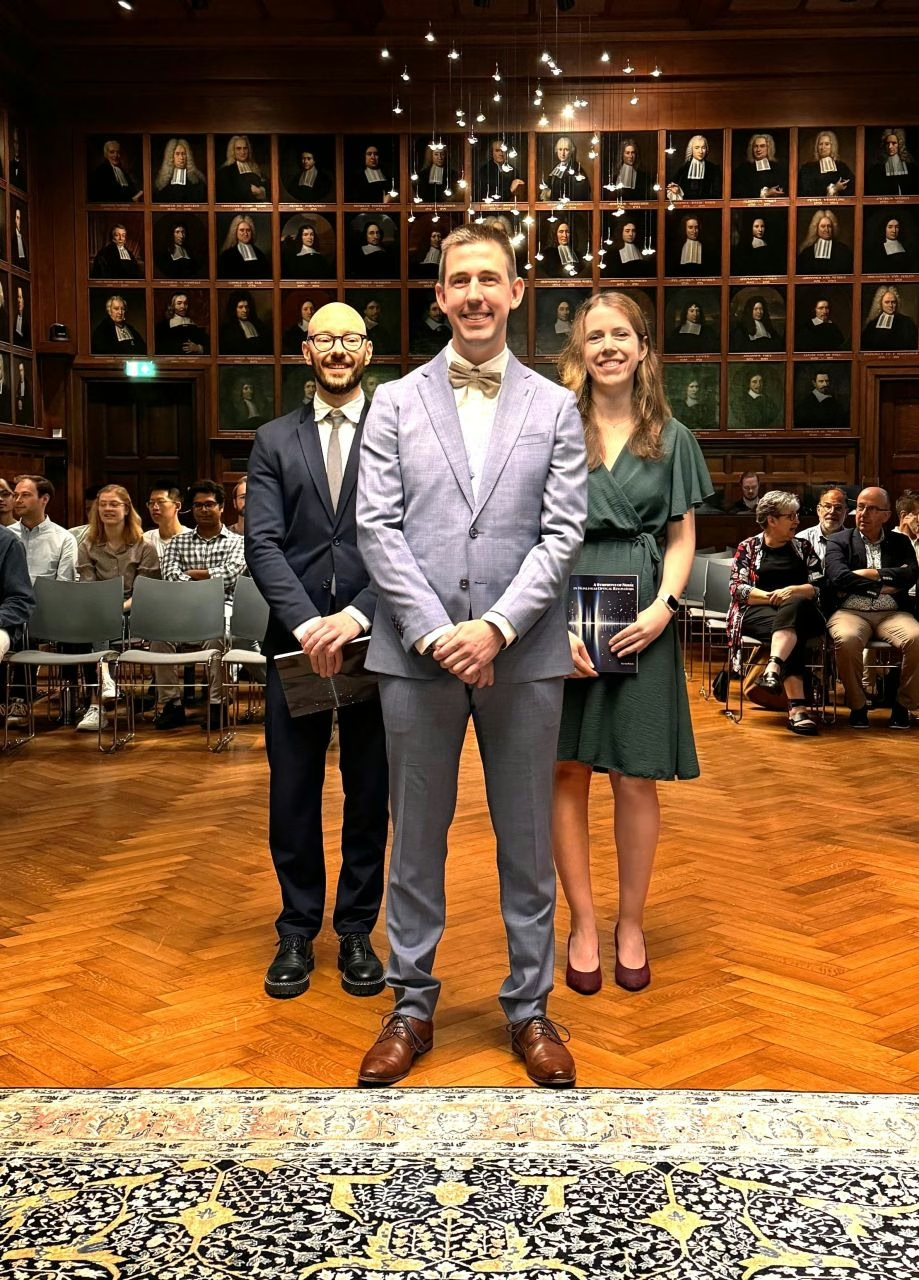
Kevin Peters (center) at PhD ceremony with his paranymphs. Photo source: Kevin Peters

The award is an initiative of the Dutch Physics Council. The award is named after Paul Ehrenfest and Tatiana Afanassjewa because of their exceptional ability to stimulate young researchers to leave the beaten path. Kevin will receive a prize certificate and € 5,000, to be spent freely. The Ehrenfest-Afanassjewa physics thesis award will be awarded during the NWO Physics conference in Veldhoven on 20-21 January 2026.

The jury is very impressed about the combination of experimental work and theory and about the conceptual innovations that Kevin Peters has brought to the research field. The jury recognizes this as exceptional, especially given that he had to build his experimental setup and develop analytical and numerical methods from scratch.

Thesis insights

Multiple new findings and insights are described in Kevin’s thesis. For example, Kevin demonstrated how a wide range of signals can be amplified by adding noise to a system. Kevin first predicted this possibility by solving a novel equation that he derived. In another line of research, Kevin demonstrated an optical sensing strategy that, paradoxically, yields more information by measuring less. In another surprising result, Kevin demonstrated how the precision of a clock can be increased free of energy cost.

Recognition of exceptional research output

Kevin has shown broad vision and came up with original research methods at the crossroads of information theory, nonlinear dynamics, and optics. Many of Kevin’s insights were influenced by his embedding in the Information in Matter department at AMOLF, which motivated him to see his optical systems through the lens of information. Kevin’s numerous results have already reshaped thinking across fields of physics and are truly exceptional. His broad and deep physics knowledge are clearly reflected in his thesis, which consists of a series of relatively short chapters conveying many of his findings.

His thesis also contains a fascinating, extensive (historical) introduction, which is appreciated by the jury. Kevin’s thesis findings have resulted in 13 peer-reviewed publications so far, including 5 in Physical Review Letters.

Learn more

To find out more about research in the Interacting Photons group of Said Rodriguez.
Share article
What's happening

Most recent news items

All news items
Collaboration

Successful outcomes of international EBEAM program led by AMOLF

The EU Pathfinder project Electron Beams Enhancing Analytical Microscopy (EBEAM) that was recently completed has received a highly positive review of the European Innovation Council (EIC). EBEAM brought together eight European research institutions and companies, including AMOLF, that develop new concepts and instruments combining spectroscopic analysis with electron microscopy.

Read news item
Research highlights

Everything you need to know about organoids

Organoids are instrumental in improving our understanding of processes that are otherwise hidden inside the body. For instance, these small 3D organs can be used to test medicines on tissue grown from a patient’s own cells. AMOLF researchers carry out unique and complex experiments to follow organoids in time. In order to enable other researchers to benefit from their experiences, they now publish their methods in the prestigious journal Nature Protocols.

Read news item
Events and outreach

Minister Rianne Letschert wears hat and shoulder ornament inspired by Wim Noorduin’s research

This year at the opening of the parliamentary year (Prinsjesdag) Minister of Education, Culture and Science Rianne Letschert wears a spectacular hat and shoulder ornament. Both of them are inspired by the microscopic structures studied by group leader Wim Noorduin (AMOLF/UvA), which look remarkably like tiny flowers under a microscope. Artist and designer Malou Beemer translated these shapes, normally invisible to the naked eye, into wearable art.

Read news item
Nachi Stern, Group Leader Learning Machines at AMOLF
People and recognition

Nachi Stern awarded ERC Starting Grant to explore how matter learns

Why do brains learn, but rocks do not? Could a material one day adapt to its environment the way a living organism does? AMOLF group leader Dr. Nachi Stern has been awarded an ERC Starting Grant to investigate the physical laws of learning, in a project called, “Physical Learning in Dynamical Systems.”

Read news item
Stay informed

Get the latest research highlights, events, and news from our institute delivered to your inbox