Research highlights

Soft robots that remember

Alberto Comoretto and his colleagues in the Soft Robotic Matter group at AMOLF have created soft robots that can remember past events – without using computers or electronics. Instead, their memory is built into the robot’s flexible body. The researchers published their paper in the Cell press journal Device, and the robot was even featured on the cover of this journal.

Soft robotic design

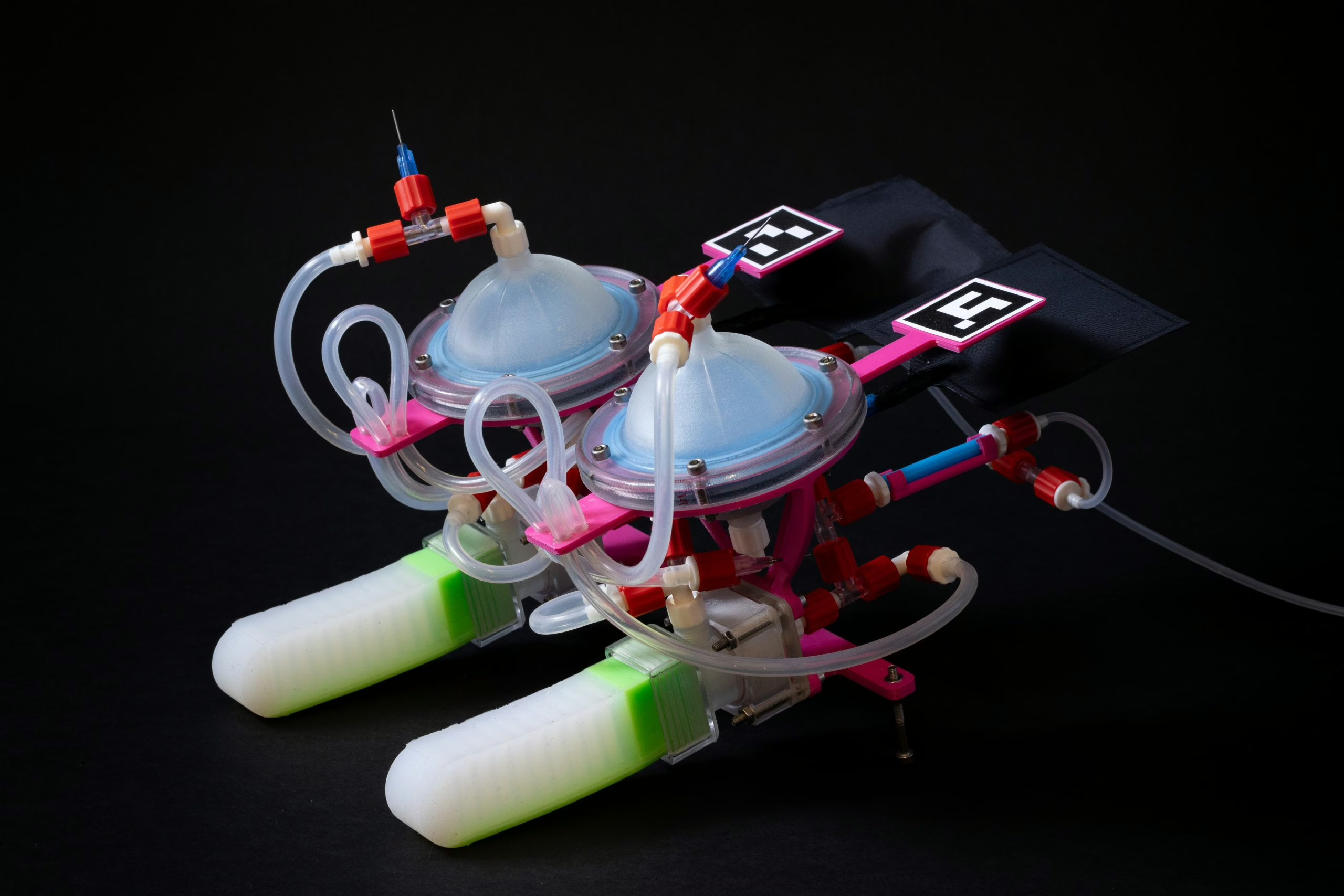
The team, led by Bas Overvelde, designed machines powered by air and made of soft materials. At their core is a small elastic shell that can snap between two shapes, allowing the robot to ‘store’ information. When touched or bumped, the shell changes shape, altering how air flows inside the robot and how it moves.

By adding soft antennae that kink when they touch something, the researchers enabled the robots to sense and respond to their surroundings. For example, when one of these robots hits a wall, it changes direction on its own – remembering the obstacle for next time.

This soft fluidic robot without electronics detects obstacles placed on its course and “remembers” their presence by steering away, thanks to the mechanical memory embodied in its structure.

Inspiration

Bas reflects on how it all started: “We were fascinated by the mechanics of the popular popping dome toy –  how it stores energy in one shape and releases it when it snaps. That simple idea became the foundation for our robots’ memory: information encoded directly in their structure and shape, not in electronics.”

These designs could lead to autonomous materials and machines that are simple, robust, and capable of exploring environments where traditional robots cannot go.

Learn more

If you have questions about this research, please contact Bas Overvelde (email: b.overvelde@amolf.nl).

This paper was published in Device by Cell Press: Embodying mechano-fluidic memory in soft machines to program behaviors upon interactions by Alberto Comoretto, Stijn Koppen, Tanaya Mandke, Bas Overvelde.
Read the full paper

Share article
What's happening

Most recent news items

All news items
Joining forces to study perovskite interfaces
People and recognition

Joining forces to study perovskite interfaces

AMOLF group leaders Professor Wiebke Albrecht and Professor Bruno Ehrler have received an NWO ENW-M2 grant for their joint research project, The Dynamic Atomic Interface between Halide Perovskites and Metals. The insights gained will pave the way for sustainable, high-performance solar energy and information technology. Wiebke and Bruno will each hire a PhD student for this project. The grant amounts to €800.000.

Read news item
Wim Noorduin and Arian van Asten presenting their scientific journey
People and recognition

Wim Noorduin and Arian van Asten presenting their scientific journey

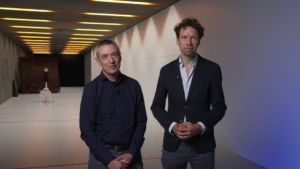
On October 8, Professor Wim Noorduin and his collaborator Professor Arian van Asten (University of Amsterdam) presented their scientific journey in a video to the audience at the ‘Avond van Wetenschap en Maatschappij’. They did so alongside the other nominees for the Huibregtsen Prize.

Read news item
Natural phenomena ‘hyperuniform disorder’ enables highly efficient, thin silicon solar cells
Research highlights

Natural phenomena ‘hyperuniform disorder’ enables highly efficient, thin silicon solar cells

Silicon solar panels are rigid and heavy, and many rooftops cannot support them. This creates a need for thin, flexible solar cells that can be integrated into building materials. However, making silicon solar cells thinner makes it harder to trap light inside the material. Researchers in the 3D Photovoltaics group found a fascinating way to overcome this challenge using a phenomenon called hyperuniform disorder. They publish their findings in the journal ACS Photonics.

The researchers were able to make highly efficient silicon solar cell materials that are 30 times thinner than conventional ones. They managed to do this by integrating a layer of nanometer sized structures on top of the material. Up close, this pattern looks random, but it is remarkably when you step back: no clumps, no gaps, and no repeating pattern. This is called hyperuniform disorder (or HUD).

Read news item
Stay informed

Get the latest research highlights, events, and news from our institute delivered to your inbox