Research highlights

Cathodoluminescence research advances measurements of light matter interactions

Researchers in the Photonic Materials group have published their latest findings using cathodoluminescence techniques to measure free electrons moving along a metal surface. The paper ‘Angle-resolved cathodoluminescence interferometry of plasmonic and dielectric scatterers’ is published in the journal Nano Letters on September 18th. The technique can be used for more precise measurements that will benefit computer chip production.

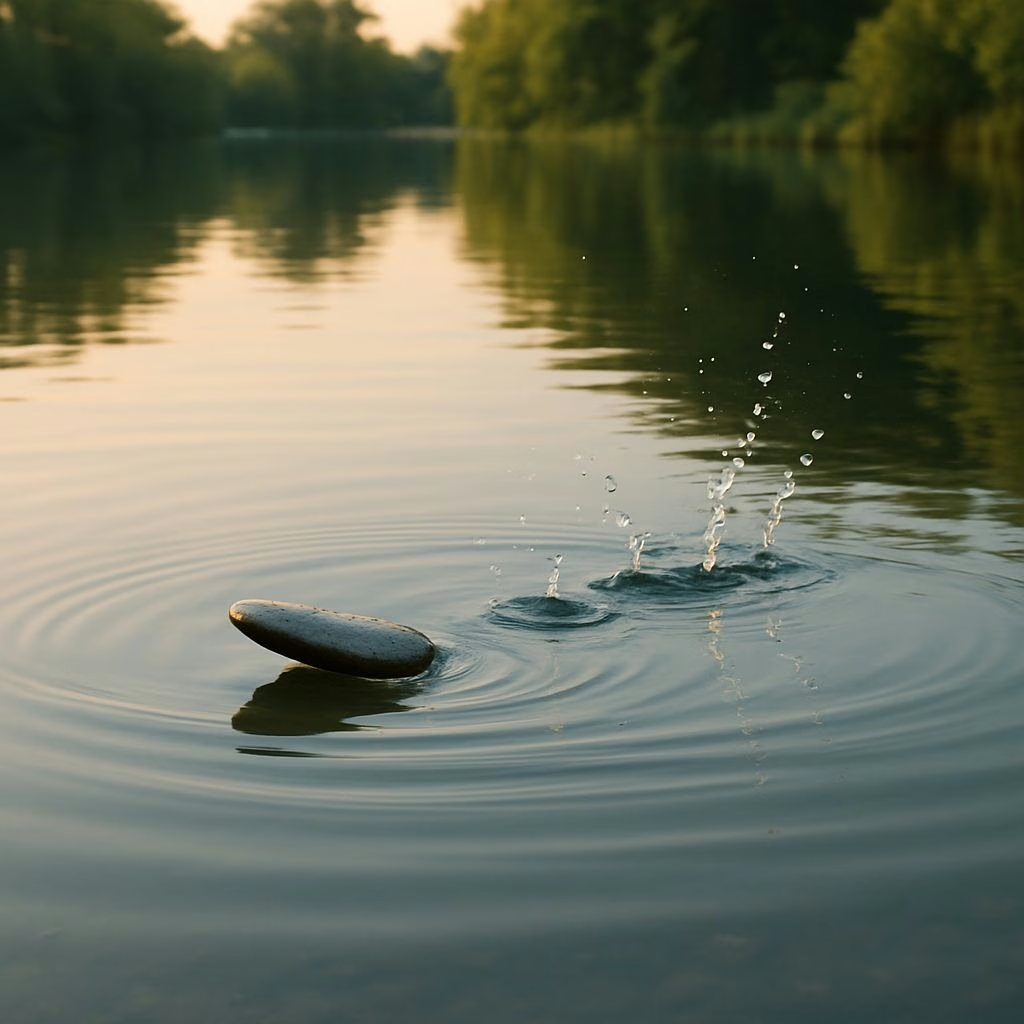
Skipping a stone across a calm pond creates waves that spreads outwards, similar to how electrons launch spherical light waves (image: ChatGPT)

Inspiration 

Imagine skipping a stone across a calm pond. Each time the stone hits the water, it creates a wave that spreads outwards. As those waves overlap, they interfere, sometimes amplifying each other, sometimes cancelling out. They create a beautiful, complex pattern on the water. 

First author Evelijn Akerboom: “In our recent work, we recreate this phenomenon, but a million times smaller using, electrons and light.” 

Cathodoluminescence technique 

“We use a technique called cathodoluminescence: where light is emitted when a material is struck by an electron inside the scanning electron microscope (SEM). While SEMs are traditionally used to image very small objects, cathodoluminescence allows us to study how these objects interact with light with a high resolution.” 

In this project, we investigate cathodoluminescence interferometry where the electron plays the role of the skipping stone.  As it flies by a metallic tip, it launches a spherical light wave. A moment later, it interacts with the gold surface below, launching a second wave. Just like ripples on a pond, these light waves meet and interfere. The resulting interference pattern contains valuable information.  
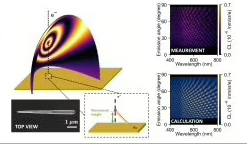
artistic impression of the scientific work with on the right measurement graphs.
On the left a schematic representation of cathodoluminescence interferometry. The electron passes by a gold nanopillar, and later reaches the gold surface. On both occasions spherical light waves are emitted that interfere in the far field. The researchers use a parabolic mirror to collect the light, where they see the beautiful interference from the two sources. On the right: experimental measurements and simulations of this effect.

What to measure? 

Evelijn says: “By carefully analyzing the spacing of the fringes, we measure the distance between two objects very precisely. Also, we can measure how long the electron takes to travel between interaction points. In other words, the time-of-flight of a single electron on the femtosecond timescale.” 

Application 

While much of this work addresses fundamental questions about electron–light-matter interactions, it also has practical applications. For example, in semiconductor manufacturing, a chip’s quality can suffer from tiny misalignments during fabrication. Evelijn: “Our technique opens new applications for more precise 3D nanoscale measurements during fabrication, helping ensure better chip performance. Turning an i3 into an i7, so to speak.” 

To read more details about these findings, read the NanoLetters publication: 

Reference

Evelijn Akerboom, Hiroshi Sugimoto, Minoru Fujii, F. Javier García de Abajo, Albert Polman, Angle-Resolved Cathodoluminescence Interferometry of Plasmonic and Dielectric Scatterers, September 18 (2025).
doi.org/10.1021/acs.nanolett.5c02952

Share article
What's happening

Most recent news items

All news items
Collaboration

Successful outcomes of international EBEAM program led by AMOLF

The EU Pathfinder project Electron Beams Enhancing Analytical Microscopy (EBEAM) that was recently completed has received a highly positive review of the European Innovation Council (EIC). EBEAM brought together eight European research institutions and companies, including AMOLF, that develop new concepts and instruments combining spectroscopic analysis with electron microscopy.

Read news item
Research highlights

Everything you need to know about organoids

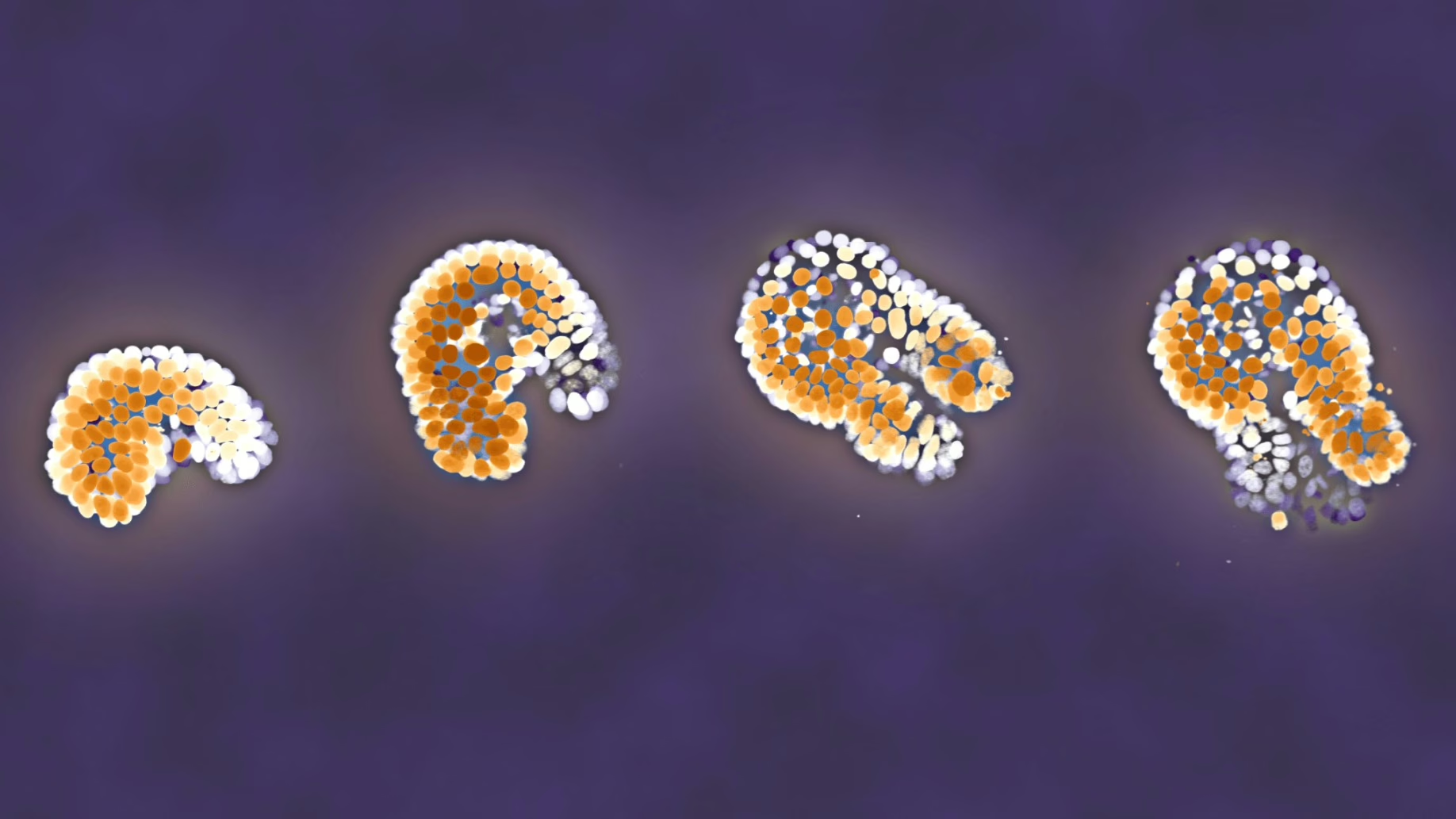
Organoids are instrumental in improving our understanding of processes that are otherwise hidden inside the body. For instance, these small 3D organs can be used to test medicines on tissue grown from a patient’s own cells. AMOLF researchers carry out unique and complex experiments to follow organoids in time. In order to enable other researchers to benefit from their experiences, they now publish their methods in the prestigious journal Nature Protocols.

Read news item
Events and outreach

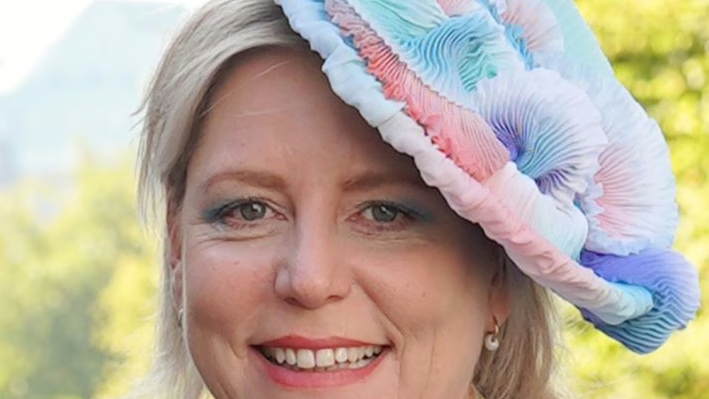
Minister Rianne Letschert wears hat and shoulder ornament inspired by Wim Noorduin’s research

This year at the opening of the parliamentary year (Prinsjesdag) Minister of Education, Culture and Science Rianne Letschert wears a spectacular hat and shoulder ornament. Both of them are inspired by the microscopic structures studied by group leader Wim Noorduin (AMOLF/UvA), which look remarkably like tiny flowers under a microscope. Artist and designer Malou Beemer translated these shapes, normally invisible to the naked eye, into wearable art.

Read news item
Nachi Stern, Group Leader Learning Machines at AMOLF
People and recognition

Nachi Stern awarded ERC Starting Grant to explore how matter learns

Why do brains learn, but rocks do not? Could a material one day adapt to its environment the way a living organism does? AMOLF group leader Dr. Nachi Stern has been awarded an ERC Starting Grant to investigate the physical laws of learning, in a project called, “Physical Learning in Dynamical Systems.”

Read news item
Stay informed

Get the latest research highlights, events, and news from our institute delivered to your inbox