Research highlights

Light controls sound in a nanoscale ‘quantum Hall’ metamaterial

AMOLF group leader Ewold Verhagen and his fellow researchers have taken a major step in creating new forms of materials that make sound waves behave in extraordinary ways. In their recent publication in Nature Communications, the researchers demonstrate how light can be used to make sound travel only in one direction through a nanomechanical network – a breakthrough inspired by one of the most celebrated effects in physics, the quantum Hall effect. This opens the door to many more surprising physical effects still waiting to be explored.

A one-way street for sound

In everyday life, sound travels freely in all directions, bouncing and scattering off obstacles. But the team engineered a nanoscale network of tiny vibrating structures where this rule no longer applies: sound energy moves along the edges in one direction only, as if on a protected one-way street. This behavior is strikingly similar to how electrons move under a magnetic field in the quantum Hall effect, a discovery that earned a Nobel Prize in 1985. The “Hall” in Hall effect refers to Edwin Hall, an American physicist who discovered the classical Hall effect in 1879.

How it works

Instead of using magnets, the researchers harnessed laser light to create ‘synthetic magnetic fields’ that influence vibrations of the nanostructures. By carefully programming the light, they can design how sound waves propagate through the network. Remarkably, this allows them not only to reproduce the hallmarks of quantum Hall physics with sound, but also to reconfigure the system on demand – exploring patterns and effects that are impossible in natural materials.
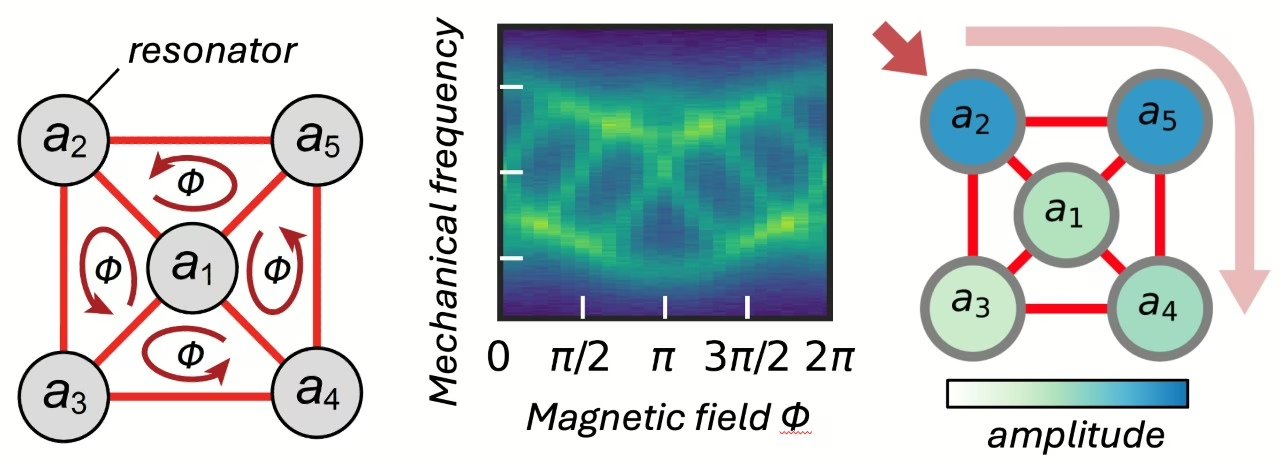
Left: light connects nanomechanical resonators into quantum Hall networks. Middle: a programmed effective magnetic field controls the mechanical frequencies of the network. Right: sound (mechanical vibrations) flow around the edge of the network in only one direction.

Why it matters

While this achievement is primarily a fundamental advance, it points to several interesting application possibilities. Unidirectional sound channels could improve how we manage noise at the nanoscale, enable robust information transfer in nanoscale and quantum devices, and inspire entirely new ways to process signals. Because the system is programmable, it provides a powerful ‘testbed’ for exploring novel phases of matter engineered by light, and how those could impact functionalities like information routing and sensing.

Developing over the years

This achievement builds on more than a decade of research. Ten years ago, theorists proposed that sound vibrations in nanomechanical resonators could mimic the behavior of electrons in the quantum Hall effect, provided that light could be used to break the usual symmetry of time like a magnetic field does for electrons. Over the years, smaller networks confirmed parts of this idea. But only now have the AMOLF researchers been able to scale up to larger lattices, where the interplay of many ‘magnetic building blocks’ finally reveals the characteristic signatures of quantum Hall physics: sound waves moving only along the edges of the network in a single direction.

Would you like to read the Nature Communications publication? Then, click here: Programmable synthetic magnetism and chiral edge states in nano-optomechanical quantum Hall networks?

Reference:

J.J. Slim, J. del Pino and E. Verhagen, Programmable synthetic magnetism and chiral edge states in nano-optomechanical quantum Hall networks, Nature Communications, 16, 7471: 1- 11, 12-8 (2025).

Read the article via the DOI-link

Share article
What's happening

Most recent news items

All news items
Collaboration

Successful outcomes of international EBEAM program led by AMOLF

The EU Pathfinder project Electron Beams Enhancing Analytical Microscopy (EBEAM) that was recently completed has received a highly positive review of the European Innovation Council (EIC). EBEAM brought together eight European research institutions and companies, including AMOLF, that develop new concepts and instruments combining spectroscopic analysis with electron microscopy.

Read news item
Research highlights

Everything you need to know about organoids

Organoids are instrumental in improving our understanding of processes that are otherwise hidden inside the body. For instance, these small 3D organs can be used to test medicines on tissue grown from a patient’s own cells. AMOLF researchers carry out unique and complex experiments to follow organoids in time. In order to enable other researchers to benefit from their experiences, they now publish their methods in the prestigious journal Nature Protocols.

Read news item
Events and outreach

Minister Rianne Letschert wears hat and shoulder ornament inspired by Wim Noorduin’s research

This year at the opening of the parliamentary year (Prinsjesdag) Minister of Education, Culture and Science Rianne Letschert wears a spectacular hat and shoulder ornament. Both of them are inspired by the microscopic structures studied by group leader Wim Noorduin (AMOLF/UvA), which look remarkably like tiny flowers under a microscope. Artist and designer Malou Beemer translated these shapes, normally invisible to the naked eye, into wearable art.

Read news item
Nachi Stern, Group Leader Learning Machines at AMOLF
People and recognition

Nachi Stern awarded ERC Starting Grant to explore how matter learns

Why do brains learn, but rocks do not? Could a material one day adapt to its environment the way a living organism does? AMOLF group leader Dr. Nachi Stern has been awarded an ERC Starting Grant to investigate the physical laws of learning, in a project called, “Physical Learning in Dynamical Systems.”

Read news item
Stay informed

Get the latest research highlights, events, and news from our institute delivered to your inbox