Research highlights

Optimizing bit-by-bit operations for energy-efficient computing

How can we make computing more energy-efficient when nature itself introduces randomness at every step? At the intersection of physics and information science, researchers from AMOLF and Imperial College London explore how thermal noise interferes with the physical switching of bits in computing devices. Their new work, published in Physical Review E, reveals that how we measure these state changes can make a surprising difference in designing the most efficient computational protocols.

Thermal noise and a bit of a challenge 
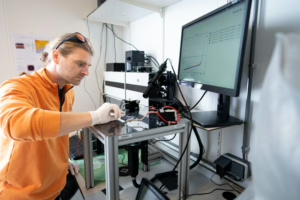
Daan Mulder at AMOLF

Temperature is an indication of random movement on the molecular level. This random movement, or thermal noise, affects the way the molecular systems in materials change from one state to another. For example, for the physical bits in your computer to turn on and off, these systems need to change states. But because thermal noise pushes the bits around, they might go back-and-forth before reaching their final state. This can be hard to control in an energy-efficient way, a challenge which interests many scientists and developers in the field of computation.  

Measuring a journey in jumps 

In trying to optimize noisy bit transitions, researchers at AMOLF and Imperial College London looked at how the duration of a state transition is measured. You could measure the duration in terms of time, but you could also look at the process in terms of how many back-and-forth steps, or “jumps,” it takes to reach the final state. The total number of jumps is also called the total activity in the system.  

It turns out that, mathematically, measuring in jumps is much simpler. However, as Daan Mulder, Thomas E. Ouldridge and Pieter Rein ten Wolde show in their paper in Physical Review E, you get different results for the most efficient protocol for resetting a bit state when measuring in terms of these two different variables. To get the most energy-efficient protocol for a given duration, you still need to do the harder, time-based math. The activity-based approach can be a good approximation, but only in some cases. This finding contributes to our understanding of how to best manipulate materials for energy-efficient computation.  

Reference 

Daan Mulder, Thomas E. Ouldridge, Pieter Rein ten Wolde, “Bit reset protocols that obey activity-constrained speed limits do not minimize work for a given speed,” Physical Review E 111, 044141, 29 April (2025). 

Read the full article: https://doi.org/10.1103/PhysRevE.111.044141

 

Share article
What's happening

Most recent news items

All news items
Joining forces to study perovskite interfaces
People and recognition

Joining forces to study perovskite interfaces

AMOLF group leaders Professor Wiebke Albrecht and Professor Bruno Ehrler have received an NWO ENW-M2 grant for their joint research project, The Dynamic Atomic Interface between Halide Perovskites and Metals. The insights gained will pave the way for sustainable, high-performance solar energy and information technology. Wiebke and Bruno will each hire a PhD student for this project. The grant amounts to €800.000.

Read news item
Wim Noorduin and Arian van Asten presenting their scientific journey
People and recognition

Wim Noorduin and Arian van Asten presenting their scientific journey

On October 8, Professor Wim Noorduin and his collaborator Professor Arian van Asten (University of Amsterdam) presented their scientific journey in a video to the audience at the ‘Avond van Wetenschap en Maatschappij’. They did so alongside the other nominees for the Huibregtsen Prize.

Read news item
Natural phenomena ‘hyperuniform disorder’ enables highly efficient, thin silicon solar cells
Research highlights

Natural phenomena ‘hyperuniform disorder’ enables highly efficient, thin silicon solar cells

Silicon solar panels are rigid and heavy, and many rooftops cannot support them. This creates a need for thin, flexible solar cells that can be integrated into building materials. However, making silicon solar cells thinner makes it harder to trap light inside the material. Researchers in the 3D Photovoltaics group found a fascinating way to overcome this challenge using a phenomenon called hyperuniform disorder. They publish their findings in the journal ACS Photonics.

The researchers were able to make highly efficient silicon solar cell materials that are 30 times thinner than conventional ones. They managed to do this by integrating a layer of nanometer sized structures on top of the material. Up close, this pattern looks random, but it is remarkably when you step back: no clumps, no gaps, and no repeating pattern. This is called hyperuniform disorder (or HUD).

Read news item
Stay informed

Get the latest research highlights, events, and news from our institute delivered to your inbox