About AMOLF

Climate envoy visits AMOLF to learn how fungal networks contribute to CO2 drawdown and storage underground 

On January 8th, a delegation led by the Netherlands’ Climate Envoy, Jaime de Bourbon de Parme, visited the AMOLF lab of Tom Shimizu. Researchers in Tom’s group are developing new robotic imaging technologies to study fungal networks. Over the past few years, Tom and his collaborator Toby Kiers from Vrije Universiteit Amsterdam and The Society for the Protection of Underground Networks (SPUN) have made significant progress in understanding how these networks function.  

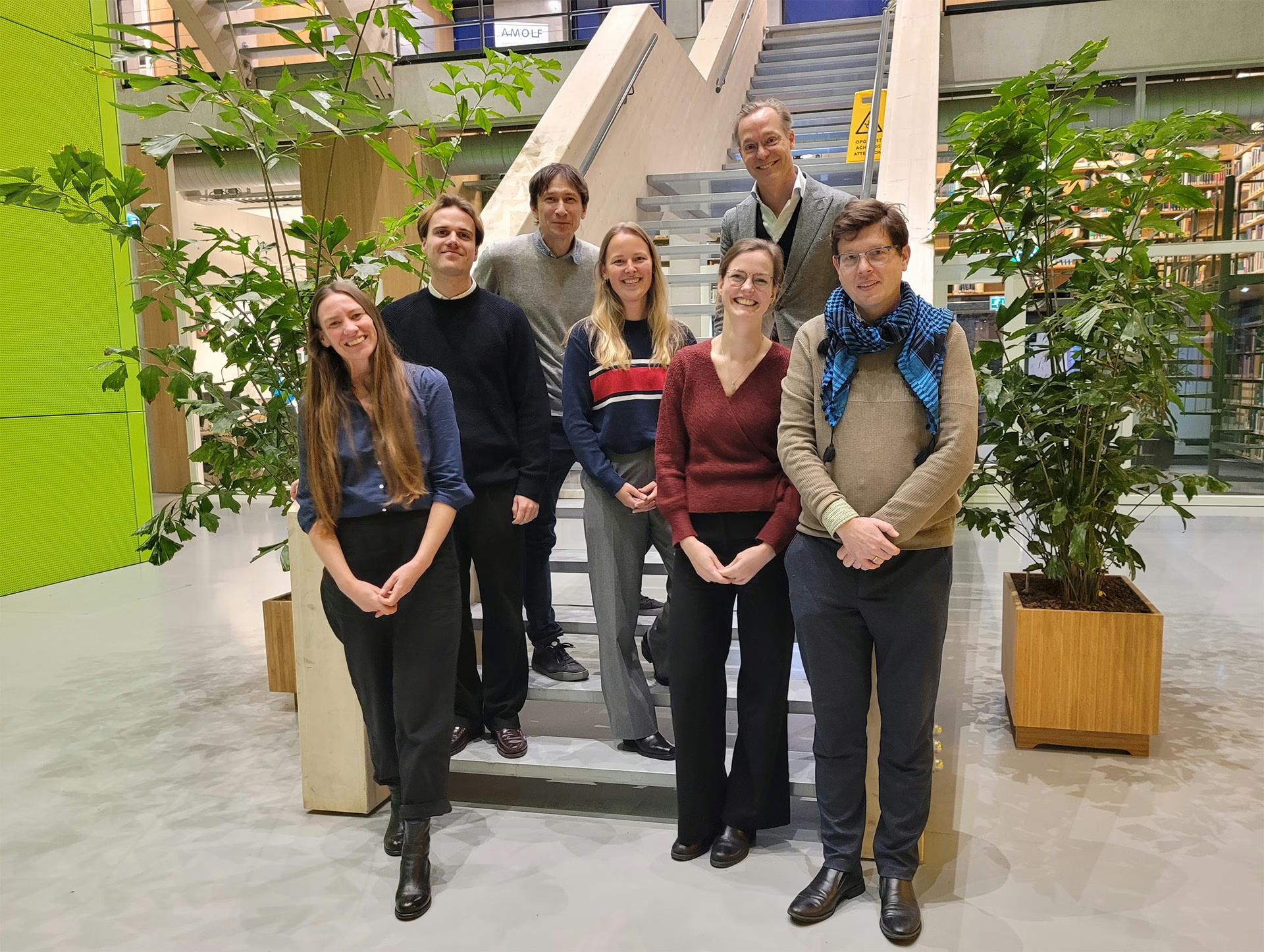
Climate envoy Jaime de Bourbon de Parme with his delegation, together with AMOLF/VU researchers.

Protecting underground fungal networks is one of the measures we can take to help control CO2 levels in the atmosphere. These microbes interact with plant roots underground to form an extensive network of nutrient exchange and transport. A key part of this underground system involves transferring carbon from plant roots into the soil through fungal networks. Healthy fungal networks can play a critical role in controlling rising CO2 levels, as the carbon they transport into the soil remains there longer compared to other sources, such as decomposed leaves. 

When asked for a first impression, Jaime de Bourbon de Parme expressed excitement that researchers in the Netherlands are playing a world-leading role in pioneering this new field of climate-relevant research. Upon live demonstrations of fungal nutrient flows in the AMOLF lab, he also expressed surprise at the complexity of fungal behaviors. “I didn’t realize how complex and dynamic these underground organisms are. It’s an unknown world with big implications for global climate.”  

To get a sense of how nutrients are transported in fungal networks, click on this video with real-time footage of carbon flows in fungi, acquired on microscopy set-ups in the AMOLF lab:  

More information about this research group?

[button type=”readmore” url=”https://amolf.nl/research-groups/physics-of-behavior/”]Visit the Physics of Behavior Research Group page[/button]

Share article
What's happening

Most recent news items

All news items
Collaboration

Successful outcomes of international EBEAM program led by AMOLF

The EU Pathfinder project Electron Beams Enhancing Analytical Microscopy (EBEAM) that was recently completed has received a highly positive review of the European Innovation Council (EIC). EBEAM brought together eight European research institutions and companies, including AMOLF, that develop new concepts and instruments combining spectroscopic analysis with electron microscopy.

Read news item
Research highlights

Everything you need to know about organoids

Organoids are instrumental in improving our understanding of processes that are otherwise hidden inside the body. For instance, these small 3D organs can be used to test medicines on tissue grown from a patient’s own cells. AMOLF researchers carry out unique and complex experiments to follow organoids in time. In order to enable other researchers to benefit from their experiences, they now publish their methods in the prestigious journal Nature Protocols.

Read news item
Events and outreach

Minister Rianne Letschert wears hat and shoulder ornament inspired by Wim Noorduin’s research

This year at the opening of the parliamentary year (Prinsjesdag) Minister of Education, Culture and Science Rianne Letschert wears a spectacular hat and shoulder ornament. Both of them are inspired by the microscopic structures studied by group leader Wim Noorduin (AMOLF/UvA), which look remarkably like tiny flowers under a microscope. Artist and designer Malou Beemer translated these shapes, normally invisible to the naked eye, into wearable art.

Read news item
Nachi Stern, Group Leader Learning Machines at AMOLF
People and recognition

Nachi Stern awarded ERC Starting Grant to explore how matter learns

Why do brains learn, but rocks do not? Could a material one day adapt to its environment the way a living organism does? AMOLF group leader Dr. Nachi Stern has been awarded an ERC Starting Grant to investigate the physical laws of learning, in a project called, “Physical Learning in Dynamical Systems.”

Read news item
Stay informed

Get the latest research highlights, events, and news from our institute delivered to your inbox