The EQUSPACE (Enabling New Quantum Frontiers with Spin Acoustics in Silicon) project has the ambitious goal to ensure a complete silicon-based quantum information system. This four-year endeavor has been awarded 3.2 million euros from the European Innovation Council’s (EIC) Pathfinder Open funding program. This program supports visionary research teams in developing the scientific basis for breakthrough technologies. The funding is part of the Horizon Europe funding program. The project starts on 1 February 2025.

Expanding the international ecosystem of the quantum industry
The project develops a technology platform that utilizes quantum bits based on impurity atoms implanted in silicon. The focus will be on developing scalable methods for reading these “silicon qubits” by utilizing commercial quantum dots and connecting them to each other using nanomechanical resonators.
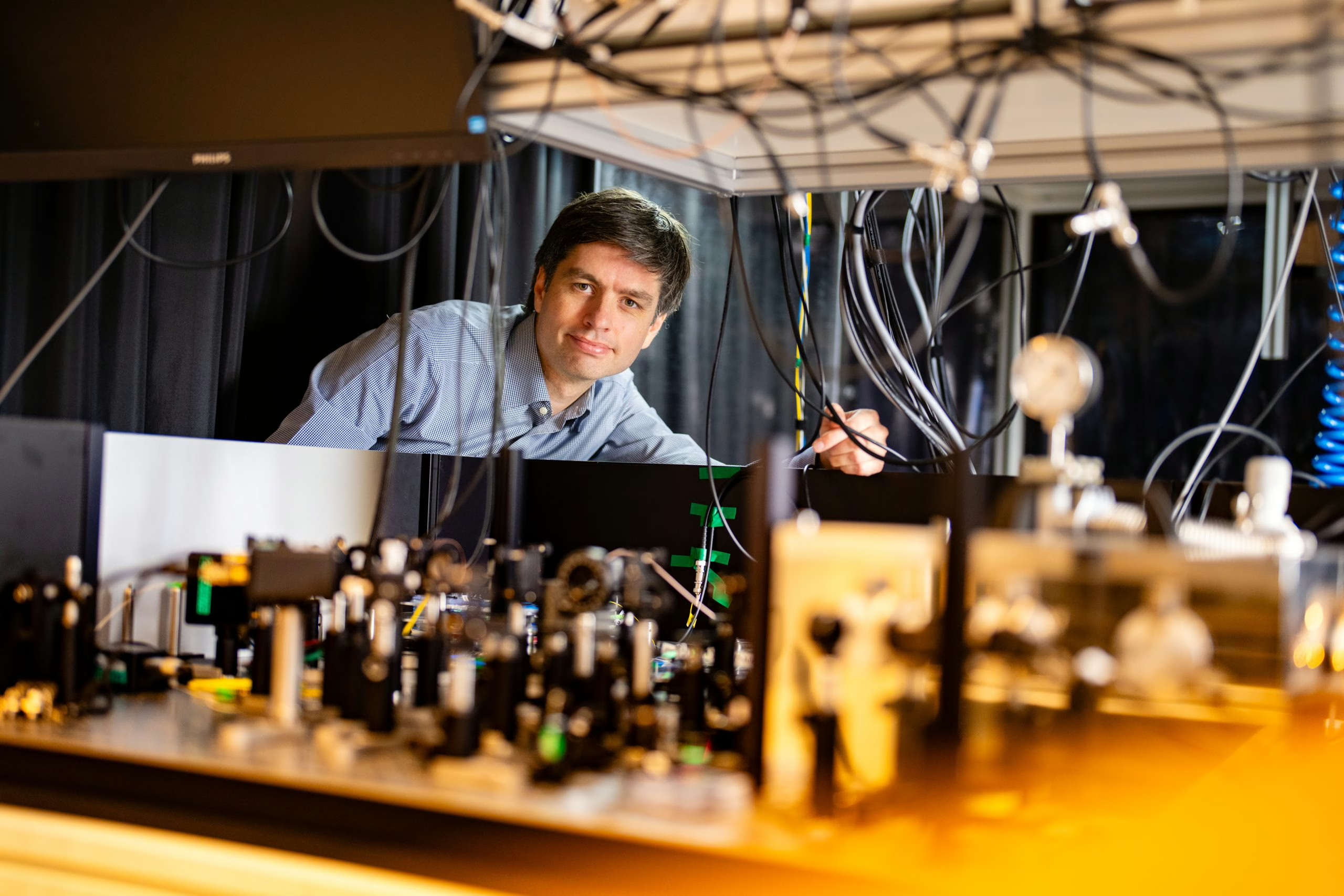
“We are excited to leverage our expertise on silicon nanomechanical resonators towards this frontier technological vision”, says AMOLF group leader Professor Ewold Verhagen.
The Consortium’s Coordinator, Professor Juha Muhonen explains: “The long-term goal is to enable the use of the qubits in quantum computing and quantum observation, while creating a Europe-wide ecosystem for the quantum technology platform.”
A quantum leap for silicon spin qubits
Although silicon has been the defining material for classical information processing, it is not currently the primary material in quantum information processing. However, silicon spin qubits have already been shown to have excellent single-qubit properties. Despite this, silicon qubits, and especially qubits formed by impurity atoms, are not yet seen as a mainstream platform for quantum computing, mainly because there are no convenient coupling and readout mechanisms for scaling up to a practical level. EQUSPACE aims to meet these challenges and promote the fact that quantum technologies could take advantage of the existing large-scale silicon infrastructure that has been set up to manufacture today’s computer chips.
“The EQUSPACE vision can only be realized by combining different disciplines and areas of expertise in Europe,” says Verhagen, “from the atom-scale modification of materials to state of art device engineering.”
The project thus not only aims to make silicon quantum technologies a European strength, but also to develop methods that can modernize the entire quantum industry. For example, materials science techniques, such as single-ion implantations and silicon isotope purification, play a big role in the project, and through these techniques the project aims to create a scalable and solid platform for all silicon quantum applications.
A European consortium brings together quantum experts
The EQUSPACE consortium comprises researchers from the University Jyväskylä (JYU) and three research institutes: VTT Technical Research Centre of Finland, Helmholtz-Zentrum Dresden-Rossendorf e.V. (HZDR) in Germany, and NWO Institute AMOLF in the Netherlands. In addition, it includes a Finnish start-up company, SemiQon Oy.
Research to boost Europe’s quantum industry
One of the main goals of the project is to enable the development in Europe of quantum technologies based on impurity atoms in silicon.
“With this new funding, EQUSPACE establishes a strong research network in Europe based on donor spin qubits, a development that will strengthen Europe’s quantum industry in the long term,” says Muhonen. “Nowadays, this platform is primarily being developed in Canada and Australia. And, of course, also China and the U.S. are strongly pursuing quantum technologies. Projects like EQUSPACE are critical for Europe to keep pace in today’s global quantum race.”
Disclaimer
This project is funded by the European Union. Views and opinions expressed are however those of the author(s) only and do not necessarily reflect those of the European Union or the European Innovation Council. Neither the European Union nor the granting authority can be held responsible for them.
Further information
If you have any questions or would like more information about AMOLF, please contact Ewold Verhagen, group leader at AMOLF (email: e.verhagen@amolf.nl). In this EQUSPACE press release, you will find more information about this project.