Events and outreach

Wim Noorduin about taking to market his research invention 

On Monday 4 November, AMOLF researcher Wim Noorduin participated in the NWO debate “Science Works! The future of research and innovation in the Netherlands” in Nieuwspoort, The Hague.

At this NWO debate, Marcel Levi (President of NWO), Jolanda Kluin (Head of Cardiothoracic Surgery at ErasmusMC and AWTI board member), Laurens Dassen (leader of parliamentary party Volt) and Robert-Jan Smits (President of Eindhoven University of Technology) discussed the conclusions of the Draghi report. Among other things, they stressed the discrepancy between the need to invest in our knowledge and innovation (also endorsed by the cabinet) on the one hand, and the huge cuts in education and science on the other. 

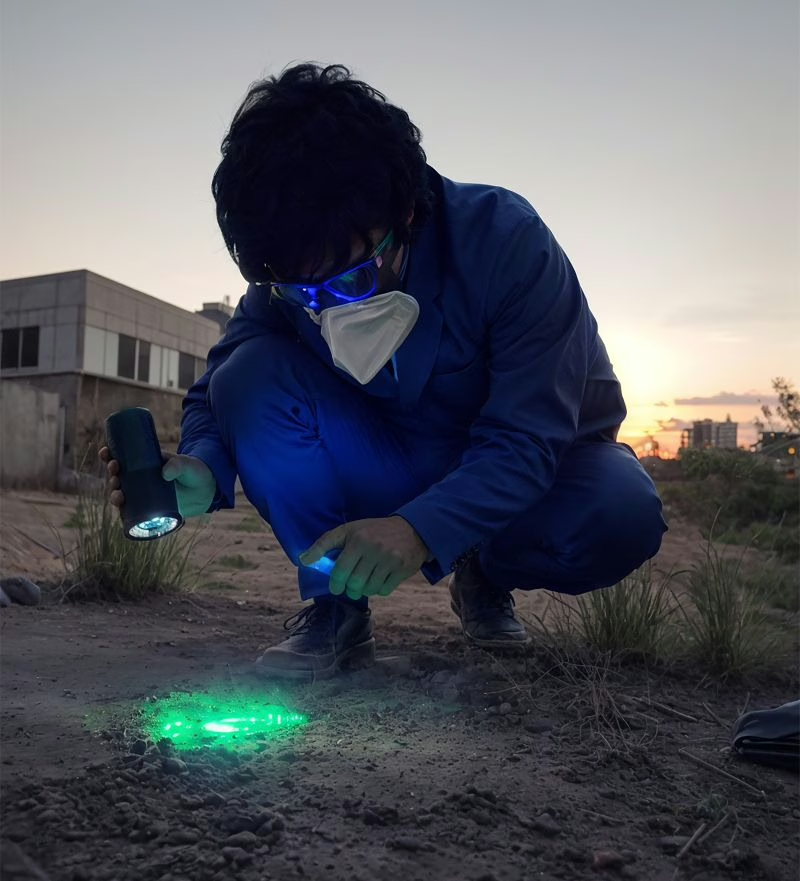
Wim Noorduin, scientific group leader at AMOLF and professor at the University of Amsterdam, was interviewed about his experiences, bringing to market a lead test spray. Wim: “I read about lead water pipes and found out that 1 in 3 children in the world has lead poisoning. That’s a whopping 800 million children. One of the biggest problems is to find the lead. Even in very small amounts, lead can cause permanent brain damage or cardiovascular disease. Building on my work on semiconductors, I then thought, ‘What if I could convert lead into a material that behaves like a semiconductor, so that the lead will reflect light? Then you can see where it is and do something about it.” 

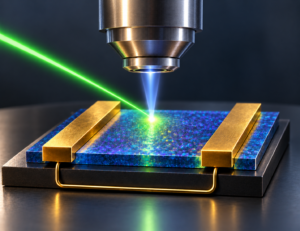
Wim proved able to turn his vision into reality: together with his PhD student Lukas Helmbrecht and other group members, he developed a spray that makes materials containing lead reflect light, even lead in very small amounts. Given the seriousness of lead poisoning worldwide, Wim realized ‘I have to do something with this finding’.  

With help from AMOLF, Wim approached NWO about his invention, receiving a grant to explore a startup. He later successfully applied for a loan, so he didn’t have to seek outside investors. Together with Lukas Heimbrecht and Jeroen van den Bosch, Wim founded the startup Lumetallix in order to turn the results into a practical kit. 

Wim: “I didn’t want to sell the invention because I wanted to avoid the proceeds going to the wrong people. I want (potential future) profits to be used to create scale, so we can deploy the product in parts of the world where this problem is greatest.” 

You can watch the interview with Wim on YouTube (in Dutch). Here you also find the panel debat.

Share article
What's happening

Most recent news items

All news items
Joining forces to study perovskite interfaces
People and recognition

Joining forces to study perovskite interfaces

AMOLF group leaders Professor Wiebke Albrecht and Professor Bruno Ehrler have received an NWO ENW-M2 grant for their joint research project, The Dynamic Atomic Interface between Halide Perovskites and Metals. The insights gained will pave the way for sustainable, high-performance solar energy and information technology. Wiebke and Bruno will each hire a PhD student for this project. The grant amounts to €800.000.

Read news item
Wim Noorduin and Arian van Asten presenting their scientific journey
People and recognition

Wim Noorduin and Arian van Asten presenting their scientific journey

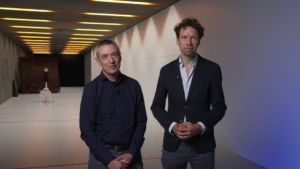
On October 8, Professor Wim Noorduin and his collaborator Professor Arian van Asten (University of Amsterdam) presented their scientific journey in a video to the audience at the ‘Avond van Wetenschap en Maatschappij’. They did so alongside the other nominees for the Huibregtsen Prize.

Read news item
Natural phenomena ‘hyperuniform disorder’ enables highly efficient, thin silicon solar cells
Research highlights

Natural phenomena ‘hyperuniform disorder’ enables highly efficient, thin silicon solar cells

Silicon solar panels are rigid and heavy, and many rooftops cannot support them. This creates a need for thin, flexible solar cells that can be integrated into building materials. However, making silicon solar cells thinner makes it harder to trap light inside the material. Researchers in the 3D Photovoltaics group found a fascinating way to overcome this challenge using a phenomenon called hyperuniform disorder. They publish their findings in the journal ACS Photonics.

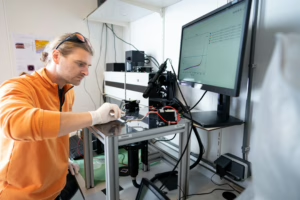
The researchers were able to make highly efficient silicon solar cell materials that are 30 times thinner than conventional ones. They managed to do this by integrating a layer of nanometer sized structures on top of the material. Up close, this pattern looks random, but it is remarkably when you step back: no clumps, no gaps, and no repeating pattern. This is called hyperuniform disorder (or HUD).

Read news item
Stay informed

Get the latest research highlights, events, and news from our institute delivered to your inbox