Research highlights

Computing with rubber

Without electronics carrying out computational tasks our daily lives would look very different. Devices such as elevators, vending machines, turnstiles, washing machines and even traffic lights use a simple form of electronic computing to switch from state to state. But, what if power supply is not available to operate these devices? A research team led by Martin van Hecke from Leiden University and AMOLF has now demonstrated how smart rubber structures can carry out such computational tasks. “We now know how to design simple materials so they can process information.” The study was published in the journal PNAS on May 20th.

In electronics, digital bits are used to perform calculations, involving complex circuits consisting of many elements. The researchers have found an alternative strategy to compute, using slender rubber elements as mechanical bits, and assembling multiple bits together in a ‘metamaterial’. But to get these materials to work as machines, they found that the key is to control the interactions between these individual bits.

A binary counter

As a first example the research team created a rubber computer that can act as a two-bit
binary counter – as demonstrated in the accompanied movie, whereby stretching the metamaterial makes it count from ‘00’ to ‘11’, and back to ‘00’ by releasing. The team employs pre-curved rubber beams as mechanical bits, mediating the interactions by connecting them. Information can thus be stored and processed. Counting is an important example of a simple so-called finite state machine, and this rubber device can, for instance, be used to control the motion of the legs of a simple robot.

Turnstiles and Combination Locks

“A significant experimental breakthrough occurred in the last month before my return to China during the pandemic”, says researcher Jingran Liu, who at the time was a visiting Ph.D. student at Leiden University and AMOLF and is now a postdoc in Madrid. “We suddenly realized how to design a more complex three-bit system, and within a few days, we had made four working samples.” The researchers quickly realized that such three-bit metamaterials were far more powerful than the two-bit predecessors.” Depending on how these samples are manipulated, they can perform seventeen different simple calculations”, explains AMOLF postdoc Lishuai Jin. For example, the metamaterials could replicate the functionality of a turnstile. “A turnstile manages entry with its rotating arms—locking and unlocking in response to the insertion of coins and the push from customers. Our metamaterials can emulate this mechanism through a specific sequence of states and driving pulses”, says Jin. Moreover, the rubber computer can also be used for a combination lock or vending machine, and much more.

A new form of computing?

“Our work shows that complex computations can be performed by smart metamaterials, in a manner that is completely different from traditional computing”, says Liu. “What I find very exciting is that our principles are not limited to mechanics. Moreover, complex memory effects, that are important in physics but difficult to study, can now be used for something extremely useful: efficient computing.”

Reference

Jingran Liu, Margot Teunisse, George Korovin, Ivo R. Vermaire, Lishuai Jin, Hadrien Bense and Martin van Hecke, Controlled Pathways and Sequential Information Processing in Serially Coupled Mechanica Hysterons, Proceedings of the National Academy of Sciences, May 20th (2024).


Share article
What's happening

Most recent news items

All news items
Collaboration

Successful outcomes of international EBEAM program led by AMOLF

The EU Pathfinder project Electron Beams Enhancing Analytical Microscopy (EBEAM) that was recently completed has received a highly positive review of the European Innovation Council (EIC). EBEAM brought together eight European research institutions and companies, including AMOLF, that develop new concepts and instruments combining spectroscopic analysis with electron microscopy.

Read news item
Research highlights

Everything you need to know about organoids

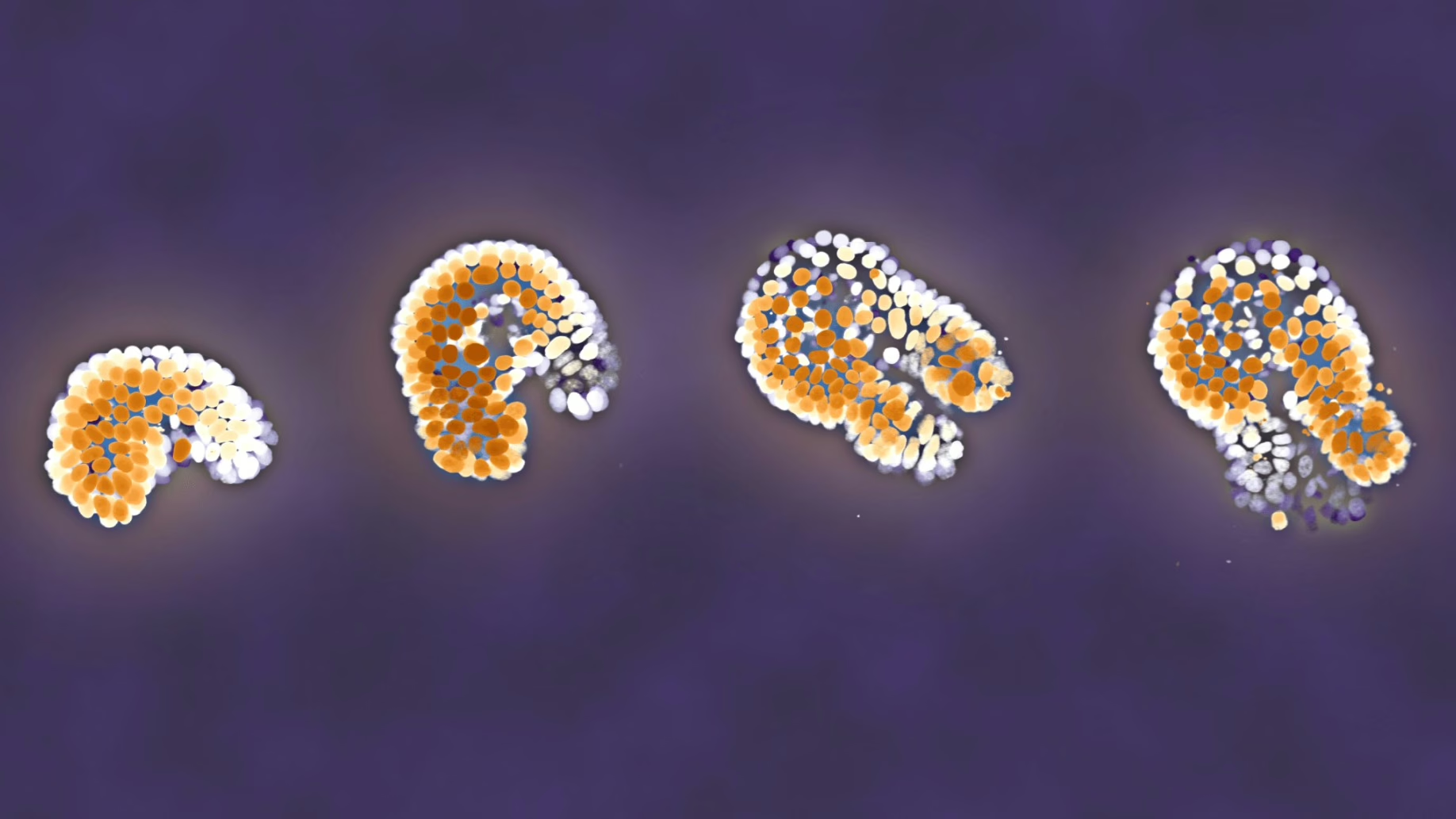
Organoids are instrumental in improving our understanding of processes that are otherwise hidden inside the body. For instance, these small 3D organs can be used to test medicines on tissue grown from a patient’s own cells. AMOLF researchers carry out unique and complex experiments to follow organoids in time. In order to enable other researchers to benefit from their experiences, they now publish their methods in the prestigious journal Nature Protocols.

Read news item
Events and outreach

Minister Rianne Letschert wears hat and shoulder ornament inspired by Wim Noorduin’s research

This year at the opening of the parliamentary year (Prinsjesdag) Minister of Education, Culture and Science Rianne Letschert wears a spectacular hat and shoulder ornament. Both of them are inspired by the microscopic structures studied by group leader Wim Noorduin (AMOLF/UvA), which look remarkably like tiny flowers under a microscope. Artist and designer Malou Beemer translated these shapes, normally invisible to the naked eye, into wearable art.

Read news item
Nachi Stern, Group Leader Learning Machines at AMOLF
People and recognition

Nachi Stern awarded ERC Starting Grant to explore how matter learns

Why do brains learn, but rocks do not? Could a material one day adapt to its environment the way a living organism does? AMOLF group leader Dr. Nachi Stern has been awarded an ERC Starting Grant to investigate the physical laws of learning, in a project called, “Physical Learning in Dynamical Systems.”

Read news item
Stay informed

Get the latest research highlights, events, and news from our institute delivered to your inbox