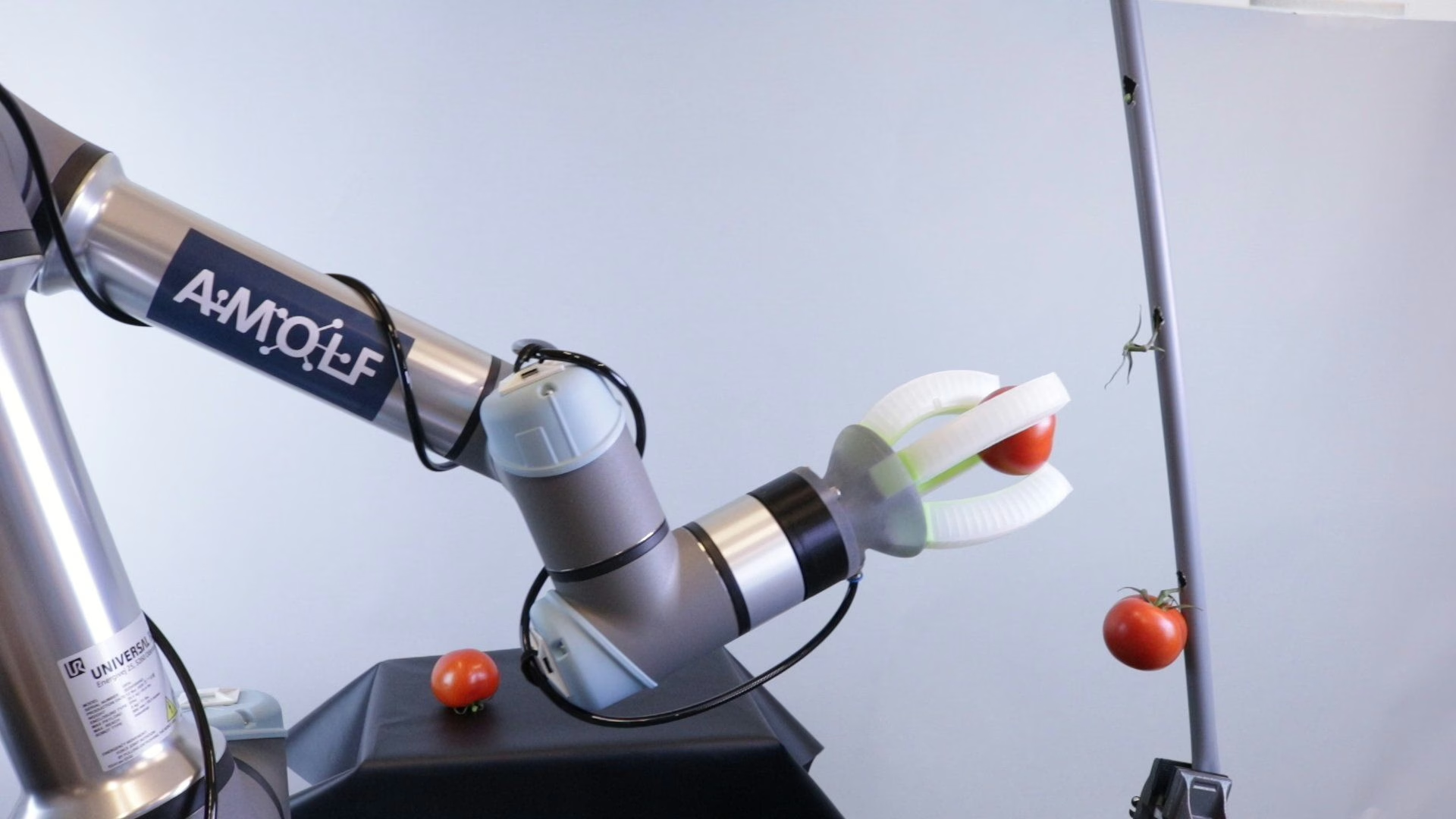
“How can we enable soft robots to feel something without the need for built-in sensors? We can now do that by externally measuring the pressure,” explains Bas Overvelde. Together with researcher Shibo Zou from his group and researchers from Eindhoven University of Technology, he developed a system to externally measure how soft robot fingers respond to interactions with the environment.
The researchers do that by measuring the air pressure required to move the robot fingers. That is because the fingers grip something by being blown up like a balloon. If they encounter something during the gripping process, it takes more force to blow them up, just like it takes you more effort to blow up a balloon if you squeeze it at the same time. The amount of extra force required is something that can be measured externally, which means that sensors are no longer required in the robot fingers.
Zou explains: “Effectively, we use one balloon, our measurement system, to blow up another balloon, the inflatable robot fingers, while they are gripping something. At the same time, we measure how much pressure this requires. This tells us something about the surface or object that the soft robot is gripping. The system uses this information to determine what it should do next.”
One of the soft grippers adapted by the researchers can pluck tomatoes. The robot grips a tomato with four soft fingers and then plucks it by rotating these. By measuring the pressure during the gripping process, the robot knows whether it is holding the tomato properly. The robot arm can also sort tomatoes. In the case of an overripe tomato, the system measures less pressure than for a ripe tomato and, as a result, puts the overripe tomato aside.
Widely applicable
All of these decisions and actions are determined by the pressure regulator that the researchers developed. Thanks to this external device, the fingers no longer require sensors. Overvelde explains: “Sensors are hard and that is not ideal for soft robot fingers. Moreover, for each application, you need to develop new sensors that must also be suitable for use in food or medical applications, for example. We have developed a plug-and-play (retrofit) system and demonstrated that it can be used on a wide range of soft robots without the need for many adjustments.” Picking tomatoes is just one application.
For example, in collaboration with researchers including Aimée Sakes from Delft University of Technology, the team also demonstrated that the new system can be used to externally control a miniature suction cup used in a minimally invasive medical procedure, such as endoscopy. “Consequently, this suction cup can now measure what kind of tissue it is gripping, which results in less tissue damage,” says Sakes.
Other soft robots that the measurement system has been applied to can determine an object’s dimensions, shape or roughness. Overvelde: “The system’s strength is that it can easily be applied to a wide range of soft robots. Now, we want to develop other types of measurements in addition to stiffness or size, such as weight.”
Reference
Shibo Zou, Sergio Picella, Jelle de Vries, Vera G. Kortman, Aimée Sakes & Johannes T. B. Overvelde, A retrofit sensing strategy for soft fluidic robots. Nature Communications, 15, 539 (2024).