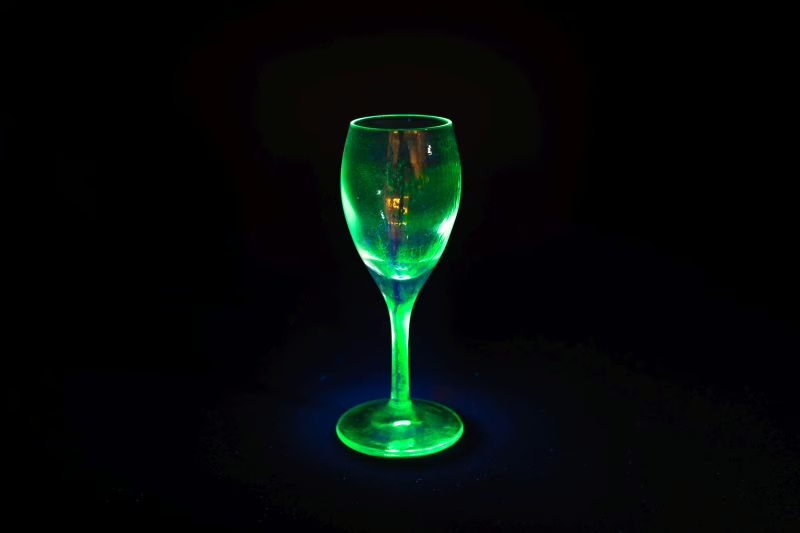
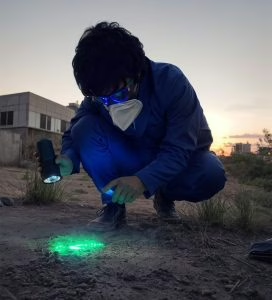
“We have hijacked the technology of perovskite semiconductors and used it in a widely deployable lead test. Nobody in this discipline had ever thought of that,” says Lukas Helmbrecht, researcher at the group Self-Organizing Matter led by Wim Noorduin at AMOLF. “We are very pleased with these results,” says Noorduin. “It is a really cool project and it is quite rare for fundamental research to literally impact the entire world with an application.”
Science at home
A couple of years ago, the group developed a two-step process to transform a calcium structure, such as the skeleton of a sea urchin, into a semiconductor. The calcium carbonate in the skeleton then reacts and changes into a lead perovskite, a semiconducting material that emits light under a UV lamp.
While stuck at home during the COVID-19 pandemic, Noorduin thought about other possible applications of this material. At the same time, he heard about the considerable health risks associated with exposure to lead, especially for small children who can suffer brain damage as a result of this. A simple test to demonstrate the presence of lead could help to reduce such exposure and perhaps the light-emitting properties of the lead perovskite could help with that.
Noorduin took a solution home with him that could form a perovskite if it came into contact with lead, and he sprayed this on a gutter. This immediately emitted a bright green color. To his surprise, the same happened with the paint on the adjacent window frame, which also lit up. Both surfaces contained a form of lead. The green light is luminescence and reveals the formation of the lead perovskite semiconductor. “This worked so amazingly easily that we started to think about developing a test to detect lead in a wide range of surfaces.”
Only lead lights up
Helmbrecht took on the challenge and discovered that a methyl ammonium bromide solution works best. As soon as this solution comes into contact with a lead compound, it immediately forms a lead perovskite, which lights up bright green under UV light. Helmbrecht tried a range of surfaces, from lead pipes and paint to lead salts, glass and plastics such as PVC and electrical wire. They all lit up bright green as proof of the presence of lead. If an iodide or chloride solution is used instead of bromide then the light emitted is red or blue, respectively.
In addition, Helmbrecht tested more than fifty materials that did not contain lead but did contain similar elements, such as tin, aluminum, and copper. None of these lit up. This indicates that the test is highly chemoselective. The test reveals lead concentrations of one nanogram per mm2, whereas most current tests have an accuracy of no more than a few micrograms per mm2. The new test is therefore 1000 times more sensitive.
Interestingly, it does not matter which lead compound the material contains metallic lead or one of the lead salts. Noorduin explains: “It seems that all compounds are converted into so-called 2+ valency of lead. We are not surprised that the chemical reaction only works with lead. We know that from work on perovskite solar cells and LEDs. The limited reaction is a disadvantage for solar cells, but for our test, it is an advantage because it makes the test highly selective. We were, however, amazed that the test works for so many different lead-containing materials.
Exactly how the chemical reaction proceeds is still being investigated, says Noorduin. “We think that it is a multi-step process in which lead first dissolves a bit, possibly undergoes a redox reaction and afterwards forms a lead salt, which is subsequently converted into perovskite. However, the reaction is so fast that we’re not yet able to detect the steps.” The knowledge from this study, which, after all, started with research into perovskite semiconductors, could, in turn, boost the same kind of research into the development of better solar cells or LEDs from perovskite, for example.
Worldwide health benefits
A spin-off of this research is the company Lumetallix that Helmbrecht and Noorduin are setting up together with Jeroen van den Bosch with the recent addition of Xander Terpstra (CCO). With AMOLF, they jointly hold an international patent on the process and development of a universal test kit. This is both affordable and easy to use for everybody who wants to know whether lead is present in the living environment. The test kits can be ordered via the website (https://www.lumetallix.com). The researchers are also working with NGOs throughout the world to spread the kits among local people in India and the Ivory Coast, for example. This would allow people to take measures for lead removal themselves and thus prevent health problems.
“The fact that a lead-containing surface lights up bright green after spraying it has many advantages compared to the existing test that only shows a change of color,” explains Helmbrecht. “First of all, the existing test does not work for people who are colorblind. Secondly, our test emits light if lead is found, which means you can also effortlessly observe the result in dark places such as cellars. Thirdly, the fact that something lights up is both magical and alarming. We therefore hope to find more people willing to do the test so that we can increase awareness about the presence of lead, also here in the Netherlands.”

Reference
Lukas Helmbrecht, Sjoerd W. van Dongen, Arno van der Weijden, Christiaan T. van Campenhout, Willem L. Noorduin, Direct environmental lead detection by photoluminescent perovskite formation with nanogram sensitivity, Environmental Science and Technology (2023).