Research highlights

Hot crystals through laser light

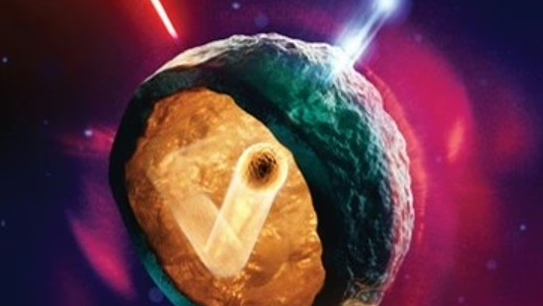
Shells, skeletons, and bones are all made of crystals. To function properly these crystals need to grow at the right time and place. Inspired by these natural processes, AMOLF researchers have developed a new method to control crystallization under artificial conditions using near-infrared laser light.

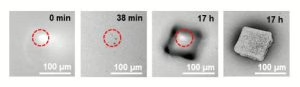
Timelapse images and SEM image of the nucleation and growth of a single CaCO3 crystal using NIR laser light, the red dashed circle indicates the focal spot of the NIR laser.

With the help of the technicians Marko Kamp and Hinco Schoenmaker, PhD student Marloes Bistervels has built a special laser setup that locally heats up an aqueous solution. Within a second the temperature in the hotspot increases to almost 100 degrees Celsius. This local heating consequently causes the formation of special crystals that decrease in solubility with increasing temperature. By controlling the power of the laser beam, Bistervels can start, stop, and steer the formation process, thereby determining precisely where and how crystals will form. Moving the laser beam she deposits a line of crystals, such that she can ’write’ patterns.
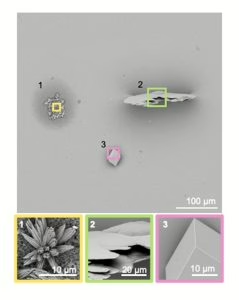
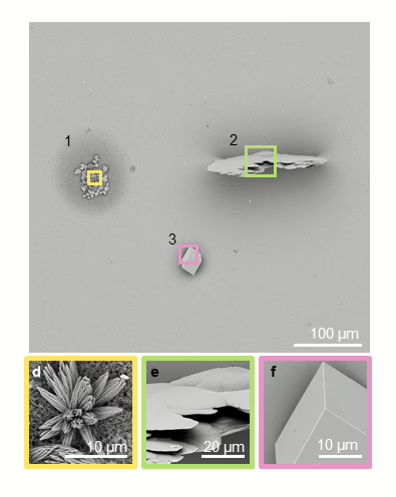
Three different CaCO3 polymorph positioned next to each other using NIR light induced nucleation.

This light-induced crystallization works for many different sorts of crystals that are relevant in biology, such as crystals that form in bones, shells, and skeletons. The ability to control crystal growth in space and time is promising for the development of next-generation functional materials that hold unique optical and mechanical properties.

The recent results booked by Bistervels are aimed at achieving spatiotemporal control over self-assembly processes using light techniques. Over the past two years she extended the toolbox to control the crystallization process with different light sources applied on different systems. For instance, instead of using ultraviolet (UV) light, she now uses near-infrared (NIR) light without the use photo sensitive molecules. Hence, a cleaner process. In addition, the technique is here applied on pure biorelevant crystals, instead of synthetic nanocomposites.

Read related news Crystals beneath a sunbed (December 14th, 2021).

Reference
M.H. Bistervels, B. Antalicz, M. Kamp, H. Schoenmaker and W.L. Noorduin, Light-driven nucleation, growth, and patterning of biorelevant crystals using resonant near-infrared laser heating, Nature Communications, 14 – Issue 1 p. 6350: 1- 9, 10-10 (2023).

Highlighted by Nature
Share article
What's happening

Most recent news items

All news items
Collaboration

Successful outcomes of international EBEAM program led by AMOLF

The EU Pathfinder project Electron Beams Enhancing Analytical Microscopy (EBEAM) that was recently completed has received a highly positive review of the European Innovation Council (EIC). EBEAM brought together eight European research institutions and companies, including AMOLF, that develop new concepts and instruments combining spectroscopic analysis with electron microscopy.

Read news item
Research highlights

Everything you need to know about organoids

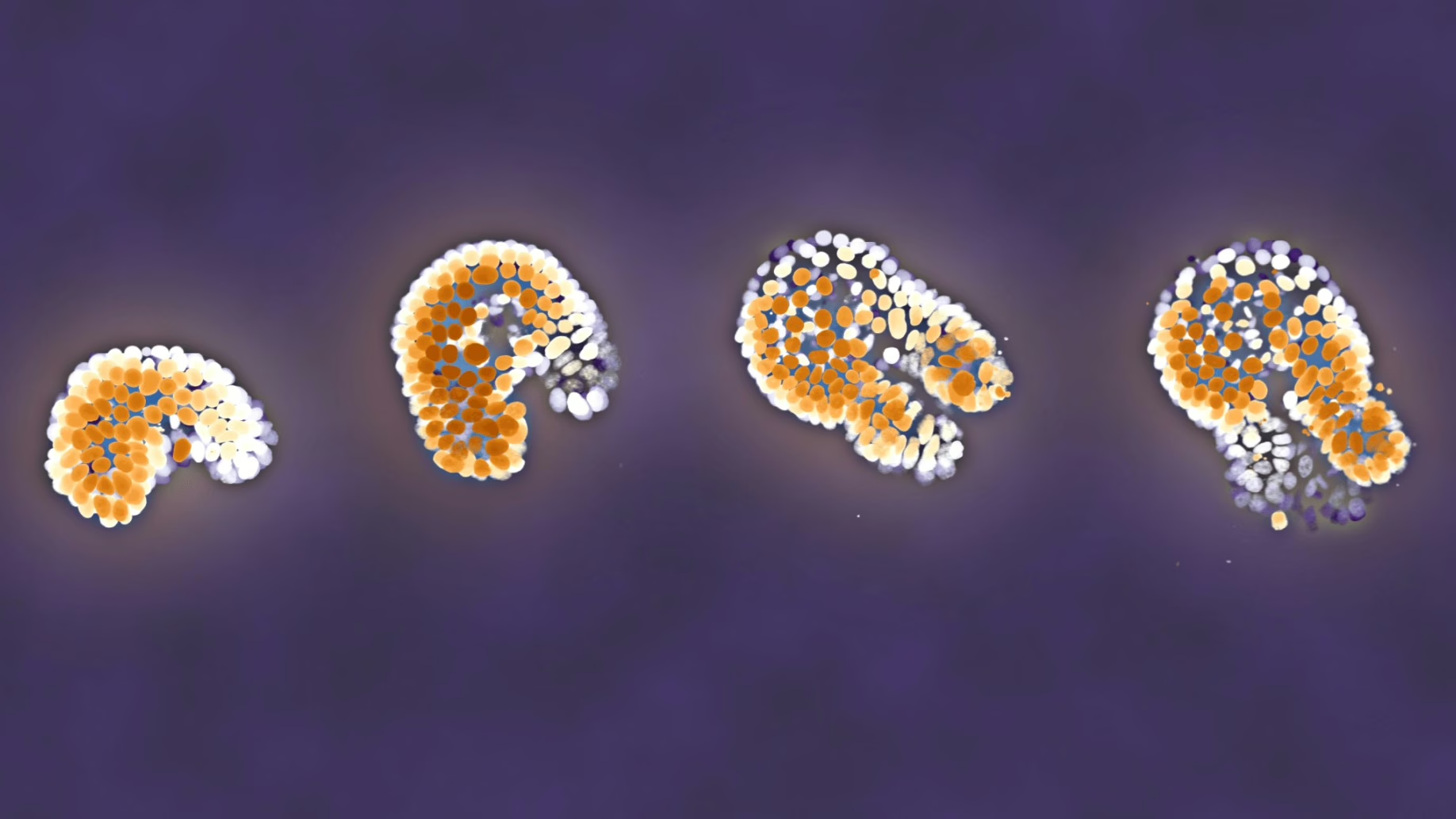
Organoids are instrumental in improving our understanding of processes that are otherwise hidden inside the body. For instance, these small 3D organs can be used to test medicines on tissue grown from a patient’s own cells. AMOLF researchers carry out unique and complex experiments to follow organoids in time. In order to enable other researchers to benefit from their experiences, they now publish their methods in the prestigious journal Nature Protocols.

Read news item
Events and outreach

Minister Rianne Letschert wears hat and shoulder ornament inspired by Wim Noorduin’s research

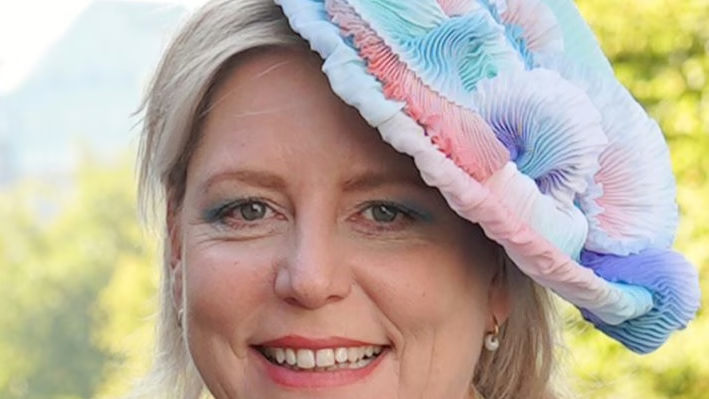
This year at the opening of the parliamentary year (Prinsjesdag) Minister of Education, Culture and Science Rianne Letschert wears a spectacular hat and shoulder ornament. Both of them are inspired by the microscopic structures studied by group leader Wim Noorduin (AMOLF/UvA), which look remarkably like tiny flowers under a microscope. Artist and designer Malou Beemer translated these shapes, normally invisible to the naked eye, into wearable art.

Read news item
Nachi Stern, Group Leader Learning Machines at AMOLF
People and recognition

Nachi Stern awarded ERC Starting Grant to explore how matter learns

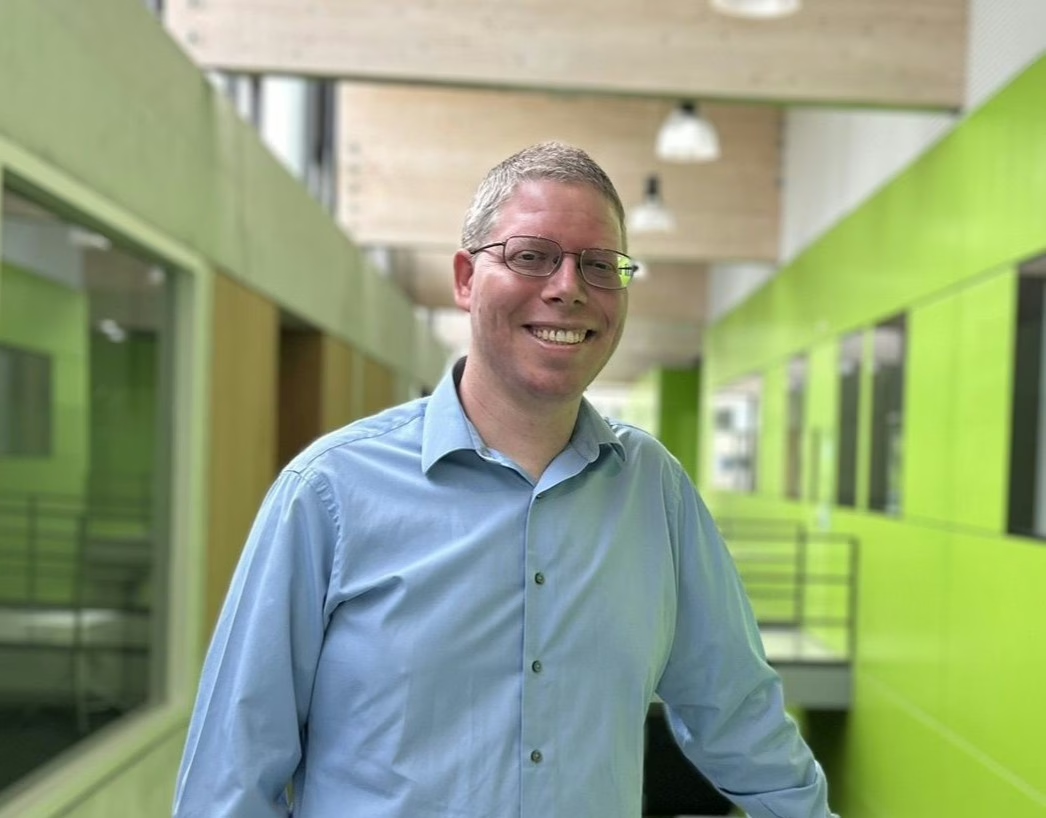
Why do brains learn, but rocks do not? Could a material one day adapt to its environment the way a living organism does? AMOLF group leader Dr. Nachi Stern has been awarded an ERC Starting Grant to investigate the physical laws of learning, in a project called, “Physical Learning in Dynamical Systems.”

Read news item
Stay informed

Get the latest research highlights, events, and news from our institute delivered to your inbox