
Research highlights

Engineering dual carriageways for signals

Routing signals and isolating them against noise and back-reflections are essential in many practical situations in classical communication as well as in quantum processing. In a theory-experimental collaboration, a team led by Andreas Nunnenkamp from the University of Vienna and AMOLF group leader Ewold Verhagen has achieved unidirectional transport of signals in pairs of “one-way streets”. This research published in Nature Physics opens up new possibilities for more flexible signaling devices.

Devices that allow to route signals, for example carried by light or sound waves, are essential in many practical situations. This is, for instance, the case in quantum information processing, where the states of the quantum computer have to be amplified to read them out – without noise from the amplification process corrupting them. That is why devices that allow signals to travel in a one-way channel e.g. isolators or circulators are much sought-after. However, at present such devices are lossy, bulky, and require large magnetic fields that break time-reversal symmetry to achieve unidirectional behaviour. These limitations have prompted strong efforts to find alternatives that take less space and that do not rely on magnetic fields.
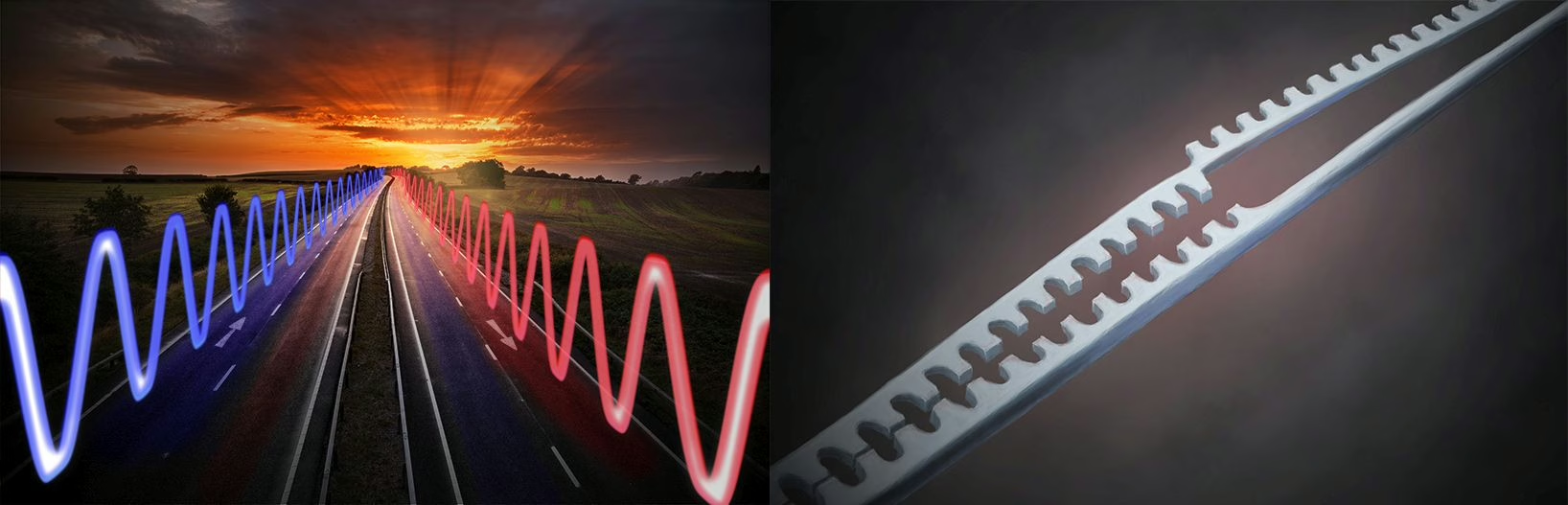
Left: A dual carriageway for signals. One quadrature is transmitted in one direction, the other quadrature in the other direction. Right: Illustration of the nanomechanical system whose vibrations are coupled by light. © Left: EddieCloud/Shutterstock.com modified by C. C. Wanjura; right: C. C. Wanjura

The new study published in Nature Physics introduces a new class of systems characterized by a phenomenon the authors call “quadrature nonreciprocity”. Quadrature nonreciprocity exploits interference between two distinct physical processes. This allows for unidirectional transmission of signals without time-reversal breaking and leads to a distinctive dependence on the phase, i.e., the quadrature, of the signal. “In these devices, transmission depends not only on the direction of the signal, but also on the signal quadrature”, says Dr Clara Wanjura, the theoretical lead author of the study. “This realizes a ‘dual carriageway’ for signals: one quadrature is transmitted in one direction and the other quadrature in the opposite direction. Time-reversal symmetry then enforces that the quadratures always travel pairwise along opposite directions in two separate lanes.”

The experimental team at AMOLF has demonstrated this phenomenon experimentally in a nanomechanical system where interactions among mechanical vibrations of small silicon strings are orchestrated by laser light. Laser light exerts forces on the strings, thereby mediating interactions between their different vibration ‘tones’. Dr Jesse Slim, the experimental lead author of the study says: “We have developed a versatile experimental toolbox that allows us to control the two different types of interactions that are needed to implement quadrature nonreciprocity. This way we could reveal the resulting unidirectional transport of the signals experimentally.”

The work opens up new possibilities for signal routing and quantum-limited amplification, with potential applications in quantum information processing and sensing.

Reference
Clara C. Wanjura, Jesse J. Slim, Javier del Pino, Matteo Brunelli, Ewold Verhagen, and Andreas Nunnenkamp, Quadrature nonreciprocity in bosonic networks without breaking time-reversal symmetry, Nature Physics, July 13 (2023).
DOI: 10.1038/s41567-023-02128-x

Share article
What's happening

Most recent news items

All news items
Collaboration

Successful outcomes of international EBEAM program led by AMOLF

The EU Pathfinder project Electron Beams Enhancing Analytical Microscopy (EBEAM) that was recently completed has received a highly positive review of the European Innovation Council (EIC). EBEAM brought together eight European research institutions and companies, including AMOLF, that develop new concepts and instruments combining spectroscopic analysis with electron microscopy.

Read news item
Research highlights

Everything you need to know about organoids

Organoids are instrumental in improving our understanding of processes that are otherwise hidden inside the body. For instance, these small 3D organs can be used to test medicines on tissue grown from a patient’s own cells. AMOLF researchers carry out unique and complex experiments to follow organoids in time. In order to enable other researchers to benefit from their experiences, they now publish their methods in the prestigious journal Nature Protocols.

Read news item
Events and outreach

Minister Rianne Letschert wears hat and shoulder ornament inspired by Wim Noorduin’s research

This year at the opening of the parliamentary year (Prinsjesdag) Minister of Education, Culture and Science Rianne Letschert wears a spectacular hat and shoulder ornament. Both of them are inspired by the microscopic structures studied by group leader Wim Noorduin (AMOLF/UvA), which look remarkably like tiny flowers under a microscope. Artist and designer Malou Beemer translated these shapes, normally invisible to the naked eye, into wearable art.

Read news item
Nachi Stern, Group Leader Learning Machines at AMOLF
People and recognition

Nachi Stern awarded ERC Starting Grant to explore how matter learns

Why do brains learn, but rocks do not? Could a material one day adapt to its environment the way a living organism does? AMOLF group leader Dr. Nachi Stern has been awarded an ERC Starting Grant to investigate the physical laws of learning, in a project called, “Physical Learning in Dynamical Systems.”

Read news item
Stay informed

Get the latest research highlights, events, and news from our institute delivered to your inbox