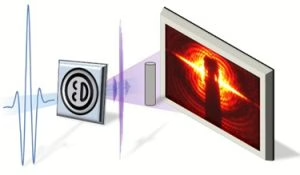
While we cannot see extreme-ultraviolet light, it has a short enough wavelength to unlock access to nanoscale features, ranging from bio-samples to modern-day computer chips. Providing light with such short wavelengths can be done using table-top sources based on high-harmonic generation, which is the conversion of infrared laser pulses into extreme-ultraviolet pulses in a gas or solid. However, controlling and manipulating this extreme-ultraviolet light with subsequent optical elements remains difficult as extreme-ultraviolet light is absorbed by all materials.
Roscam Abbing et al. circumvent this problem by directly manipulating the light at the location where it is generated using a nanostructured solid material to generate light from. This approach gives unprecedented flexibility to control emission characteristics of the generated extreme-ultraviolet light. In addition to light manipulation, Roscam Abbing et al. also demonstrate that even quite complex nanostructures (see figure below) can be imaged with a similar approach. In this case the extreme-ultraviolet emission profile of the nanostructures is recorded after the light-generation process and then the profile is used to retrieve the structure itself. This new way of imaging provides a dramatically improved resolution thanks to the short wavelength of the extreme-ultraviolet emission.
The article was picked as an editor’s suggestion in PRL, and a synopsis in APS Physics can be found under:
https://physics.aps.org/articles/v15/s72