
“Physics is about taking measurements to gather information of a system or to reduce uncertainty about the state of a system. Sometimes precision is most important – how sure are you that something in the system has changed? In other cases, speed is most important – how quickly can you gather information? In most detectors, accuracy comes at the expense of speed,” says AMOLF group leader Rodriguez. “Consider something so simple as looking at a painting: if you only see the painting for a few seconds, you will gather much less information than when you get see it for a few minutes. In other words: the longer we measure, the more information we gather and the more precisely we know the state of the system (the painting).”
Noise
When measuring very small signals, the influence of noise is also important. “A typical optical detector, based on a resonator or a cavity, gives a signal when, for example, a molecule perturbs the resonator. But this signal can be so small that it barely exceeds the noise from the laser. The signal can only be detected by averaging multiple measurements or by using a longer measurement time,” says Rodriguez, who, together with PhD student Kevin Peters, is looking for ways to reduce the influence of noise in detection with optical systems.
‘Exceptional point’
The researchers found inspiration for their unique new measurement concept in an exotic physical phenomenon that occurs in open quantum systems, like optical resonators that measure the presence of molecules or viruses. “Such systems have complex eigenvalues that sometimes coincide. In that case we speak of an ‘exceptional point’ and theory suggests that measurements at exactly such a point should be much more sensitive,” says Rodriguez. “However, it turned out that while the signals were indeed enhanced at these ‘exceptional points’, so was the noise. Moreover, determining the exact location of the exceptional point, at which to measure, is a very complicated and cumbersome task.”
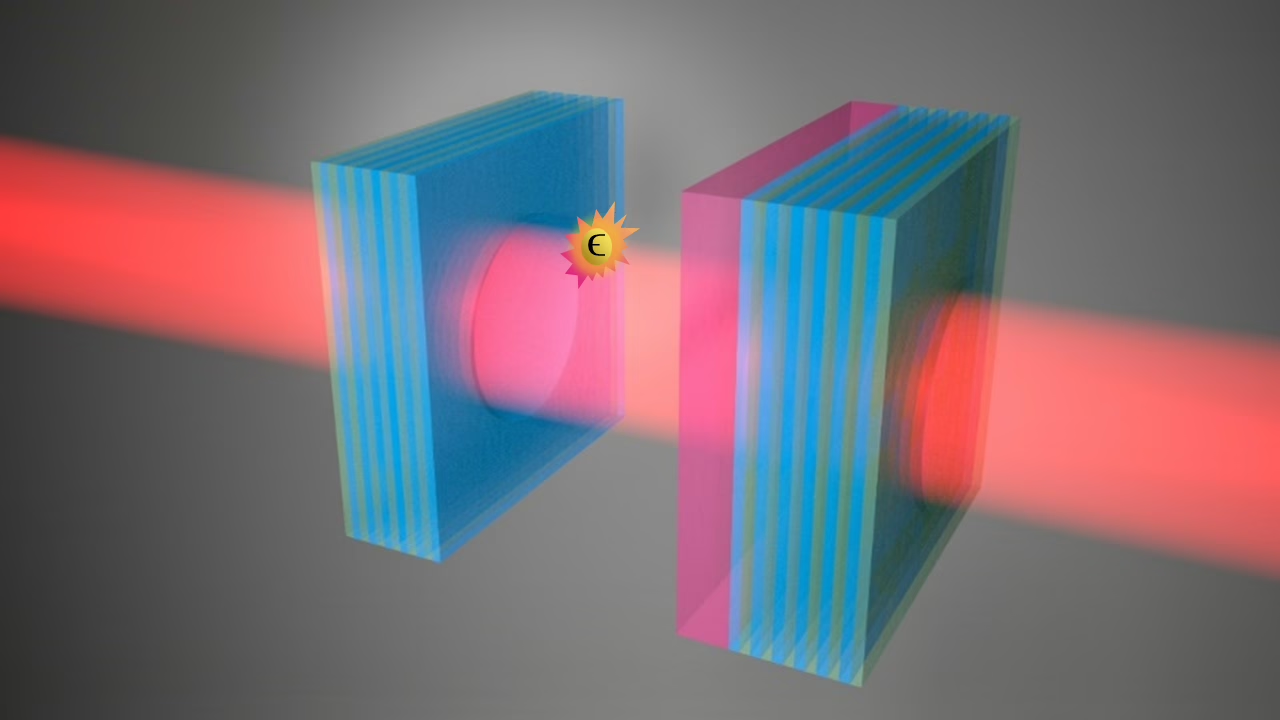
The researchers realized that something similar to the ‘exceptional points’ could also be identified in the non-linear optical cavities (a type of resonator) they work with. Rodriguez: “Non-linear cavities can have optical hysteresis. When you ramp the laser power up, the light intensity in the cavity builds up in a certain way. But then, when you ramp the laser power down, the light intensity leaves the cavity in a different way. This results in hysteresis, similar to the magnetization of certain materials when a magnetic field is applied to them. We found that the difference in light intensity between the points where the hysteresis opens and closes, is proportional to the square root of the disturbance of the resonator (e.g. caused by a molecule to be measured). The measurement of this ‘difference signal’ is therefore very sensitive to small perturbations. Moreover, we showed that with faster measurements, the influence of noise becomes smaller, contrary to what happens in conventional measurement methods.”
Practical feasibility
The researchers made theoretical calculations for the proposed sensor, but also thought about the practical feasibility. Setting the correct modulation frequency for measurements with the proposed optical resonator is easily possible with existing equipment. Therefore, Rodriguez would like to collaborate with industry to explore the idea further and use it for optical sensing. “This way of measuring is interesting for all kinds of applications where optical sensors are already in use,” he says. “Think of sensors for position or motion determination, for chemical measurements, or for detecting nanoparticles. In fact, anything that you shine light on and then measure what comes out can benefit from our more sensitive non-linear approach.
Reference
K.J.H. Peters and S.R.K. Rodriguez, Exceptional precision of a nonlinear optical sensor at a square-root singularity, Physical Review Letters, June 21st (2022).
DOI: 10.1103/PhysRevLett.129.013901