Research highlights

Light-Catalyst Interactions to Sense and Steer Chemical Reactions

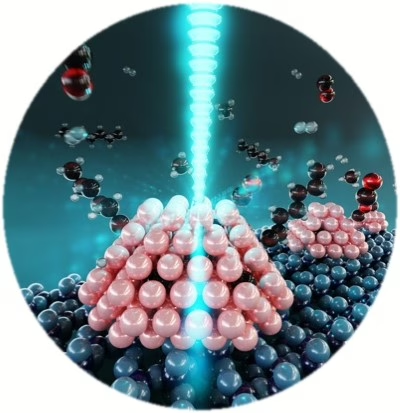
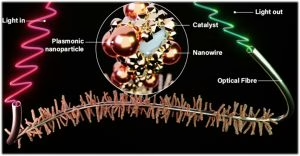
AMOLF and Utrecht University have been awarded a 1.9 million euro research project by the Dutch Research Council (NWO) Key Technologies 2020-2023 programme to develop radically new catalytic reactors using plasmonic systems. The project entitled “Sensing and Steering Catalytic Reactions with Light” (CatLight) is a multidisciplinary collaboration between AMOLF (Alarcon-Llado, Albrecht, Ehrler, Garnett and Polman), Utrecht University (Weckhuysen, Hutter, Rabouw), and industrial partners BASF, ExxonMobil, Shell, Toyota Motor Europe, DENSsolutions, and Delmic.

Credit: Thomas Hartman (Weckhuysen group at Utrecht University)

The focus of the CATLight research project is to gain fundamental understanding and to develop new technologies that deliver targeted heat in industrially relevant catalyst systems with unprecedented spatio-temporal accuracy. This will create a promising new platform for efficient catalysis by using light and nanophotonic concepts.

The new optically-driven catalysis technology will thus contribute to create more sustainable ways to efficiently drive important chemical reactions. The smarter use of energy and active thermal management enabled by photonic architectures developed in this research project will represent a paradigm shift for modern catalysis towards sustainable chemistry research.
Credits: Thomas Hartman (Weckhuysen group Utrecht University)

Research plans
The consortium will demonstrate an entirely new way to make commercially relevant catalytic processes more active, selective and energy efficient. It will do so by combining the mature control over light-matter interactions at AMOLF, the unique in-situ and operando spectroscopy for investigating catalytic processes at Utrecht University and the know-how of the chemical and analytical industry partners . CatLight introduces the use of intense light pulses to steer chemical reactions at the catalytically active sites that are locally heated by absorption of optical radiation at plasmonic nanoparticles. A 3D network of optical waveguides decorated with plasmonic nanoreactors guides intense light pulses to the catalytically active sites and is embedded in a reaction vessel. Simultaneously, optical excitation provides key thermal and spectroscopic fingerprints of the reactive species involved in the chemical pathways as they proceed in space and time.

Read more about Key Technologies (KIC)



Share article
What's happening

Most recent news items

All news items
Collaboration

Successful outcomes of international EBEAM program led by AMOLF

The EU Pathfinder project Electron Beams Enhancing Analytical Microscopy (EBEAM) that was recently completed has received a highly positive review of the European Innovation Council (EIC). EBEAM brought together eight European research institutions and companies, including AMOLF, that develop new concepts and instruments combining spectroscopic analysis with electron microscopy.

Read news item
Research highlights

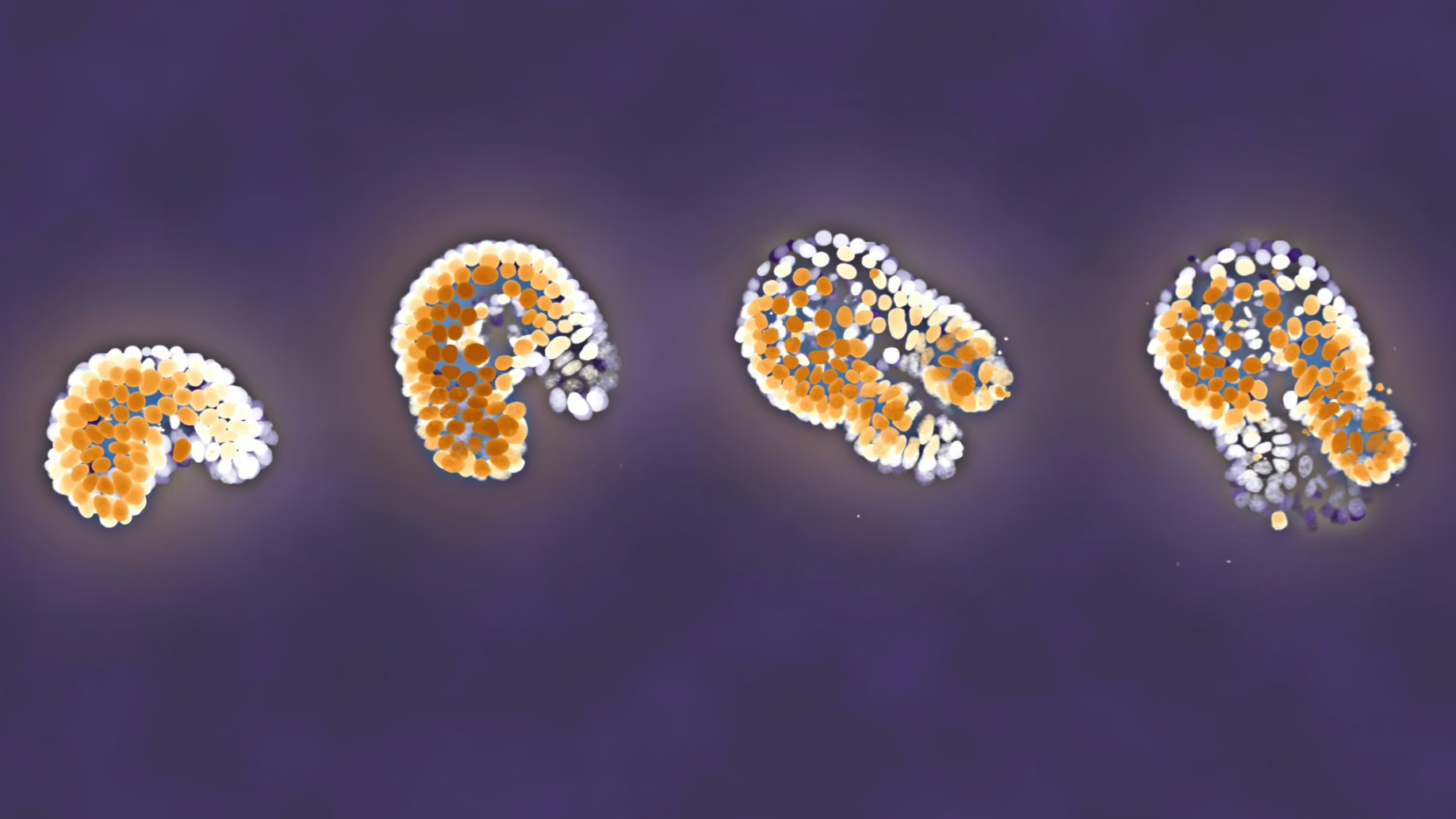
Everything you need to know about organoids

Organoids are instrumental in improving our understanding of processes that are otherwise hidden inside the body. For instance, these small 3D organs can be used to test medicines on tissue grown from a patient’s own cells. AMOLF researchers carry out unique and complex experiments to follow organoids in time. In order to enable other researchers to benefit from their experiences, they now publish their methods in the prestigious journal Nature Protocols.

Read news item
Events and outreach

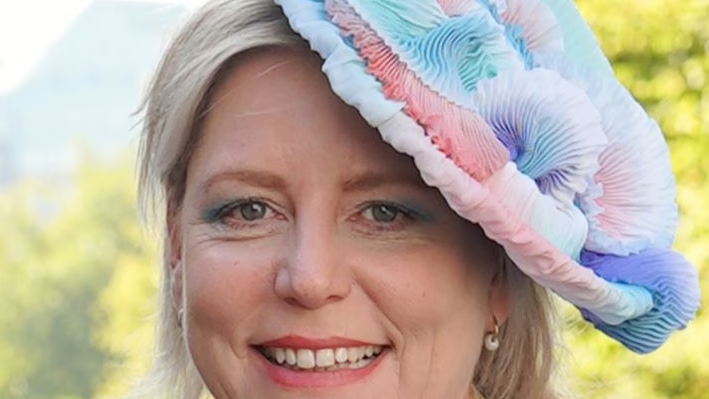
Minister Rianne Letschert wears hat and shoulder ornament inspired by Wim Noorduin’s research

This year at the opening of the parliamentary year (Prinsjesdag) Minister of Education, Culture and Science Rianne Letschert wears a spectacular hat and shoulder ornament. Both of them are inspired by the microscopic structures studied by group leader Wim Noorduin (AMOLF/UvA), which look remarkably like tiny flowers under a microscope. Artist and designer Malou Beemer translated these shapes, normally invisible to the naked eye, into wearable art.

Read news item
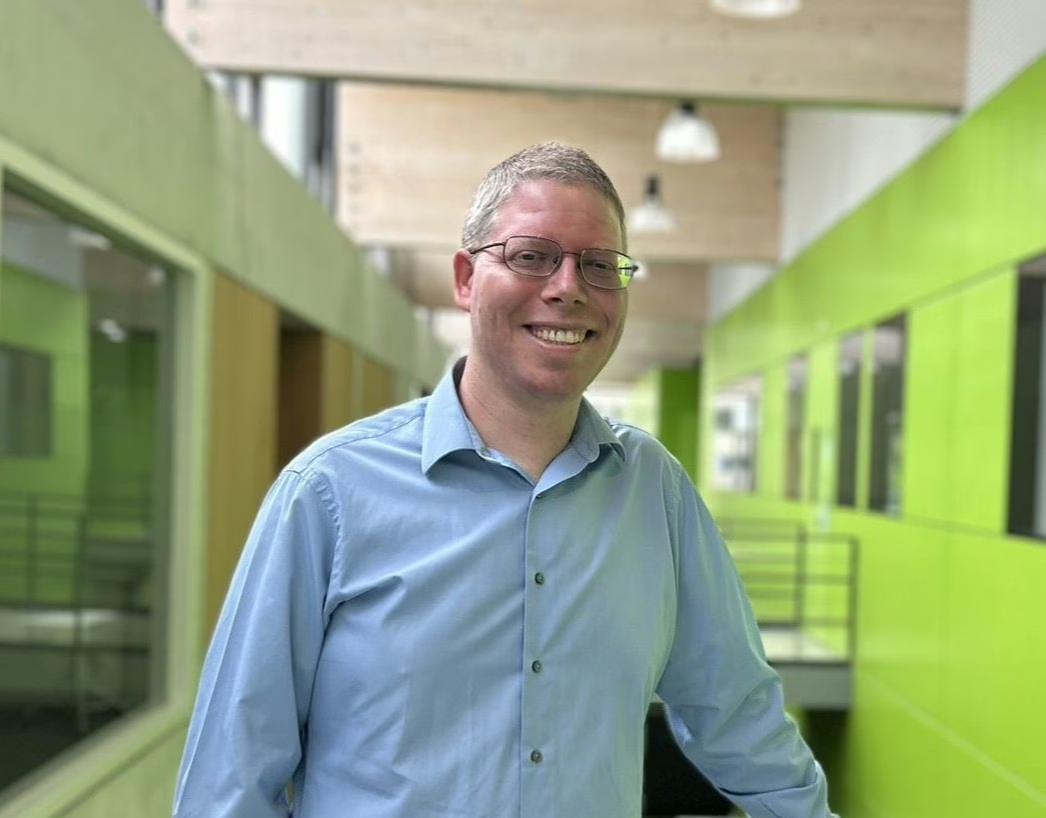
Nachi Stern, Group Leader Learning Machines at AMOLF
People and recognition

Nachi Stern awarded ERC Starting Grant to explore how matter learns

Why do brains learn, but rocks do not? Could a material one day adapt to its environment the way a living organism does? AMOLF group leader Dr. Nachi Stern has been awarded an ERC Starting Grant to investigate the physical laws of learning, in a project called, “Physical Learning in Dynamical Systems.”

Read news item
Stay informed

Get the latest research highlights, events, and news from our institute delivered to your inbox