Research highlights

Signal discovered that connects cell size with cell growth

The mechanisms connecting growth with cell size have been mysterious – up till now: in a recent publication in Current Biology, researchers from AMOLF and TU Delft  have uncovered that the signaling molecule ppGpp is essential to regulate cell size. Surprisingly, they also discover cells adjust their sizes to concentrations of ppGpp, rather than strictly according to growth rate.

It is a longstanding observation that bacterial cells are larger when they grow rapidly, and smaller when they grow slowly. But how do cells connect size with growth rate? Researchers Ferhat Büke, Sander Tans (both AMOLF and TU Delft), and Greg Bokinsky (TU Delft), artificially changed the concentration of the signaling molecule ppGpp (guanosine tetraphosphate) in live E. coli, and by doing so discovered that cell size is not determined by the growth rate alone, but that ppGpp maintains the link between cell size and growth rate.

Regulator for bacteria cell size

The small molecule ppGpp is already known in the bacterial world as a molecule with outsized influence over many cellular machines and processes. To address whether ppGpp also plays a role in cell size, the research team recorded films of individual cells growing in tiny fabricated channels. Dr. Büke discovered that a sudden increase in ppGpp quickly shrinks the cells by transiently accelerating cell divisions, while decreasing ppGpp delays cell division, leading to larger cells. In both cases, the growth rate of the cells decreased, but this decrease was far slower than the cell division response. This shows that ppGpp could be regulating cell size by controlling division timing.

Bokinsky explains: “The molecule ppGpp appears in stressful situations, but is also important for normal cell growth: the faster a bacteria grows, the less of this molecule is present. You would expect that the size of the bacteria responds only to the changing growth rate, but we found something else: cell size responds directly to concentrations of ppGpp. We were able to gently alter the concentration of ppGpp in bacteria and time the change in growth rate, cell size, and division timing accurately. This allowed us to show for the first time that cell size does not respond to the growth rate, but rather that ppGpp controls both cell size and growth rate in parallel; ppGpp somehow sits in the middle and regulates both processes.”
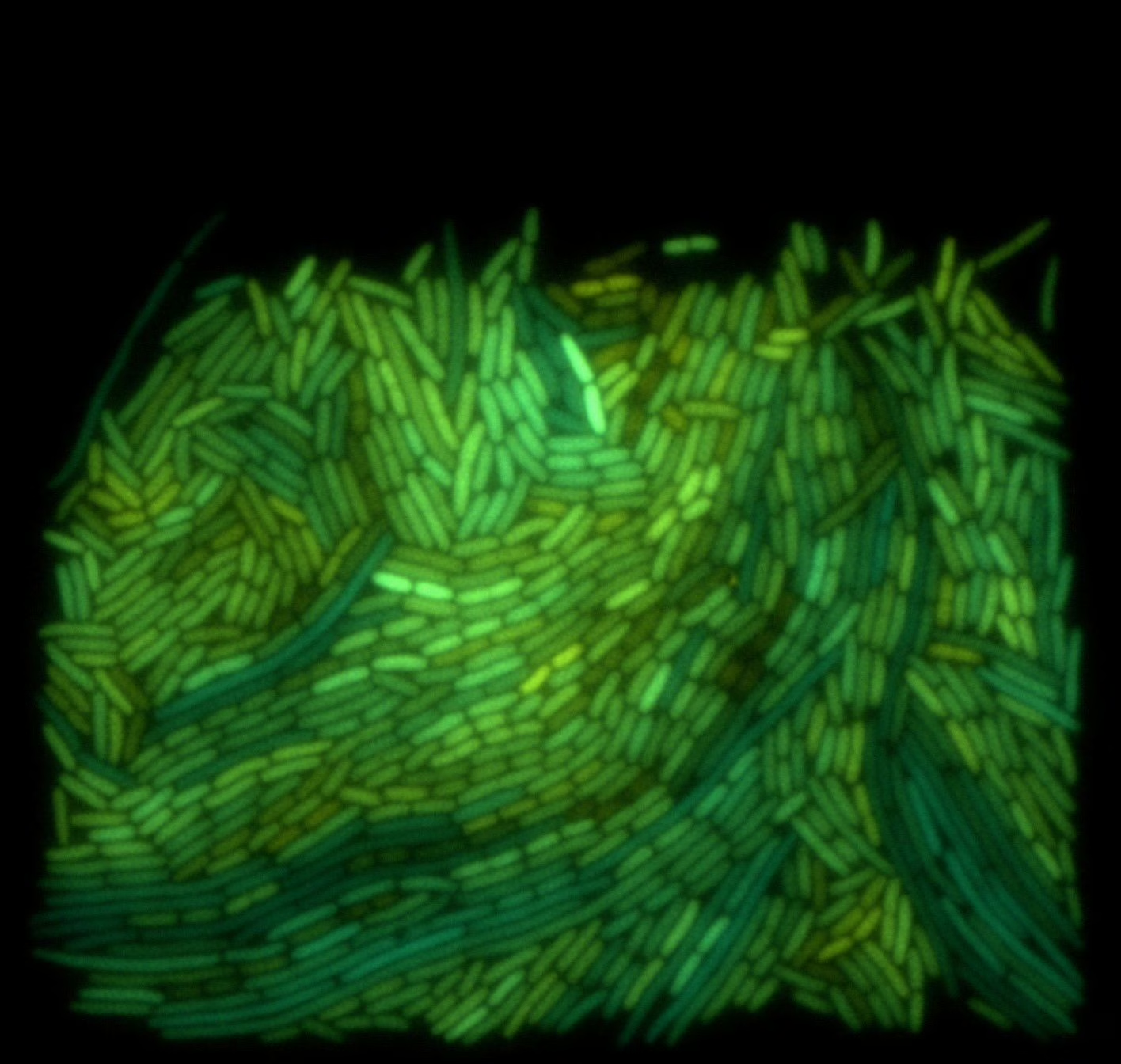
Figure: Microscopic images (inherently blurry with postprocessing) of E.coli cells containing the two synthetic ppGpp control enzymes. Cyan colored enzyme degrades ppGpp and Yellow colored one synthesizes it. Therefore Yellow cells have more ppGpp and cyan cells have less. Researchers can observe the effects of varying levels of ppGpp on the single cell level using such images.

Reference
F. Büke, J. Grilli, M. Cosentino Lagomarsino, G. Bokinsky, and S.J. Tans, ppGpp is a bacterial cell size regulator, Current Biol., 32(1-8), 1–19 (2022) doi:10.1016/j.cub.2021.12.033

Read more
The Tans Lab
Bokinsky Lab

 

Share article
What's happening

Most recent news items

All news items
Collaboration

Successful outcomes of international EBEAM program led by AMOLF

The EU Pathfinder project Electron Beams Enhancing Analytical Microscopy (EBEAM) that was recently completed has received a highly positive review of the European Innovation Council (EIC). EBEAM brought together eight European research institutions and companies, including AMOLF, that develop new concepts and instruments combining spectroscopic analysis with electron microscopy.

Read news item
Research highlights

Everything you need to know about organoids

Organoids are instrumental in improving our understanding of processes that are otherwise hidden inside the body. For instance, these small 3D organs can be used to test medicines on tissue grown from a patient’s own cells. AMOLF researchers carry out unique and complex experiments to follow organoids in time. In order to enable other researchers to benefit from their experiences, they now publish their methods in the prestigious journal Nature Protocols.

Read news item
Events and outreach

Minister Rianne Letschert wears hat and shoulder ornament inspired by Wim Noorduin’s research

This year at the opening of the parliamentary year (Prinsjesdag) Minister of Education, Culture and Science Rianne Letschert wears a spectacular hat and shoulder ornament. Both of them are inspired by the microscopic structures studied by group leader Wim Noorduin (AMOLF/UvA), which look remarkably like tiny flowers under a microscope. Artist and designer Malou Beemer translated these shapes, normally invisible to the naked eye, into wearable art.

Read news item
Nachi Stern, Group Leader Learning Machines at AMOLF
People and recognition

Nachi Stern awarded ERC Starting Grant to explore how matter learns

Why do brains learn, but rocks do not? Could a material one day adapt to its environment the way a living organism does? AMOLF group leader Dr. Nachi Stern has been awarded an ERC Starting Grant to investigate the physical laws of learning, in a project called, “Physical Learning in Dynamical Systems.”

Read news item
Stay informed

Get the latest research highlights, events, and news from our institute delivered to your inbox