People and recognition

ERC Starting Grant for Marc Serra-Garcia

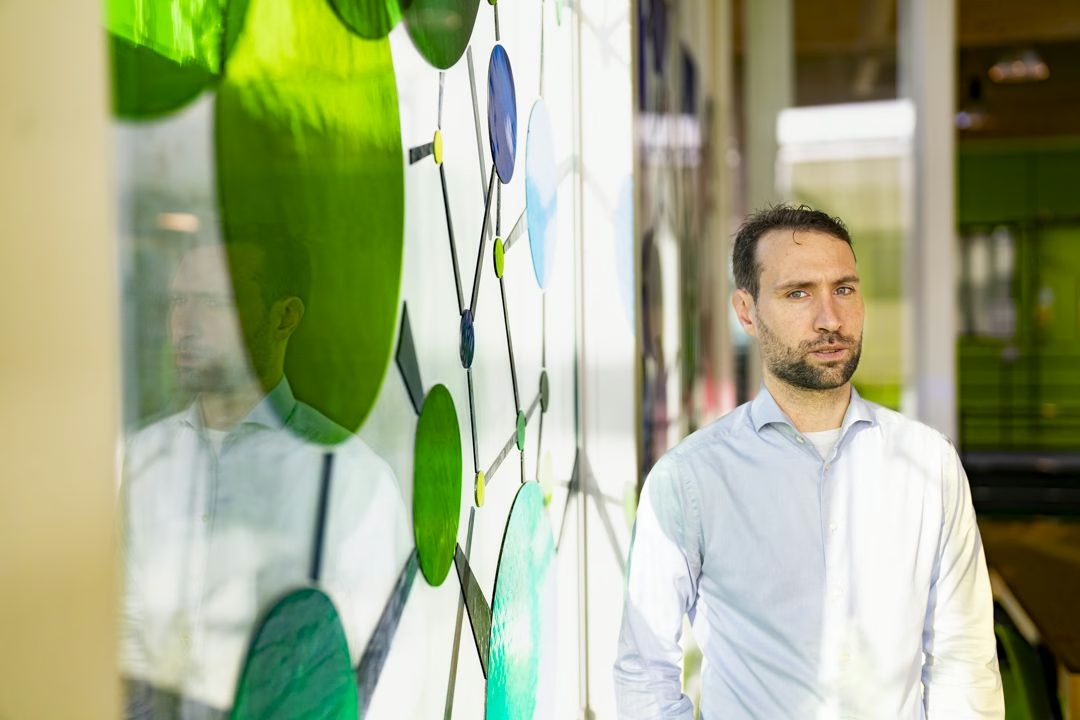
AMOLF tenure-track group leader Marc Serra-Garcia (Hypersmart Matter) has received a Starting Grant of 1.68 million euros from the European Research Council (ERC). With the project INFOPASS he will investigate information processing in passive elastic structures. The ERC uses the Starting Grants to support talented scientists in the early stages of their career in pursuing ground-breaking projects for a duration of five years.

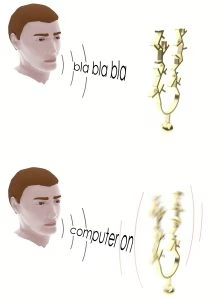
Illustration: Henk-Jan Boluijt

Continuous energy consumption
From a cell phone waiting for a call, to a fitness monitor ready to detect steps, to a smart speaker waiting for a ‘Hey Alexa’ command, our world is full of electronic gadgets ready to chip in when needed. To figure out if they are needed, those devices convert external signals (sound, acceleration, etc.) into electrical currents, and perform complex computations to determine if the key event (incoming call, voice command, etc.) has taken place. Transducing signals and analyzing the resulting constant stream of data consumes energy, which results in bulkier batteries with lower life and has a negative environmental impact. This is a problem we all are familiar with: If we leave our phone in a room for a couple of days, the battery will be dead, just from waiting for calls, commands, etc.

Zero-power event detection
With INFOPASS, Serra-Garcia aims to demonstrate zero-power event detection, focusing specifically on speech recognition. To do so, his team will leverage mechanical resonances. In the same way that a tuning fork responds to signals at one particular frequency but not others, an artificial ‘vibrating brain’ made of many microscopic tuning forks will resonate when excited by a particular word but not others. This type of ‘resonating brain’ is possible because elastic vibrations process information so efficiently that the whole word detection computation can be powered from the energy of sound itself.

Besides its applications in zero-energy information processing and the internet of things, INFOPASS also aims to shed light on the fundamental question on how a large number of ‘dumb’ masses and springs, when connected together, give rise to intelligent responses such as understanding speech.

Read Dutch language interview with Serra-Garcia

Read ERC press release
Share article
What's happening

Most recent news items

All news items
Collaboration

Successful outcomes of international EBEAM program led by AMOLF

The EU Pathfinder project Electron Beams Enhancing Analytical Microscopy (EBEAM) that was recently completed has received a highly positive review of the European Innovation Council (EIC). EBEAM brought together eight European research institutions and companies, including AMOLF, that develop new concepts and instruments combining spectroscopic analysis with electron microscopy.

Read news item
Research highlights

Everything you need to know about organoids

Organoids are instrumental in improving our understanding of processes that are otherwise hidden inside the body. For instance, these small 3D organs can be used to test medicines on tissue grown from a patient’s own cells. AMOLF researchers carry out unique and complex experiments to follow organoids in time. In order to enable other researchers to benefit from their experiences, they now publish their methods in the prestigious journal Nature Protocols.

Read news item
Events and outreach

Minister Rianne Letschert wears hat and shoulder ornament inspired by Wim Noorduin’s research

This year at the opening of the parliamentary year (Prinsjesdag) Minister of Education, Culture and Science Rianne Letschert wears a spectacular hat and shoulder ornament. Both of them are inspired by the microscopic structures studied by group leader Wim Noorduin (AMOLF/UvA), which look remarkably like tiny flowers under a microscope. Artist and designer Malou Beemer translated these shapes, normally invisible to the naked eye, into wearable art.

Read news item
Nachi Stern, Group Leader Learning Machines at AMOLF
People and recognition

Nachi Stern awarded ERC Starting Grant to explore how matter learns

Why do brains learn, but rocks do not? Could a material one day adapt to its environment the way a living organism does? AMOLF group leader Dr. Nachi Stern has been awarded an ERC Starting Grant to investigate the physical laws of learning, in a project called, “Physical Learning in Dynamical Systems.”

Read news item
Stay informed

Get the latest research highlights, events, and news from our institute delivered to your inbox