Research highlights

The optimal design of cellular sensing systems

To survive and prosper living cells continually have to respond and adapt to changes in their environment. To this end, they have developed sensing systems that rival the best man-made sensing devices. Yet, how accurately these systems can measure chemical concentrations remains poorly understood. Researchers from AMOLF have now developed a theory that predicts the optimal design that maximizes the sensing precision of these systems. An analysis of experimental data revealed that the sensing system of the bacterium E. coli obeys the design principles as predicted by their theory. The AMOLF team presented their work in the journal eLife.

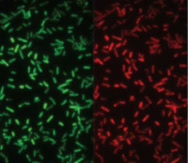
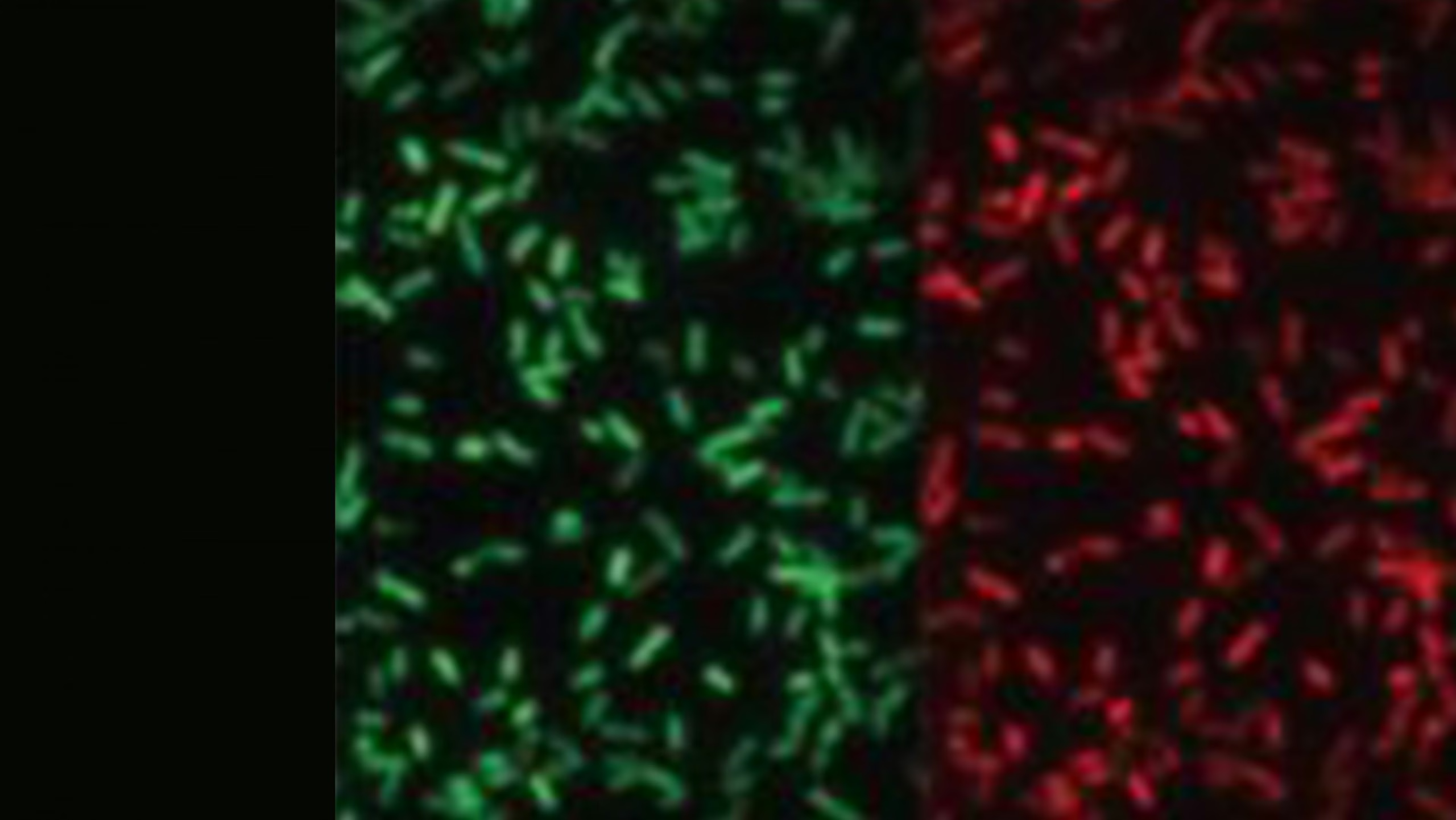
Image of a measurement of the sensing system of the bacterium E. coli. The colors show the activity of two proteins that are involved in the chemical sensing process. Image courtesy of Johannes Keegstra and Tom Shimizu link publication Keegstra and Shimizu in eLife 2017;6:e27455.

Living cells, be it bacteria searching for food or cells differentiating inside an embryo, continually need to respond to signals in their environment. These signals are typically chemical concentrations of some species – proteins or food molecules. Cells have developed dedicated sensing systems that enable them to measure such chemical concentrations.

Like any information-processing device, resources are required to build and operate the cellular sensing system. Components are needed to construct the system, time is needed to process the information, and energy is required to process the information reliably. Yet, how these resources constrain the sensing performance was not understood.

The AMOLF researchers have now developed a theory that allows them to predict the optimal design of cellular sensing systems. This optimal design maximizes the sensing precision given constraints on the availability of the cellular resources. The theory allows the researchers to predict how much energy and how many proteins are needed to reach a required sensing precision, and how this depends on the speed and strength of the signal fluctuations in the environment.

The researchers applied their theory to the best characterized sensing system in biology, the chemotaxis system of E. coli. It has been known for a long time that this system can detect extremely small concentration changes, which vary by less than a pro mille over the body length of the bacterium. Measuring such shallow concentration gradients is very challenging. The theory of the authors predicts that E. coli can nonetheless do so, precisely because its sensing system has been designed optimally, leaving no resource wasted.

Reference
Giulia Malaguti and Pieter Rein ten Wolde, Theory for the optimal detection of time-varying signals in cellular sensing systems, eLife 2021;10:e62574.

Share article
What's happening

Most recent news items

All news items
Joining forces to study perovskite interfaces
People and recognition

Joining forces to study perovskite interfaces

AMOLF group leaders Professor Wiebke Albrecht and Professor Bruno Ehrler have received an NWO ENW-M2 grant for their joint research project, The Dynamic Atomic Interface between Halide Perovskites and Metals. The insights gained will pave the way for sustainable, high-performance solar energy and information technology. Wiebke and Bruno will each hire a PhD student for this project. The grant amounts to €800.000.

Read news item
Wim Noorduin and Arian van Asten presenting their scientific journey
People and recognition

Wim Noorduin and Arian van Asten presenting their scientific journey

On October 8, Professor Wim Noorduin and his collaborator Professor Arian van Asten (University of Amsterdam) presented their scientific journey in a video to the audience at the ‘Avond van Wetenschap en Maatschappij’. They did so alongside the other nominees for the Huibregtsen Prize.

Read news item
Natural phenomena ‘hyperuniform disorder’ enables highly efficient, thin silicon solar cells
Research highlights

Natural phenomena ‘hyperuniform disorder’ enables highly efficient, thin silicon solar cells

Silicon solar panels are rigid and heavy, and many rooftops cannot support them. This creates a need for thin, flexible solar cells that can be integrated into building materials. However, making silicon solar cells thinner makes it harder to trap light inside the material. Researchers in the 3D Photovoltaics group found a fascinating way to overcome this challenge using a phenomenon called hyperuniform disorder. They publish their findings in the journal ACS Photonics.

The researchers were able to make highly efficient silicon solar cell materials that are 30 times thinner than conventional ones. They managed to do this by integrating a layer of nanometer sized structures on top of the material. Up close, this pattern looks random, but it is remarkably when you step back: no clumps, no gaps, and no repeating pattern. This is called hyperuniform disorder (or HUD).

Read news item
Stay informed

Get the latest research highlights, events, and news from our institute delivered to your inbox