Research highlights

Quantifying topological protection of light on a chip

Photonic topological insulators are currently at the forefront of on-chip photonic research due to their potential for loss-free information transport. Realized in photonic crystals, they enable robust propagation of optical states along domain walls. But how robust is robust? In order to answer this, researchers from AMOLF and TU Delft quantified photonic edge state transport using phase-resolved near-field optical microscopy. The findings provide a crucial step towards error-free integrated photonic quantum networks. The results were published in the journal Light Science & Applications.

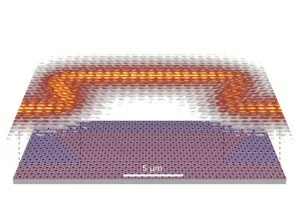
Experimental visualization of light propagation in a topological photonic crystal. The top shows a two-dimensional map of the light field flowing unhindered around four corners. It is measured with a scanning probe that detects the field just above the photonic crystal membrane in which it propagates. The bottom shows an electron microscope image of the structure, with the domain wall that guides the edge waves separating the blue and red domains of topological crystals. Credits images: Sonakshi Arora, Thomas Bauer, and co-authors

Topologically tailored photonic crystals have opened up the possibility for attaining robust unidirectional transport of photonic signals. The unprecedented guiding capabilities – supporting unhindered transport around imperfections and sharp corners without the need for any optimization – are highly beneficial for efficient distribution of information through dense on-chip photonic networks at telecom wavelengths. However, transport properties of such topologically non-trivial states have so far only been inferred by transmission measurements, and quantification of robustness remains challenging.

In a new paper published in Light: Science & Applications, a team of researchers led by former AMOLF group leader Kobus Kuipers (currently at Delft University of Technology) and Ewold Verhagen (AMOLF, Photonic Forces group), reports a rigorous robustness evaluation of photonic edge eigenstates at telecom wavelengths. They fabricated a topological photonic crystal that consists of triangular holes perforating a silicon membrane. The crystal contains two different hole sizes, which gives the mathematical description of light waves propagating in the crystal a special structure, or ‘topology’. Then, when two crystals with different arrangements of the smaller and larger holes are brought together, the boundary between both crystals supports a light wave that has intriguing properties; it can flow unhindered around any sharp corner of the boundary. The researchers visualized those photonic edge states in the photonic chip with a phase-resolved near-field optical microscope. The technique allowed them to separate forward propagating light from backward travelling waves with extreme sensitivity and thus perform local monitoring of back-scattering along the domain wall.

The researchers further complemented their quantitative analysis of the topological edge waves with light waves propagating in an ordinary photonic crystal waveguide.
They found that in stark contrast to the waves in the topological crystal, the light in the ordinary crystal shows significant loss across a ‘defect’, consisting of four sharp waveguide corners. The light waves are scattered to a back-reflected wave. The topological waves instead flow around the sharp corners seemingly unhindered. The researchers were able to conclude that the topological protection reduces the back-reflection from an individual corner by two orders of magnitude for all optical frequencies.

Reference
Sonakshi Arora, Thomas Bauer, René Barczyk, Ewold Verhagen and L. Kuipers, Direct quantification of topological protection in symmetry-protected photonic edge states at telecom wavelengths, Light: Science & Applications, 10, 9 (2021).

Share article
What's happening

Most recent news items

All news items
Collaboration

Successful outcomes of international EBEAM program led by AMOLF

The EU Pathfinder project Electron Beams Enhancing Analytical Microscopy (EBEAM) that was recently completed has received a highly positive review of the European Innovation Council (EIC). EBEAM brought together eight European research institutions and companies, including AMOLF, that develop new concepts and instruments combining spectroscopic analysis with electron microscopy.

Read news item
Research highlights

Everything you need to know about organoids

Organoids are instrumental in improving our understanding of processes that are otherwise hidden inside the body. For instance, these small 3D organs can be used to test medicines on tissue grown from a patient’s own cells. AMOLF researchers carry out unique and complex experiments to follow organoids in time. In order to enable other researchers to benefit from their experiences, they now publish their methods in the prestigious journal Nature Protocols.

Read news item
Events and outreach

Minister Rianne Letschert wears hat and shoulder ornament inspired by Wim Noorduin’s research

This year at the opening of the parliamentary year (Prinsjesdag) Minister of Education, Culture and Science Rianne Letschert wears a spectacular hat and shoulder ornament. Both of them are inspired by the microscopic structures studied by group leader Wim Noorduin (AMOLF/UvA), which look remarkably like tiny flowers under a microscope. Artist and designer Malou Beemer translated these shapes, normally invisible to the naked eye, into wearable art.

Read news item
Nachi Stern, Group Leader Learning Machines at AMOLF
People and recognition

Nachi Stern awarded ERC Starting Grant to explore how matter learns

Why do brains learn, but rocks do not? Could a material one day adapt to its environment the way a living organism does? AMOLF group leader Dr. Nachi Stern has been awarded an ERC Starting Grant to investigate the physical laws of learning, in a project called, “Physical Learning in Dynamical Systems.”

Read news item
Stay informed

Get the latest research highlights, events, and news from our institute delivered to your inbox