Text: Bastienne Wentzel / Video: Bruno van Wayenburg
What is the difference between a sheet of paper and a crumpled ball of paper? Both are made from the same material, but a sheet of paper is flat and floppy, while a crumpled ball is stiff and spherical. So by crumpling up a sheet of paper, we change its properties. “We call paper a mechanical metamaterial: by changing its shape, the material acquires different properties,” says Anne Meeussen. But how exactly does one change the shape to obtain peculiar properties?
Introducing errors
The latest idea comes from a collaboration between AMOLF, Leiden University and Tel Aviv University. Anne Meeussen, Erdal Oğuz, Yair Shokef and Martin van Hecke investigated the deliberate incorporation of a small error in a material, a topological imperfection, to observe its effects. “We built a structure that shows peculiar behavior when it is pressed at not one, but two points. By doing that, you can steer forces and deformations to different locations. Such a material can be used for applications where internal forces and deformations must be coordinated. These range from shoe soles and protheses to soft robots.”
Puzzle pieces
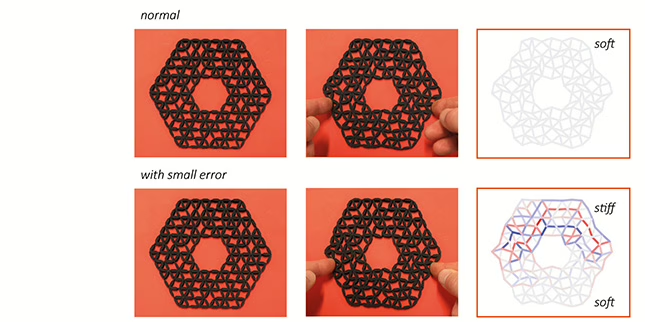
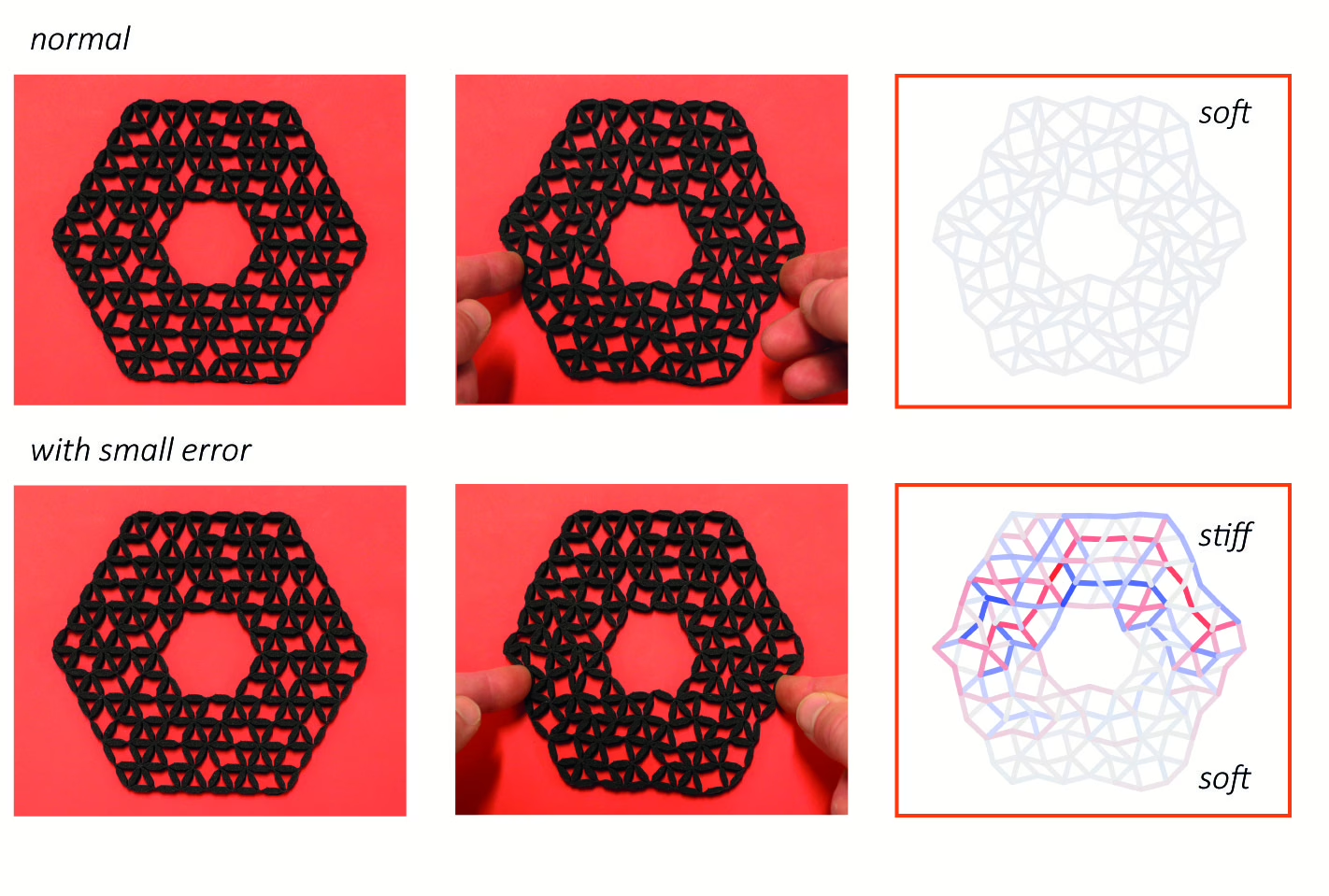
Small errors in a material influence its properties. However, the controlled insertion of a small error in a metamaterial is not that simple. The team devised a flat material made up of triangular puzzle pieces whose sides can become either concave or convex. Using a 3D printer, the researchers made a real version of the theoretical material: a mat of small rods linked together with flexible hinges. This allows you to feel what happens when the structure is squeezed. In a perfect material, the puzzle pieces fit exactly together so that concave sides are only found next to convex sides. When you press on two sides, the mat is easily deformed and feels soft.
Peculiar effects
But what happens if you rotate a row of puzzle pieces in such a way that they no longer fit? “We call that a topological imperfection,” explains Meeussen. “You cannot simply resolve that imperfection by rotating back a single puzzle piece.” In the metamaterial that Meeussen designed, such a topological imperfection has unusual consequences. When you squeeze the imperfect material from two sides, you obtain a soft half that deforms and a hard half that remains stiff. If you squeeze at slightly different points, then the halves switch: soft becomes hard and hard becomes soft.
Broadly applicable
Meeussen states: “Such an asymmetric effect of a topological imperfection has never previously been demonstrated. We have discovered how to incorporate these imperfections in a controlled way, and we have formulated general rules to do so. Therefore, everybody can work with this concept. It is a new way of looking at mechanical metamaterials because we apply concepts from condensed matter and mathematics. It is exciting to see that there is an interest in our results across all these disciplines.”
Reference
Anne S. Meeussen, Erdal C. Oğuz, Yair Shokef and Martin van Hecke, Topological defects produce exotic mechanics in complex metamaterials, Nature Physics, 16, 27 January 2020.
doi:10.1038/s41567-019-0763-6