Research highlights

Less can be more: semiconductor nanowires for flexible photovoltaics

Capturing and manipulating light at nanoscale is a key factor to build high efficiency solar cells. Researchers in the 3D Photovoltaics group have recently presented a promising new design. Their simulations show that vertically stacked nanowires on top of ultrathin silicon films reduces the total amount of material needed by 90% while increasing the efficiency of the solar cell. These promising simulation results are an important step towards new generation solar cells that are used in myriad ways in our buildings and landscape. The results have been published on May 23rd in Optics Express.

How does it work
A fascinating strategy to reduce both cost and rigidity is to combine ultrathin silicon photovoltaic films with semiconductor nanowire solar cells. The mechanical flexibility and resilience of micrometer thin cells make them well suited to apply on curved surfaces. The idea is to optically couple the two materials stacked on top of each other as a tandem cell: a Gallium Arsenide (GaAs) nanowire array on top of an ultrathin silicon (2um-thick) film. GaAs vertical  nanowires are well-known semiconductor components in photovoltaic applications.

Earlier experimental research in the 3D photovoltaics group has shown that such nanowires are able to absorb light ten to hundred times their geometrical cross section. Silicon, the second material in the tandem cell, is a highly desirable component thanks to the mature understanding of its optical and electronic properties as well as its widely available fabrication technologies. The challenge researchers typically encounter when trying to downscale silicon to a few micrometers in thickness is that it compromises the solar cell’s performance due to poor absorption of infrared light. Light management strategies are therefore needed to compensate. The research team decided to add  vertically standing nanowires on top of silicon film and thereby make it  up to four times more efficient in trapping infrared light in the silicon bottom cell.

Reference
Nasim Tavakoli and Esther Alarcon-Llado, Combining 1D and 2D waveguiding in an ultrathin GaAs NW/Si tandem solar cell, Optics Express, 27, A909-A923 (2019).
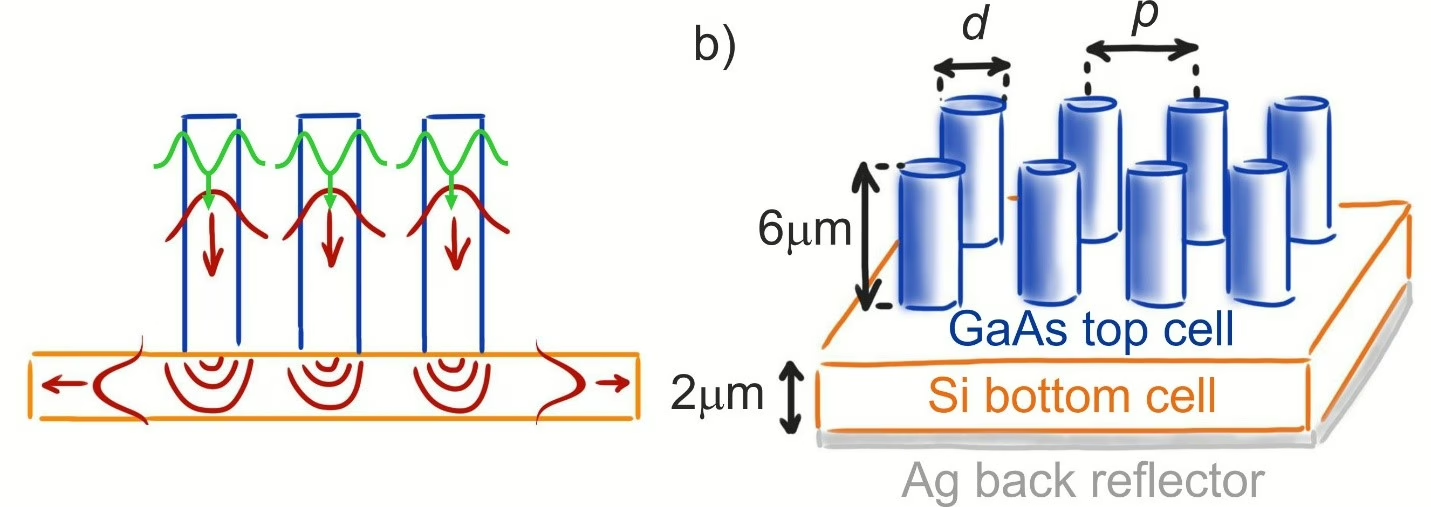
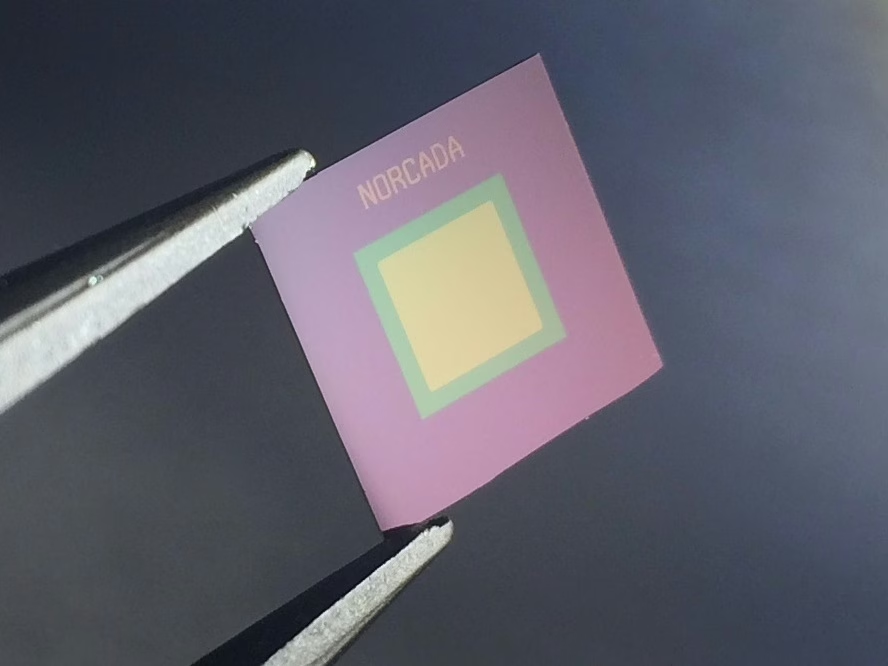
Caption: Optically coupled tandem of GaAs nanowires (6um tall) on silicon ultrathin film (2um). Sunlight is efficiently absorbed in each nanowire, and the array will transmit infrared light to be trapped into silicon film.
Share article
What's happening

Most recent news items

All news items
Collaboration

Successful outcomes of international EBEAM program led by AMOLF

The EU Pathfinder project Electron Beams Enhancing Analytical Microscopy (EBEAM) that was recently completed has received a highly positive review of the European Innovation Council (EIC). EBEAM brought together eight European research institutions and companies, including AMOLF, that develop new concepts and instruments combining spectroscopic analysis with electron microscopy.

Read news item
Research highlights

Everything you need to know about organoids

Organoids are instrumental in improving our understanding of processes that are otherwise hidden inside the body. For instance, these small 3D organs can be used to test medicines on tissue grown from a patient’s own cells. AMOLF researchers carry out unique and complex experiments to follow organoids in time. In order to enable other researchers to benefit from their experiences, they now publish their methods in the prestigious journal Nature Protocols.

Read news item
Events and outreach

Minister Rianne Letschert wears hat and shoulder ornament inspired by Wim Noorduin’s research

This year at the opening of the parliamentary year (Prinsjesdag) Minister of Education, Culture and Science Rianne Letschert wears a spectacular hat and shoulder ornament. Both of them are inspired by the microscopic structures studied by group leader Wim Noorduin (AMOLF/UvA), which look remarkably like tiny flowers under a microscope. Artist and designer Malou Beemer translated these shapes, normally invisible to the naked eye, into wearable art.

Read news item
Nachi Stern, Group Leader Learning Machines at AMOLF
People and recognition

Nachi Stern awarded ERC Starting Grant to explore how matter learns

Why do brains learn, but rocks do not? Could a material one day adapt to its environment the way a living organism does? AMOLF group leader Dr. Nachi Stern has been awarded an ERC Starting Grant to investigate the physical laws of learning, in a project called, “Physical Learning in Dynamical Systems.”

Read news item
Stay informed

Get the latest research highlights, events, and news from our institute delivered to your inbox