When you press your ear lobe it feels soft, but when you stretch it, you will find that it stiffens. This ability of skin and other tissues to switch between soft and stiff is crucial in our daily life. On the one hand, tissues need to be soft and change shape easily, which happens when we breathe or smile. On the other hand, tissues need to become stiffer when we stretch them too much, so that they do not break. Even upon prolonged stretching, as during pregnancy, the tissues in our body do not break. To understand how skin and other biological tissues are able to cope with such large mechanical deformations, many scientists investigate the properties of collagen: a protein that is present throughout our body and is well-known to contribute to the stiffness of tissues.
Collagen
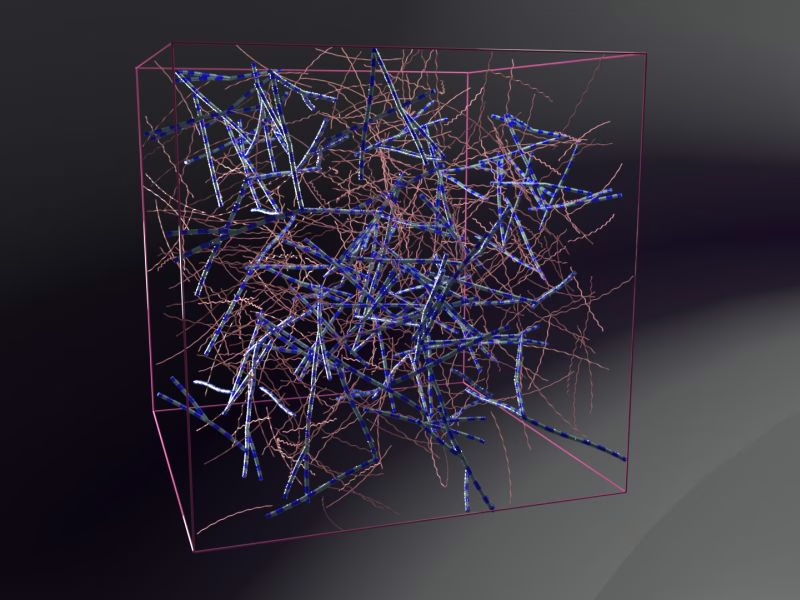
“Collagen molecules in tissue form a network that behaves a bit like a fishing net when it is stretched”, says Federica Burla, a PhD student in the Biological Soft Matter group at AMOLF. On the beach under the influence of minor forces, such a net can easily be stretched. However, when a fisherman is at sea and pulls up a heavy net full of fish, the network is stiff enough not to break.
Hyaluronan
Despite their knowledge on collagen, scientists remained puzzled about the variation in the functionalities of the different types of tissue. Each type of tissue, ranging from cartilage to lung tissue, has its own stiffness properties that match the position and function in the body. “It seemed like there were molecules present in the tissue that influenced the properties of collagen”, says Burla. “We thought that hyaluronan may be responsible for directing these adaptations because the quantities of hyaluronan vary in different types of tissue. This made it an excellent candidate to direct functionalities in tissue. And our assumption was right!”
Tissues under stress
If you cut a living tissue such as a piece of cartilage, it will pop open. “This is because many molecules present in the tissue including hyaluronan have a very high electrostatic charge, so they exert a large internal stress on the tissue”, Burla explains. She and her colleagues also observed this effect in the simplified lab model of tissues they created by combining purified collagen and hyaluronan. “Due to its electrostatic charge, hyaluronan strengthens the collagen matrix, but it also changes the amount of stretch that is required to switch it from being a soft material to being rigid.”
Artificial tissues
Burla and her colleagues teamed up with theoretical physicists at Wageningen University to create a computer model that describes how collagen with different amounts of hyaluronan behaves under stress. “Our model is also applicable to other fibrous networks”, says Burla. “Therefore, we can use it not only to explain the properties of tissues under stress, but also use it for engineering bioinspired materials with smart mechanical functions. Our knowledge can be used to create artificially-engineered tissues that behave as much as possible like biological ones, like skin grafts for wound burns.
Referentie
F. Burla, J. Tauber, S. Dussi, J. van der Gucht, G.H. Koenderink, Stress management in composite biopolymer networks, Nature Physics (2019), doi.org/10.1038/s41567-019-0443-6
Credits: R. Struik (AMOLF)
Caption
Tissues in the human body are supported by networks that are mainly composed of collagen (banded blue fibres). Figure shows a schematic of a tissue with a high content of hyaluronan (red fibres) , which contributes to delaying the moment in which a tissue switches from soft to rigid when stress is applied.