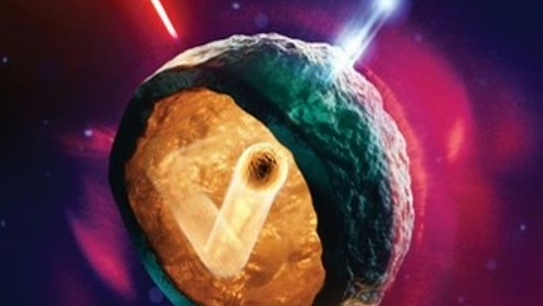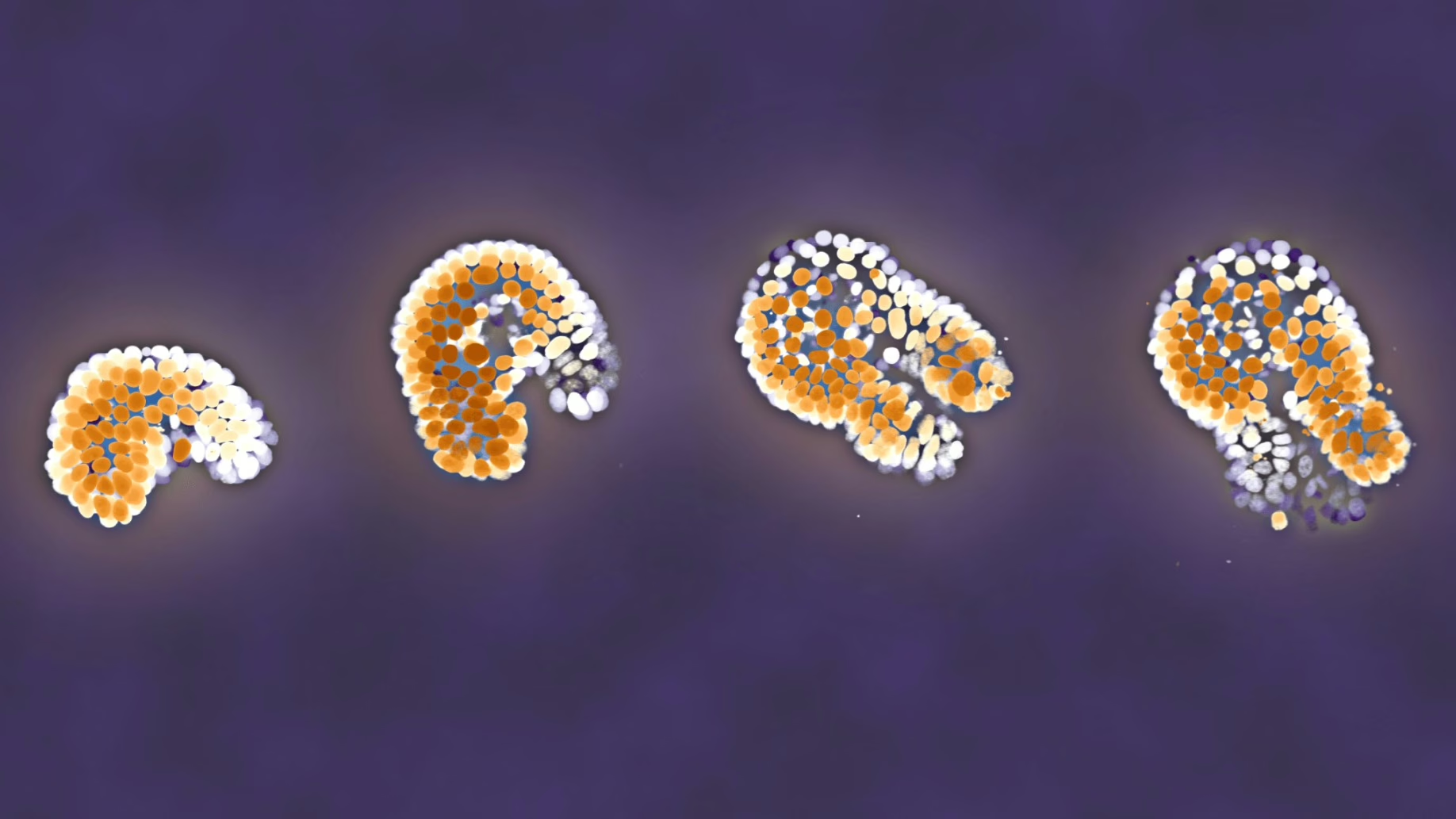
“Evolution in new environments is inherently unpredictable. Mutations are found to arise randomly in different genes and at different moments,” says AMOLF group leader Sander Tans. “In addition, you rarely know beforehand what effect a mutation will have on cellular functions and what the influence of environmental factors is.” Another key complication is that mutations can also indirectly influence each other: a mutation that is unfavorable could actually provide an evolutionary advantage in combination with other mutations.

Protein signaling cascade
Tans and his colleagues investigated the interplay between mutations in two genes within the bacterium E. coli. These genes help to detect the presence of sugar in the environment: the sugar molecules activate the first gene, which in turn activates the second one, and so on. This type of detection system is essential to express and activate genes at the right moment, for instance enzymes that can degrade sugars. Hence, optimal detection can provide a substantial evolutionary advantage. “The challenge was to find a way to predict how this system would evolve, says Tans.”
“We first developed a theoretical model. But, we quickly realized something quite simple really: if one gene gets mutated, then this does not directly affect the properties of another gene. By itself this does not appear to help our understanding of evolution. But together with previously acquired knowledge on how genes are activated by increased expression, this leads to specific predictions. For instance that mutations in genes at the end of such a signaling cascade can be advantageous, but that this is more likely when genes at the beginning of the cascade have mutated first. This means that we can predict that evolution proceeds in a certain temporal order, and which genes at the beginning of the cascade have mutated first. Then again, evolutionary deadlock can also occur: a particular gene can only evolve if the other one evolves at the same time. This means that if both genes wait for each other, then nothing will happen.”
In addition, Tans and his colleagues checked the predictions experimentally in E. coli. By introducing a range of mutations in both genes, and combining them in all possible sequences, it was possible to check the interactions between the genes, and hence to verify the predictions.
Evolutionary weather map
Predicting evolution in this manner is somewhat similar to how meteorologists predict the weather. They state the probability of rain, for example. “The point is that a prediction does not have to be exact like when you shoot a cannonball and can predict quite precisely where it will land,” says Tans. “We do not predict where and when mutations arise. Rather, it is about predicting certain limitations of the evolutionary process, and ultimately to provide probabilities for different scenarios. Our study reveals that such predictions in evolution are possible. This type of predictive insight could be very useful. For example, it may help to limit the evolution of bacterial resistance to antibiotics by administering antibiotics in certain sequences.”
In the longer term, the study raises questions about evolution in other contexts. “Take, for example, the question whether or not humans still evolve substantially and what the limitations are,” says Tans. “More general, in evolutionary research we typically study evolution historically, both in nature and in the lab. But it is also interesting – and useful – to consider what is possible or impossible in the future.”
Reference
Philippe Nghe, Manjumatha Kogenaru, Sander Tans, Sign epistasis caused by hierarchy within signaling cascades, Nature Communications, 13 April 2018, doi: 10.1038/s41467-018-03644-8