AMOLF projects
Doubling the amount of electricity from solar cells
Bruno Ehrler (AMOLF), Han Zuilhof (Wageningen University & Research), Laurens Siebbeles (Delft University of Technology)
Partners: Surfix, Toyota Motor Europe, Energy research Centre of the Netherlands, Wageningen University & Research, Delft University of Technology,
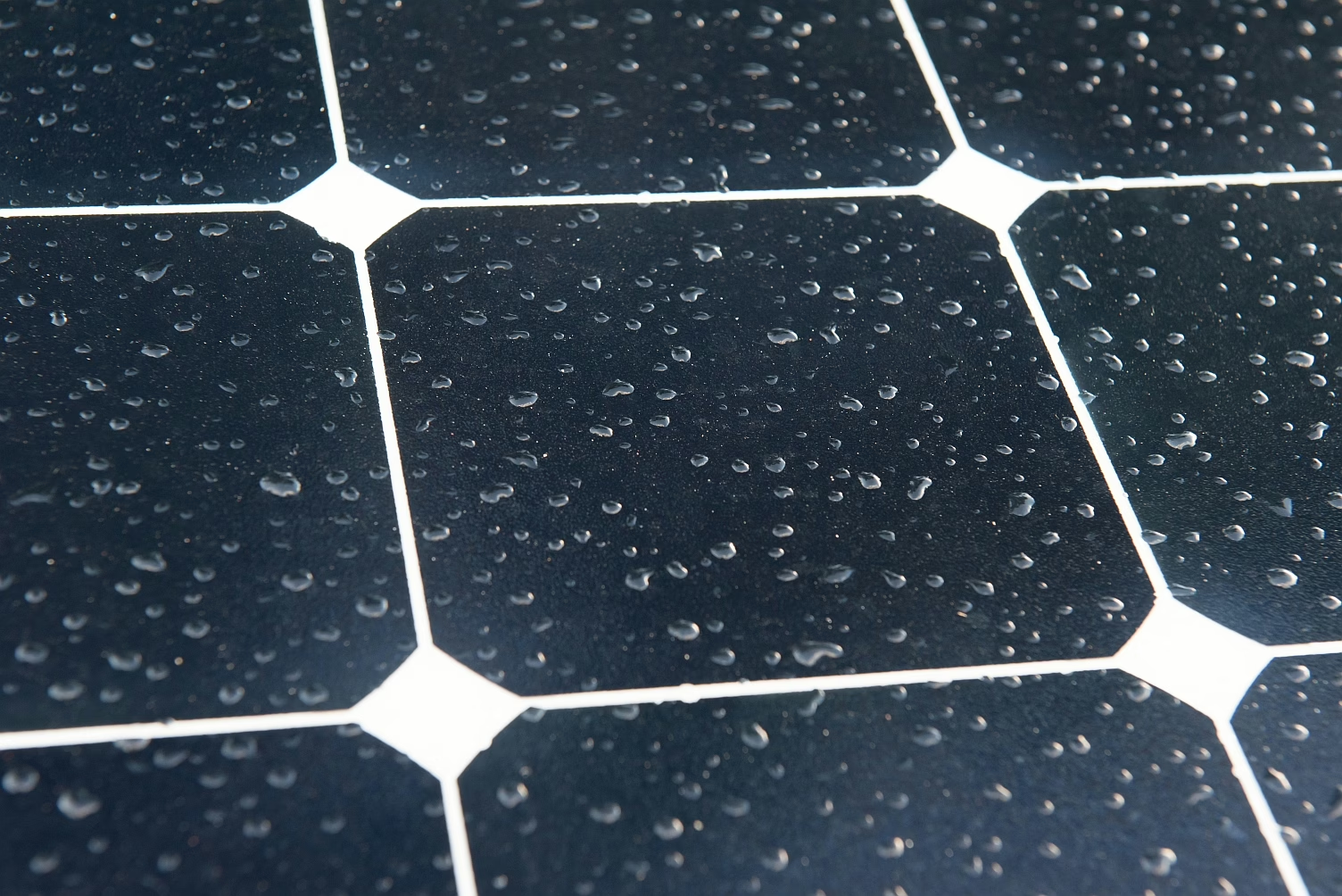
A consortium of researchers from AMOLF, Delft University of Technology and Wageningen University will work on a new type of solar cell capable of doubling the power output per photon, in theory. This is based on the principle of ‘singlet fission’, in which the energy of a high-energy molecule is divided between two molecules. If this can be implemented efficiently, it will lead to a substantial reduction in the cost of solar cells. This, in turn, should expand and accelerate the introduction of renewable energy sources.
Record-breaking solar cell with novel crystalline structure
Jos Haverkort (Eindhoven University of Technology), Erik Bakkers (Eindhoven University of Technology), Erik Garnett (AMOLF)
Partners: AMOLF
The aim of this research is to create a silicon germanium solar cell with a novel crystalline structure. The researchers expect this new hexagonal crystalline structure to break the current efficiency records for silicon solar cells. This material has a direct bandgap, so they suspect it should even be possible to break the 33.7 percent efficiency limit (known as the Shockley Queisser limit) with this technology, which is compatible with existing silicon technology.
Meta solar cells with improved functionality
Albert Polman (AMOLF), Andrea Alù (University of Texas)
Partners: University of Texas, Energy research Centre of the Netherlands (Petten), Fraunhofer Institute for Solar Energy Systems (Freiburg), University of New South Wales (Sydney) and California Institute of Technology (Pasadena)
This project’s goal is to develop a new method for boosting the absorption and conversion of sunlight in solar cells. The team’s approach involves the use of metagratings – surfaces and interfaces featuring nanoscale patterns and structures. The metagratings consist of a periodic grid of light-scattering elements that have a specially designed shape. Using these gratings, different colours of light can be scattered at a specific angular distribution within the solar cell. The researchers plan to build these metagratings into solar cells, to boost their efficiency. Other uses include ultrathin flexible solar films, as well as coloured and transparent solar panels for applications in the built environment.
About NWO materials research
The Mat4Sus program is the first step in the development of a larger-scale materials program for the Netherlands. NWO’s 2018-2019 support for the top sectors of Energy, Chemistry, and High Tech Systems and Materials (HTSM) includes a wide range of funding options for materials research within the ‘Materials NL’ scheme. This offers scope both for public-private partnerships and for fundamental research.
Read the NWO press release (Dutch)