Research highlights

Nanoparticles give solar panels a green color

Researchers from AMOLF, the University of Amsterdam (UvA) and the Energy Research Centre of the Netherlands (ECN) have developed a technology to create efficient bright green colored solar panels. Arrays of silicon nanoparticles integrated in the front module glass of a silicon heterojunction solar cell scatter a narrow band of the solar spectrum and create a green appearance for a wide range of angles. The remainder of the solar spectrum is efficiently coupled into the solar cell. The current generated by the solar panel is only  reduced by 10%. The realization of efficient colorful solar panels is an important step for the integration of solar panels into the built environment and landscape. The new design was published online on August 15, 2017, in the journal Applied Physics Letters.

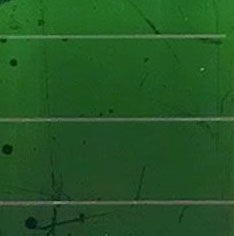
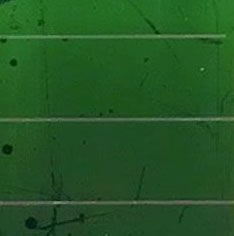
Green silicon solar minimodule (0,7 x 0,7 cm2)

Photovoltaic research has much focused on maximizing the electricity yield obtained from solar panels: nowadays, commercial panels have a maximum conversion efficiency from sunlight into electricity of around 22%. To reach such high efficiency, silicon solar cells have been equipped with a textured surface with an antireflection layer to absorb as much light as possible. This creates a dark blue or black appearance of the solar panels.

Green solar panels
To create the colored solar panels the researchers have used the effect of Mie scattering, the resonant backscattering of light with a particular color by nanoparticles. They integrated dense arrays of silicon nanocylinders with a diameter of 100 nm in the top module cover slide of a high-efficiency silicon heterojunction solar cell. Due to the resonant nature of the light scattering effect, only the green part of the spectrum is reflected; the other colors are fully coupled into the solar cell. The current generated by the mini solar panel (0,7 x 0,7 cm2)  is only reduced by 10%. The solar panel appears green over a broad range of angles up to 75 degrees. The nanoparticles are fabricated using soft-imprint lithography, a technique that can readily be scaled up to large-area fabrication.

Building materials
The light scattering effect due to Mie resonances is easily controllable: by changing the size of the nanoparticles the wavelength of the resonant light scattering can be tuned. Following this principle the researchers are now working to realize solar cells in other colors, and on a combination of different colors to create solar panels with a white appearance. For the large-scale application of solar panels, it is essential that their color can be tailored. In this way, solar panels become building materials that can be used in many different ways: red panels can serve as roof tiles, white ones can serve as walls in buildings. And solar panels placed in nature are ideally green, so they are invisible.
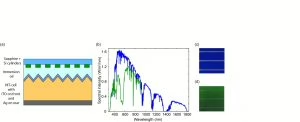
Green solar cell (a) Schematic of green solar cell design (b) AM1.5G solar spectrum (dark blue) and solar spectrum after transmission of the nanoparticle array (green). Because green light is reflected from the nanoparticle array, the transmitted spectrum has a dip at 550-580 nm. Photographs under diffused sunlight (0.5 x 0.5 cm²) of (c) untreated solar cell and (d) green silicon heterojunction solar minimodule

Reference:
Verena Neder, Stefan L. Luxembourg, and Albert Polman, Efficient colored silicon solar modules using integrated resonant dielectric nanoscatterers, Appl. Phys. Lett. 111, in press (2017) DOI:10.1063/1.4986796

Share article
What's happening

Most recent news items

All news items
Collaboration

Successful outcomes of international EBEAM program led by AMOLF

The EU Pathfinder project Electron Beams Enhancing Analytical Microscopy (EBEAM) that was recently completed has received a highly positive review of the European Innovation Council (EIC). EBEAM brought together eight European research institutions and companies, including AMOLF, that develop new concepts and instruments combining spectroscopic analysis with electron microscopy.

Read news item
Research highlights

Everything you need to know about organoids

Organoids are instrumental in improving our understanding of processes that are otherwise hidden inside the body. For instance, these small 3D organs can be used to test medicines on tissue grown from a patient’s own cells. AMOLF researchers carry out unique and complex experiments to follow organoids in time. In order to enable other researchers to benefit from their experiences, they now publish their methods in the prestigious journal Nature Protocols.

Read news item
Events and outreach

Minister Rianne Letschert wears hat and shoulder ornament inspired by Wim Noorduin’s research

This year at the opening of the parliamentary year (Prinsjesdag) Minister of Education, Culture and Science Rianne Letschert wears a spectacular hat and shoulder ornament. Both of them are inspired by the microscopic structures studied by group leader Wim Noorduin (AMOLF/UvA), which look remarkably like tiny flowers under a microscope. Artist and designer Malou Beemer translated these shapes, normally invisible to the naked eye, into wearable art.

Read news item
Nachi Stern, Group Leader Learning Machines at AMOLF
People and recognition

Nachi Stern awarded ERC Starting Grant to explore how matter learns

Why do brains learn, but rocks do not? Could a material one day adapt to its environment the way a living organism does? AMOLF group leader Dr. Nachi Stern has been awarded an ERC Starting Grant to investigate the physical laws of learning, in a project called, “Physical Learning in Dynamical Systems.”

Read news item
Stay informed

Get the latest research highlights, events, and news from our institute delivered to your inbox