Collaboration

Dutch researchers join forces to build synthetic cell

The Dutch research consortium BaSyC is taking on the challenge of building a synthetic biological cell. For part of its funding, it has received a grant worth almost € 19 million from the Gravitation programme of the Netherlands Organisation for Scientific Research (NWO). The research partners will themselves be funding the remaining six million of the total of over € 25 million that the research programme will cost. AMOLF, together with five universities, is taking part in the consortium  that is led by TU Delft. ‘A fundamental understanding of life within a cell will bring huge intellectual, scientific and technological rewards.’

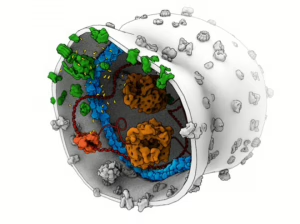
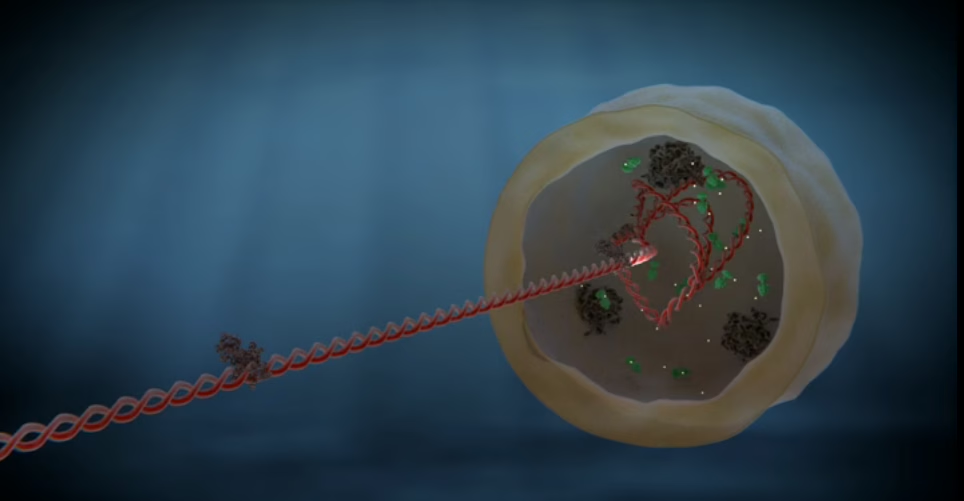
Artist’s impression (Graham Johnson) of a synthetic cell, representing the three basic processes taking place in a living cell: cell fuelling (green), DNA processing (orange/red), and cell division (blue). In the BaSyC programme we take on the challenge to bring the essential components of a cell together, controlling the complex interactions among them, and constructing a synthetic cell with the basic functionalities of a living cell: self-sustained growth, transmission of information, and division.

Life
Constructing a synthetic biological cell is one of science’s greatest challenges of the 21st century. We already have extensive knowledge of the molecular building blocks that form the basis of life, but we do not yet understand how they work together to make life possible.
The cell is the basis of all organisms. ‘The BaSyC consortium therefore aims to combine biomolecular building blocks to construct an autonomous, self-reproducing cell: a cell that can maintain its own integrity, grow and reproduce’, says coordinating scientist Prof. Marileen Dogterom, head of TU Delft’s BioNanoscience department.

Bottom up
‘We intend to build this synthetic cell from the bottom up, the most fundamental strategy for learning to understand a cell’, continues Dogterom. ‘A fundamental understanding of life within a cell will bring huge intellectual, scientific and technological rewards. It will also simultaneously raise philosophical and ethical questions about how society should deal with this new understanding and potential.’
‘We plan to derive the molecular building blocks and mechanisms from various existing rudimentary organisms. This means that the end product will function based on the principles of life as we know it, without mimicking any specific existing species.’

https://youtu.be/68h_54aq4Ok

Video ‘BaSyC: Building a synthetic cell, bottom-up’, by Enrique Sahagún

Opportunities
Knowledge of the processes of life opens up unprecedented opportunities for a healthy and sustainable world in many areas of healthcare, agriculture, materials and energy. According to Dogterom, a better understanding of the molecular basis for cellular behaviour can contribute to the future development of more targeted medication and personalised treatments for chronic diseases and cancer, for example. ‘Potential applications include new screening methods for antibiotics and medicines, biosensors and solutions to antimicrobial resistance’. Designing synthetic cellular systems will also enable humankind to produce new, smart and environmentally-friendly materials in the high-tech industry, new biofuels and biodegradable polymers. It will also help facilitate the sustainable production of safe and healthy food.

Consortium
‘A major challenge of this kind cannot be tackled by a single research group or even a single scientific discipline. It calls for the concerted efforts of scientists who excel in various fields of research. This is why we are taking on the challenge of building a synthetic cell with a group of leading Dutch scientists, with complementary knowledge of chemistry, physics and biology. For the first time, the consortium brings together a truly interdisciplinary pool of expertise to construct the first synthetic cell from the bottom up.’
BaSyC (Building a Synthetic Cell) is a joint project involving TU Delft, University of Groningen, VU University Amsterdam, Wageningen University & Research, Radboud University Nijmegen and AMOLF.
AMOLF group leader Prof.dr. Gijsje Koenderink is co-applicant of the Gravitation program. Other AMOLF group leaders involved are prof.dr. Sander Tans, prof.dr. Bela Mulder and prof.dr. Pieter Rein ten Wolde.

With the NWO Gravitation program, the government is encouraging outstanding research in the Netherlands. It is intended for scientific consortia that have the potential to rank among the world’s best.



Share article
What's happening

Most recent news items

All news items
Collaboration

Successful outcomes of international EBEAM program led by AMOLF

The EU Pathfinder project Electron Beams Enhancing Analytical Microscopy (EBEAM) that was recently completed has received a highly positive review of the European Innovation Council (EIC). EBEAM brought together eight European research institutions and companies, including AMOLF, that develop new concepts and instruments combining spectroscopic analysis with electron microscopy.

Read news item
Research highlights

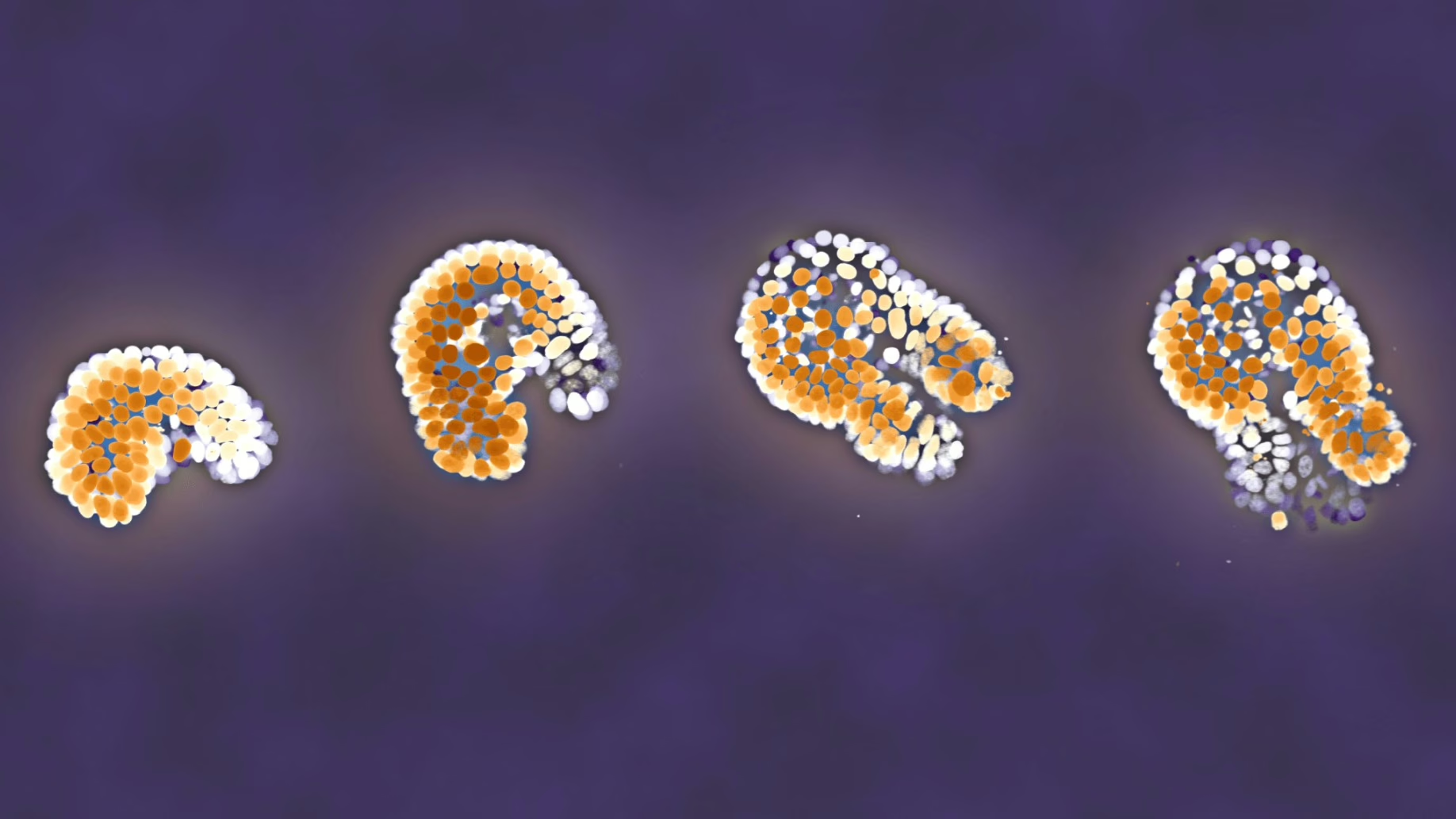
Everything you need to know about organoids

Organoids are instrumental in improving our understanding of processes that are otherwise hidden inside the body. For instance, these small 3D organs can be used to test medicines on tissue grown from a patient’s own cells. AMOLF researchers carry out unique and complex experiments to follow organoids in time. In order to enable other researchers to benefit from their experiences, they now publish their methods in the prestigious journal Nature Protocols.

Read news item
Events and outreach

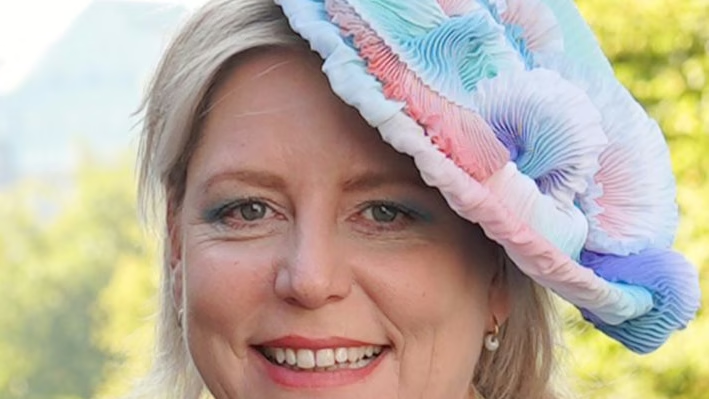
Minister Rianne Letschert wears hat and shoulder ornament inspired by Wim Noorduin’s research

This year at the opening of the parliamentary year (Prinsjesdag) Minister of Education, Culture and Science Rianne Letschert wears a spectacular hat and shoulder ornament. Both of them are inspired by the microscopic structures studied by group leader Wim Noorduin (AMOLF/UvA), which look remarkably like tiny flowers under a microscope. Artist and designer Malou Beemer translated these shapes, normally invisible to the naked eye, into wearable art.

Read news item
Nachi Stern, Group Leader Learning Machines at AMOLF
People and recognition

Nachi Stern awarded ERC Starting Grant to explore how matter learns

Why do brains learn, but rocks do not? Could a material one day adapt to its environment the way a living organism does? AMOLF group leader Dr. Nachi Stern has been awarded an ERC Starting Grant to investigate the physical laws of learning, in a project called, “Physical Learning in Dynamical Systems.”

Read news item
Stay informed

Get the latest research highlights, events, and news from our institute delivered to your inbox