Research highlights

Building with flexible blocks

On an apparently normal cube a pattern of hollows and bulges appears when the cube is compressed. Physicists from FOM Institute AMOLF and Leiden University together with colleagues from Tel Aviv University have developed a method to design such three-dimensional structures and to construct these using simple building blocks. This paves the way for the use of ‘machine materials’ in, for example, prostheses and wearable technology. The researchers published their findings on 28 July in an article in Nature.

Normally, atoms and molecules determine the properties of the materials they form. However that is different for ‘metamaterials’ designed by humans. “In the case of metamaterials, the spatial structure determines the material’s behavior,” explains AMOLF group leader professor Martin van Hecke. “For example, a pattern of holes in a sheet of material gives rise to a mechanical response that is completely different than in the same material without holes. We also wanted to investigate this phenomenon for a three-dimensional pattern of holes.”

3D puzzle
Van Hecke and his colleagues designed a cube-shaped, flexible building block with a hole in it. If pressure is applied to such a block then some of the sides cave in, whereas others bulge out. By stacking several of these building blocks researchers could make three-dimensional structures. Van Hecke: “The orientation of the blocks in the metamaterial is important. Under pressure, all of the hollow and bulging sides must fit exactly together. Most of the stacks are ‘frustrated’: somewhere within two hollows or bulges meet. However a large number of fitting solutions for this three-dimensional puzzle were found.”

Patterns
Van Hecke’s colleagues at Tel Aviv University calculated the number of possible, non-frustrated stacks for different cubes of building blocks. “For one cube of 14x14x14 building blocks that is a number with no less than 65 figures,” says Van Hecke. “For each possible stack the deformation within the cube results in a specific pattern on the sides of the cube. By smartly combining the building blocks we can program the material such that every desired pattern appears on the sides of a compressed cube. Surprisingly such a cube can also be used to analyse patterns. If we press it against a pattern of hollows and bulges then we measure a force that is dependent on the pattern.”

Machine materials
Although Van Hecke’s research is fundamental in nature there are applications on the horizon. “This type of programmable ‘machine materials’ could be ideal for prostheses or wearable technology in which a close fit with the body is important,” says Van Hecke. “If we can make the building blocks more complex or produce these from other materials then the possibilities really are endless.”

Reference
Corentin Coulais, Eial Teomy, Koen de Reus, Yair Shokef and Martin van Hecke
Combinatorial Design of Textured Mechanical Metamaterials
Nature 535, 529-532 (2016), DOI:10.1038/nature18960
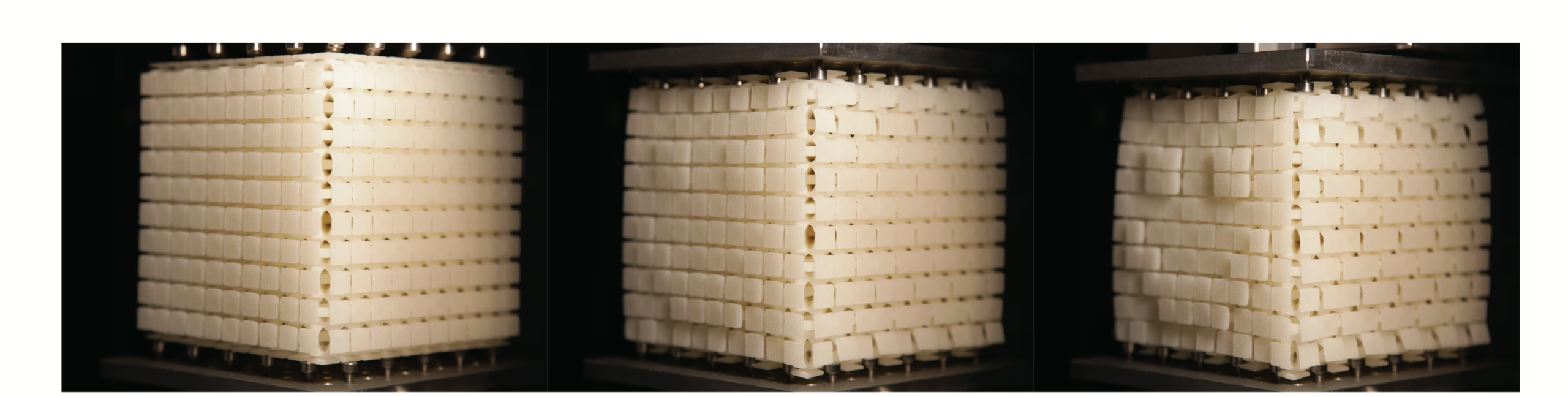
Photo: To demonstrate that any pattern can be produced on a cube’s surface, the researchers developed a cube of 10x10x10 blocks on which a smiley appears when the cube is compressed. credits photo: Corentin Coulais


credits video: Fast Facts
Share article
What's happening

Most recent news items

All news items
Joining forces to study perovskite interfaces
People and recognition

Joining forces to study perovskite interfaces

AMOLF group leaders Professor Wiebke Albrecht and Professor Bruno Ehrler have received an NWO ENW-M2 grant for their joint research project, The Dynamic Atomic Interface between Halide Perovskites and Metals. The insights gained will pave the way for sustainable, high-performance solar energy and information technology. Wiebke and Bruno will each hire a PhD student for this project. The grant amounts to €800.000.

Read news item
Wim Noorduin and Arian van Asten presenting their scientific journey
People and recognition

Wim Noorduin and Arian van Asten presenting their scientific journey

On October 8, Professor Wim Noorduin and his collaborator Professor Arian van Asten (University of Amsterdam) presented their scientific journey in a video to the audience at the ‘Avond van Wetenschap en Maatschappij’. They did so alongside the other nominees for the Huibregtsen Prize.

Read news item
Natural phenomena ‘hyperuniform disorder’ enables highly efficient, thin silicon solar cells
Research highlights

Natural phenomena ‘hyperuniform disorder’ enables highly efficient, thin silicon solar cells

Silicon solar panels are rigid and heavy, and many rooftops cannot support them. This creates a need for thin, flexible solar cells that can be integrated into building materials. However, making silicon solar cells thinner makes it harder to trap light inside the material. Researchers in the 3D Photovoltaics group found a fascinating way to overcome this challenge using a phenomenon called hyperuniform disorder. They publish their findings in the journal ACS Photonics.

The researchers were able to make highly efficient silicon solar cell materials that are 30 times thinner than conventional ones. They managed to do this by integrating a layer of nanometer sized structures on top of the material. Up close, this pattern looks random, but it is remarkably when you step back: no clumps, no gaps, and no repeating pattern. This is called hyperuniform disorder (or HUD).

Read news item
Stay informed

Get the latest research highlights, events, and news from our institute delivered to your inbox