People and recognition

Vici grant for Femius Koenderink

The Netherlands Organisation for Scientific Research (NWO) has awarded a Vici grant to AMOLF group leader Femius Koenderink. A total of 216 researchers submitted a pre-prososal. Out of 132 elaborated proposals, 36 researchers now receive a Vici grant of up to 1.500.000 euro.

Koenderinks proposal Hybrid nanophotonic architectures for ultrafast quantum optics explores a completely new approach to controlling light, coined “hybrid nanophotonics.”

Control over the interaction between a single emitter and a single photon is crucial for microscopy, solid state lighting, and optical information processing. Currently, researchers pursue two diametrically opposite routes to reach such control. They either build the best possible microcavity around the emitter that stores light for a very long time , or conversely they build the best possible nano-antenna to help the emitter send and receive photons as fast as possible. The new research program “hybrid nanophotonic architectures for ultrafast quantum optics” combines the best of both approaches: developing hybrids that contain both the light emitting antennas and the light receiving microcavities. This approach leads to a  very strong interaction between light and matter that takes place over unprecedented THz bandwidths, and with unprecedented, ultrafast response times.

At AMOLF Koenderink heads the Resonant Nanophotonics group. He is also a professor by special appointment at the Institute of Physics at the University of Amsterdam (UvA).

About the Vici grants
The Innovational Research Incentives Scheme has been set up in 2000 by NWO, KNAW and the universities jointly. The aim is to promote innovation in the academic research field. The scheme is directed at providing encouragement for individual researchers and gives talented, creative researchers the opportunity to conduct their own research programme independently and promote talented researchers to enter and remain committed to the scientific profession. It includes three forms of grant: Veni (for researchers who have recently completed their doctorates), Vidi (for experienced researchers) and Vici (for researchers of professorial quality).
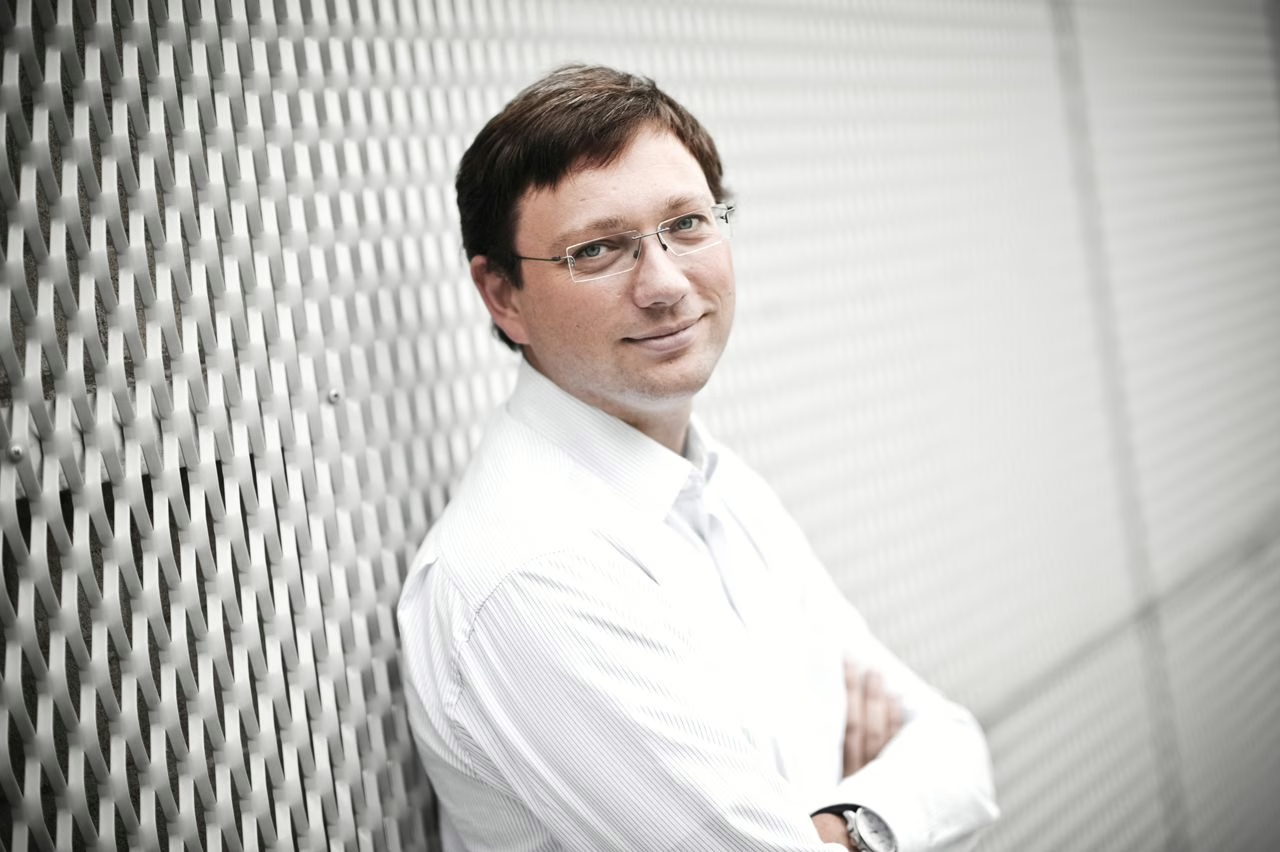
Femius Koenderink
Picture: Jeroen Oerlemans

Share article
What's happening

Most recent news items

All news items
Collaboration

Successful outcomes of international EBEAM program led by AMOLF

The EU Pathfinder project Electron Beams Enhancing Analytical Microscopy (EBEAM) that was recently completed has received a highly positive review of the European Innovation Council (EIC). EBEAM brought together eight European research institutions and companies, including AMOLF, that develop new concepts and instruments combining spectroscopic analysis with electron microscopy.

Read news item
Research highlights

Everything you need to know about organoids

Organoids are instrumental in improving our understanding of processes that are otherwise hidden inside the body. For instance, these small 3D organs can be used to test medicines on tissue grown from a patient’s own cells. AMOLF researchers carry out unique and complex experiments to follow organoids in time. In order to enable other researchers to benefit from their experiences, they now publish their methods in the prestigious journal Nature Protocols.

Read news item
Events and outreach

Minister Rianne Letschert wears hat and shoulder ornament inspired by Wim Noorduin’s research

This year at the opening of the parliamentary year (Prinsjesdag) Minister of Education, Culture and Science Rianne Letschert wears a spectacular hat and shoulder ornament. Both of them are inspired by the microscopic structures studied by group leader Wim Noorduin (AMOLF/UvA), which look remarkably like tiny flowers under a microscope. Artist and designer Malou Beemer translated these shapes, normally invisible to the naked eye, into wearable art.

Read news item
Nachi Stern, Group Leader Learning Machines at AMOLF
People and recognition

Nachi Stern awarded ERC Starting Grant to explore how matter learns

Why do brains learn, but rocks do not? Could a material one day adapt to its environment the way a living organism does? AMOLF group leader Dr. Nachi Stern has been awarded an ERC Starting Grant to investigate the physical laws of learning, in a project called, “Physical Learning in Dynamical Systems.”

Read news item
Stay informed

Get the latest research highlights, events, and news from our institute delivered to your inbox