
Research highlights

AMOLF group leaders publish review article in Science on challenges in photovoltaic energy conversion

Analyzing 16 record-efficiency solar cell materials, the paper presents opportunities to improve photovoltaic efficiency using nanoscale light management and to enhance carrier collection with innovative materials science and engineering strategies.

The article describes the electrical characteristics of 16 photovoltaic material geometries that have led to solar cells with record power conversion efficiencies laying between 10 and 29%. The authors start with a comparison between the current and voltage of these cells and the limiting values predicted by the Shockley-Queisser thermodynamic detailed-balance model. Then, the key limiting factors of each of the 16 researched materials are identified, showing  the losses originating in either incomplete light absorption or charge carrier collection. Finally, the authors discuss the prospects for practical applications and large-scale fabrication.

AMOLF’s Light Management in New Photovoltaic Materials (LMPV) program aims to provide solutions for these light management and carrier collection problems. It has recently demonstrated novel concepts to improve solar energy conversion efficiencies in wafer-based Si solar cells, and thin-film Si, organic, CuInGaSe, and perovskite solar cells. In addition, the LMPV scientists are developing alternative 3D structuring techniques to reach efficiencies beyond the fundamental limits of solar cells with conventional planar designs.

As photovoltaic records are continually being broken, up-to-date versions of the charts presented in the paper will be maintained at: http://lmpv.amolf.nl/SQ.

The article is authored by LMPV group leaders Albert Polman, Erik Garnett, and Bruno Ehrler, postdoc Mark Knight, and visiting scientist Wim Sinke (ECN).

Reference
Albert Polman, Mark W. Knight, Erik C. Garnett, Bruno Ehrler, Wim C. Sinke, Photovoltaic materials: Present efficiencies and future challenges Science 352, aad4424 (2016) | DOI: 10.1126/science.aad4424
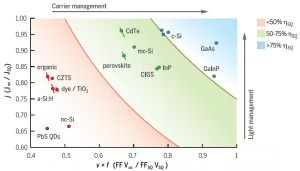
 

Short-circuit current and open circuit voltage-fill factor product for 16 record-efficiency solar cell materials and geometries relative to the limiting values according to the Shockley-Queisser model. An ideal solar cell is placed in the top right corner of the graph. Non-ideal cells suffer from problems with either light management (vertical axis) or carrier management (horizontal axis).


Short-circuit current and open circuit voltage-fill factor product for 16 record-efficiency solar cell materials and geometries relative to the limiting values according to the Shockley-Queisser model. An ideal solar cell is placed in the top right corner of the graph. Non-ideal cells suffer from problems with either light management (vertical axis) or carrier management (horizontal axis).



Share article
What's happening

Most recent news items

All news items
Collaboration

Successful outcomes of international EBEAM program led by AMOLF

The EU Pathfinder project Electron Beams Enhancing Analytical Microscopy (EBEAM) that was recently completed has received a highly positive review of the European Innovation Council (EIC). EBEAM brought together eight European research institutions and companies, including AMOLF, that develop new concepts and instruments combining spectroscopic analysis with electron microscopy.

Read news item
Research highlights

Everything you need to know about organoids

Organoids are instrumental in improving our understanding of processes that are otherwise hidden inside the body. For instance, these small 3D organs can be used to test medicines on tissue grown from a patient’s own cells. AMOLF researchers carry out unique and complex experiments to follow organoids in time. In order to enable other researchers to benefit from their experiences, they now publish their methods in the prestigious journal Nature Protocols.

Read news item
Events and outreach

Minister Rianne Letschert wears hat and shoulder ornament inspired by Wim Noorduin’s research

This year at the opening of the parliamentary year (Prinsjesdag) Minister of Education, Culture and Science Rianne Letschert wears a spectacular hat and shoulder ornament. Both of them are inspired by the microscopic structures studied by group leader Wim Noorduin (AMOLF/UvA), which look remarkably like tiny flowers under a microscope. Artist and designer Malou Beemer translated these shapes, normally invisible to the naked eye, into wearable art.

Read news item
Nachi Stern, Group Leader Learning Machines at AMOLF
People and recognition

Nachi Stern awarded ERC Starting Grant to explore how matter learns

Why do brains learn, but rocks do not? Could a material one day adapt to its environment the way a living organism does? AMOLF group leader Dr. Nachi Stern has been awarded an ERC Starting Grant to investigate the physical laws of learning, in a project called, “Physical Learning in Dynamical Systems.”

Read news item
Stay informed

Get the latest research highlights, events, and news from our institute delivered to your inbox