
Research highlights

New mechanism to convert light into electricity: the ‘plasmo-electric effect’

Researchers of the FOM Institute AMOLF and the California Institute of Technology have discovered a new method to generate electrical potentials using light. Using precisely sculpted metal nanocircuits they found that light can be effectively captured and converted to an electrical potential as high as 100 millivolt. The research was published on 30 October 2014 in the journal Science. The AMOLF-Caltech team, who have been collaborators for many years, give the newly discovered effect the name “plasmo-electric effect”. Albert Polman, the leader of the AMOLF-part of the team: “This is an entirely new way to convert light into electricity. We have now shown that we can create a voltage; the next step is to see if we can also collect current and generate electrical power.”

Nobel metal particles made of copper, silver, and gold, are well known for their colorful spectra when illuminated with light. A well-known example are the stained glass windows in ancient churches in which the colors originate from small metal nanoparticles that are embedded in the glass. Light that is incident on these particles is converted into plasmons, oscillations of free electrons in the metal, which leads to strong absorption and scattering of particular colors of light.

The AMOLF-Caltech team investigated this light absorption process in artificially created metal nanostructures that they made using modern cleanroom techniques. They discovered that a negative electrical potential was formed on gold nanospheres, if they are illuminated with blue light. In contrast, a positive potential was found for illumination with red light. The voltage was measured using an ultra-sensitive needle that was placed above the nanospheres while they were being illuminated with laser light.

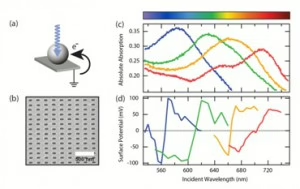
Inspired by this initial result, the team fabricated metal nanocircuits composed of a square array of minute 100-nanometer-diameter holes in a 20-nm-thin gold film. Like the nanoparticles, these metal hole arrays possess bright plasmon resonances, of which the wavelength can be controlled by the spacing between the holes. When irradiating these circuits with a laser, and gradually tuning the color of the light from blue to red, a negative potential (-100 mV) was found for blue light and a positive potential (+100 mV) for red light.

The researchers developed a thermodynamic model that describes the measured data well. The model shows that the incident light generates minute temperature variations that thermodynamically drive the exchange of electrical charges on the circuits, leading to the measured potentials.

Reference
M. Sheldon, J. van de Groep, A.M. Brown, A. Polman, and H.A. Atwater, Plasmoelectric potentials in metal nanostructures Science 346, in press (2014), published online October 30, 2014 | DOI: 10.1126/science.1258405
photonic materials albert polman plasmo-electric effect

Plasmo-electric effect (a) Schematic of a metal nanoparticle that becomes electrically charged by illumination . (b) Electron microscopy image of the metal nanocircuit, composed of an array of nanoscale holes in a 20-nm-thin gold film. The scale bar is 500 nanometer. (c) Measured optical absorption spectra for metal nanocircuits with different spacings between the holes (175, 225, 250, and 300 nm). (d) Electrical potential of the nanocircuits in (c) as a function of wavelength of the incident light. The measured potentials range from -100 mV to +100 mV as the wavelength of the incident light is tuned from blue to red.
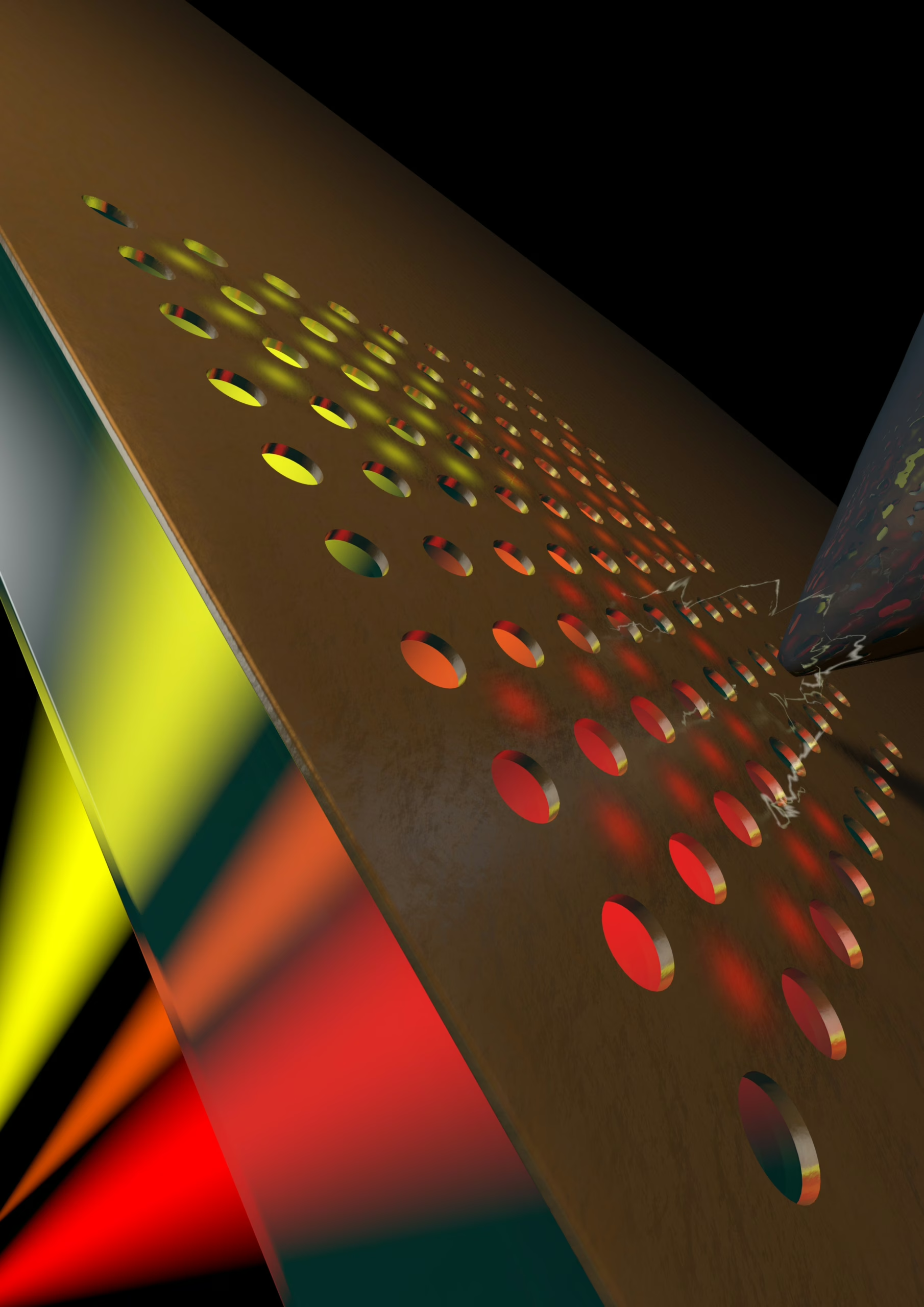
© AMOLF/Tremani Artist impression of the plasmo-electric effect. An ultra-sensitive needle measures the voltage that is generated while the nanospheres are illuminated.

 

Share article
What's happening

Most recent news items

All news items
Collaboration

Successful outcomes of international EBEAM program led by AMOLF

The EU Pathfinder project Electron Beams Enhancing Analytical Microscopy (EBEAM) that was recently completed has received a highly positive review of the European Innovation Council (EIC). EBEAM brought together eight European research institutions and companies, including AMOLF, that develop new concepts and instruments combining spectroscopic analysis with electron microscopy.

Read news item
Research highlights

Everything you need to know about organoids

Organoids are instrumental in improving our understanding of processes that are otherwise hidden inside the body. For instance, these small 3D organs can be used to test medicines on tissue grown from a patient’s own cells. AMOLF researchers carry out unique and complex experiments to follow organoids in time. In order to enable other researchers to benefit from their experiences, they now publish their methods in the prestigious journal Nature Protocols.

Read news item
Events and outreach

Minister Rianne Letschert wears hat and shoulder ornament inspired by Wim Noorduin’s research

This year at the opening of the parliamentary year (Prinsjesdag) Minister of Education, Culture and Science Rianne Letschert wears a spectacular hat and shoulder ornament. Both of them are inspired by the microscopic structures studied by group leader Wim Noorduin (AMOLF/UvA), which look remarkably like tiny flowers under a microscope. Artist and designer Malou Beemer translated these shapes, normally invisible to the naked eye, into wearable art.

Read news item
Nachi Stern, Group Leader Learning Machines at AMOLF
People and recognition

Nachi Stern awarded ERC Starting Grant to explore how matter learns

Why do brains learn, but rocks do not? Could a material one day adapt to its environment the way a living organism does? AMOLF group leader Dr. Nachi Stern has been awarded an ERC Starting Grant to investigate the physical laws of learning, in a project called, “Physical Learning in Dynamical Systems.”

Read news item
Stay informed

Get the latest research highlights, events, and news from our institute delivered to your inbox